





Zero Trust has become one of the most important principles in modern cybersecurity.
Its premise is often summarized simply:
Never trust. Always verify.
But there is a problem with the way many organizations interpret that idea.
Verification is frequently treated as synonymous with authentication.
Authenticate the customer.
Authenticate the employee.
Authenticate the administrator.
Authenticate the device.
Then allow access.
But authentication answers only part of the security question.
In banking and enterprise environments, successfully proving who you are should not give you unlimited authority once you are inside.
That is where authorization becomes critical.
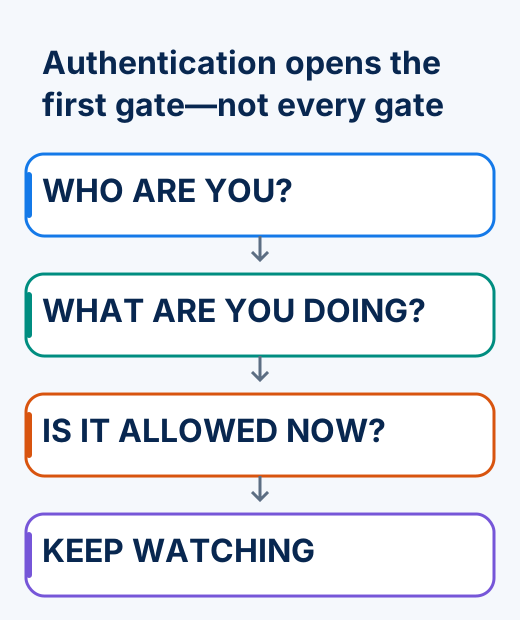
Authentication answers:
"Are you really who you claim to be?"
Authorization answers:
"Now that we know who you are, what are you permitted to do?"
Those are two very different questions.
And in today's financial environment, we need strong answers to both.
The distinction also creates an important opportunity. When authentication and authorization are applied intelligently, financial institutions do not have to choose between strong security and customer convenience.
They can potentially deliver both.
That is where Zero Trust can move beyond cybersecurity and become a catalyst for growth.
Authentication Gets You In. Authorization Determines What Happens Next.
Consider something millions of people do every day.
A customer opens a mobile banking application and authenticates.
The bank establishes confidence in the customer's identity.
The customer can now see account balances, review recent transactions, look at credit card activity or perform other routine banking functions.
But what happens next?
Should successful authentication mean that the customer is automatically authorized to perform every possible transaction?
Should they be able to wire $500?
$5,000?
$50,000?
Should they be able to add a new recipient and immediately transfer a substantial amount of money to that account?
Should they be able to change critical account information without additional verification?
The answer is obvious.
Authentication should not equal unlimited authorization.
This is one of the most important distinctions in Zero Trust.
Knowing who someone is does not automatically determine everything that person should be allowed to do.
The Risk Changes When the Action Changes
Imagine a customer has successfully authenticated to a mobile banking application.
They check their balance.
Low risk.
They review transactions.
Low risk.
They transfer $200 between two accounts they own.
The activity may still be relatively routine.
Now suppose that same customer attempts to wire $5,000 to another account.
The customer's identity has not necessarily changed.
But the risk has.
That should change the security response.
Suppose the financial institution has established a policy requiring explicit authorization for wire transfers exceeding $1,000.
The $1,000 figure is simply an example. The bank determines its own threshold according to its risk policies, customer profiles, transaction types and other factors.
Once the transaction exceeds that threshold, the authorization process can be invoked automatically.
The customer is no longer simply being asked:
"Are you the legitimate account holder?"
That was established during authentication.
Now the bank is asking:
"Do you authorize this specific transaction?"
That distinction is enormously important.
Apply Security Where the Risk Is

Traditional security often applies friction broadly.
Everyone gets challenged.
Everyone enters another code.
Everyone approves another notification.
Everyone deals with another interruption.
But not every action carries the same level of risk.
Zero Trust gives us an opportunity to create a much more intelligent relationship between risk and friction.
Instead of applying maximum security to every interaction, apply stronger security when the action requires it.
The customer checks a balance.
No unnecessary interruption.
The customer reviews recent transactions.
No unnecessary interruption.
The customer transfers a modest amount between their own accounts.
Allow the experience to remain simple when policy permits.
Then the customer attempts a higher-value wire transfer.
Authorization is automatically invoked.
Security appears precisely when it matters.
That is a very different philosophy from making customers prove themselves repeatedly simply because security exists.
The Right Security at the Right Time
This leads to a principle that I believe should sit at the center of modern Zero Trust:
The future of Zero Trust is not about putting more security in front of every action. It is about applying the right security to the right action at the right time.
That is how stronger security and less friction can coexist.
For legitimate customers performing routine activities, security can remain largely in the background.
When risk increases, security can become more visible.
When the transaction becomes consequential, authorization can become more explicit.
This gives the institution greater control without making every customer interaction feel like a security exercise.
And that matters because customers did not open their banking application to authenticate.
They opened it to bank.
Security should enable that experience rather than dominate it.
Mobile Banking Demonstrates Why Authorization Matters
The relationship between authorization and growth becomes particularly clear when we look at mobile banking.
Customers increasingly expect to perform sophisticated financial activities from their phones.
They want to manage accounts.
Move money.
Pay bills.
Transfer funds.
Manage investments.
Approve transactions.
And increasingly, they expect to perform activities digitally that once required a visit to a branch.
That creates enormous opportunities for financial institutions.
Digital transactions can increase convenience, improve customer satisfaction, extend service availability and reduce the operational cost associated with some traditional banking interactions.
But increased customer freedom cannot mean decreased institutional control.
Authorization helps reconcile those objectives.
A bank can give customers the convenience of initiating a wire transfer from a mobile device while retaining control over the conditions under which that transfer is permitted to proceed.
The customer gains mobility.
The institution retains policy control.
And higher-risk transactions receive additional protection.
That is not security slowing the business down.
That is security making a new business capability possible.
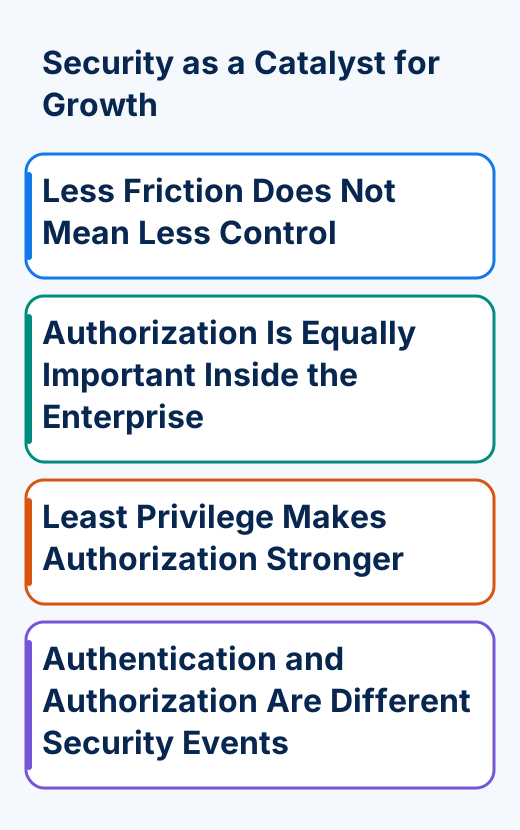
Security as a Catalyst for Growth
This is where the conversation becomes larger than cybersecurity.
For years, security was primarily measured by what it prevented.
Prevent the breach.
Prevent fraud.
Prevent unauthorized access.
Prevent data loss.
Prevent account takeover.
Those objectives remain essential.
But modern security leaders should also ask:
What can better security enable us to do?
Can we allow customers to conduct more transactions remotely?
Can we reduce unnecessary visits to branches?
Can we make mobile banking more capable?
Can we improve the customer experience?
Can employees work more efficiently?
Can we introduce new digital services with greater confidence?
Can we reduce friction without increasing risk?
When the answer is yes, cybersecurity stops being merely a defensive function.
It becomes infrastructure for growth.
Less Friction Does Not Mean Less Control
This is particularly important because financial institutions sometimes face what appears to be a contradiction.
Customers want less friction.
Banks want more control.
At first glance, those objectives seem incompatible.
They are not.
The solution is not to weaken security for the sake of convenience.
It is to become more precise about where security is required.
A customer who has strongly authenticated does not necessarily need to be interrupted repeatedly while reviewing routine account information.
But the same customer initiating a high-risk transaction may need to explicitly authorize it.
That allows the institution to remove unnecessary friction from lower-risk activities while strengthening control around higher-risk ones.
The result is an important combination:
More freedom for legitimate customers.
More control for the financial institution.
That is the kind of security architecture that can improve customer experience while protecting the business.
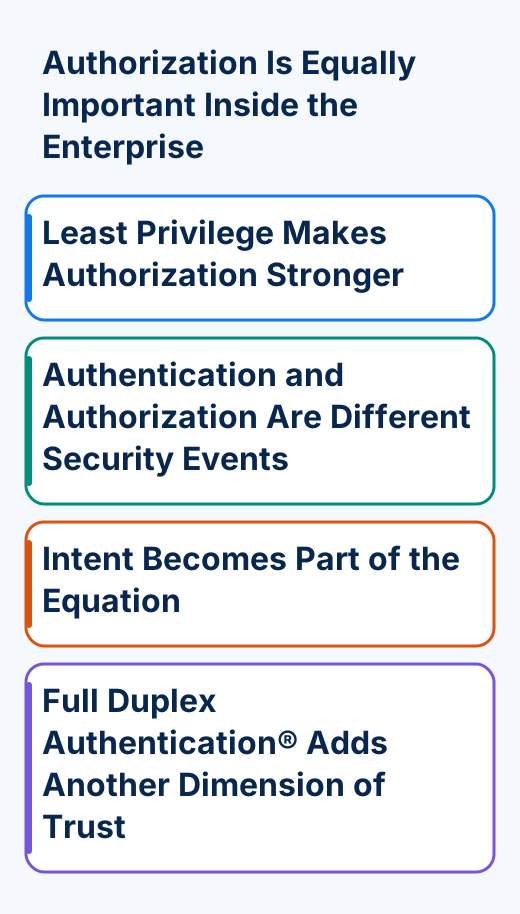
Authorization Is Equally Important Inside the Enterprise
The same principle applies to employees.
An employee successfully authenticating to the corporate environment should not automatically receive access to everything inside it.
Authentication establishes:
"This is an authorized employee."
Authorization determines:
"This employee is permitted to access these specific resources and perform these specific actions."
Consider a bank employee in the finance department.
The employee might be authorized to prepare a payment.
That does not necessarily mean the same employee should be able to approve it.
A manager may be authorized to approve transactions up to a certain amount.
Larger transactions may require authorization from someone with a higher level of authority.
An IT administrator may require access to particular systems but not customer financial records unrelated to that person's responsibilities.
An employee working with commercial customers should not automatically receive access to every retail customer's information.
Authentication establishes identity.
Authorization establishes boundaries.
That distinction is fundamental to Zero Trust.
Least Privilege Makes Authorization Stronger
Authorization also works hand in hand with another important Zero Trust principle:
Least privilege.
Users should receive the access required to perform their responsibilities, not unrestricted access simply because they successfully authenticated.
This helps reduce the consequences of compromised credentials or accounts.
Suppose an attacker manages to compromise an employee identity.
If authentication is the only meaningful control, that identity may provide extensive access once the attacker gets inside.
Authorization and least privilege create additional boundaries.
The compromised identity may be valid, but that does not mean it is authorized to access every system or perform every transaction.
This is why Zero Trust should not stop at the front door.
The security decision should follow the user.
Authentication and Authorization Are Different Security Events
There is another important concept here.
Authentication and authorization do not necessarily have to happen at the same moment.
A customer might authenticate at 9:00 a.m.
At 9:05, they check a balance.
At 9:10, they review recent transactions.
At 9:15, they initiate a high-value wire.
The fact that authentication occurred fifteen minutes earlier does not automatically mean the high-value transaction should proceed without additional authorization.
The action itself can create a new security event.
This gives financial institutions a much more flexible security model.
Instead of treating trust as something granted once at login, trust can be evaluated according to what the user is actually attempting to accomplish.
Intent Becomes Part of the Equation
Authorization also introduces another important concept:
Intent.
Suppose a banking customer receives a request to authorize a transaction.
The institution should ideally establish more than the fact that the person can successfully authenticate.
It should also help establish:
Did this person actually intend to perform this transaction?
This distinction becomes increasingly important as social engineering, account takeover, push fatigue and other forms of fraud become more sophisticated.
A generic notification asking:
"Approve?"
provides very little context.
Approve what?
Did the customer initiate it?
Was the transaction expected?
Is the customer responding reflexively?
Identité can provide contextual information during the authentication or authorization experience, including asking:
"Did you request this authentication session?"
An image and three-digit number can provide additional context on the same screen.
The objective is to move the customer away from reflexive approval and toward deliberate confirmation.
For financial transactions, that distinction can be extremely valuable.
Full Duplex Authentication® Adds Another Dimension of Trust
There is still another question that traditional authentication frequently overlooks.
Financial institutions spend enormous resources determining:
"Is this really our customer?"
But the customer should also have confidence in:
"Is this really my financial institution?"
That question becomes increasingly important as phishing sites, lookalike domains, fraudulent applications and AI-assisted impersonation become more convincing.
Identité's patented Full Duplex Authentication® addresses this through mutual authentication.
Instead of authentication being entirely one directional, both sides participate in establishing trust.
The user establishes legitimacy.
The legitimate destination establishes legitimacy.
This adds another important component to the Zero Trust relationship.
Because trust should never be based solely on appearance.
A fraudulent website can copy a logo.
It can reproduce a bank's colors.
It can imitate the language.
It can create a deceptively similar domain.
But copying what an institution looks like is not the same as establishing that it is the legitimate institution.
Zero Trust Should Mean Zero Assumptions

Perhaps we should think about Zero Trust in a slightly different way.
Instead of simply:
Never trust. Always verify.
Think:
Assume nothing. Establish everything that matters.
Do not assume that because someone has a password, they are the legitimate user.
Establish identity.
Do not assume that because someone authenticated, they should have unlimited access.
Establish authorization.
Do not assume that because a customer is logged in, every transaction should proceed.
Evaluate the action.
Do not assume that because a request reached the user's phone, the user intended it.
Establish intent.
Do not assume that because a website looks like the bank, it is the bank.
Establish the destination.
Do not assume that yesterday's trust decision automatically applies to today's transaction.
Continuously evaluate context and risk.
That creates a much more complete Zero Trust model.
Identity + Authentication + Authorization + Intent + Context + Destination + Least Privilege + Continuous Verification
Each component answers a different security question.
Identity: Who are you?
Authentication: Can you prove it?
Authorization: Are you permitted to perform this action?
Intent: Did you actually request it?
Context: Does this activity make sense?
Destination: Are you interacting with the legitimate institution?
Least Privilege: Are you limited to the access required for your role?
Continuous Verification: Has anything changed that should cause trust to be reevaluated?
Together, these principles create something much stronger than a login.
They create a trust architecture.
PasswordFree®: Reducing Friction Without Reducing Security
Identité's PasswordFree® is our SaaS passwordless authentication solution.
The objective is not simply to eliminate passwords.
It is to create greater confidence in identity while reducing unnecessary effort for legitimate users.
PasswordFree® is designed around capabilities including passwordless authentication, patented Full Duplex Authentication®, trusted-device authentication, decentralized biometric verification, authentication intent, contextual verification, Emergency PIN Authentication and Secure Backup & Restore.
For financial SaaS environments, this can help make strong authentication part of the customer experience without making security the experience itself.
Because again, customers do not open a banking application because they want to authenticate.
They want to accomplish something.
NoPass™: Enterprise Control for Financial Institutions
For enterprise environments requiring greater infrastructure control and integration, Identité offers NoPass™, our PaaS solution powered by patented Full Duplex Authentication®.
NoPass™ can be deployed on premises or in the cloud and can support enterprise environments involving Microsoft Active Directory, Microsoft Entra ID, Microsoft 365 / Office 365 and Microsoft Azure.
This flexibility is particularly important in banking.
Financial institutions are often reluctant to place sensitive customer information or critical authentication infrastructure outside environments they directly control.
For institutions that prefer this model, NoPass™ can be deployed on premises.
This allows the organization to maintain greater control while implementing passwordless authentication, mutual authentication and authorization policies appropriate to its environment.
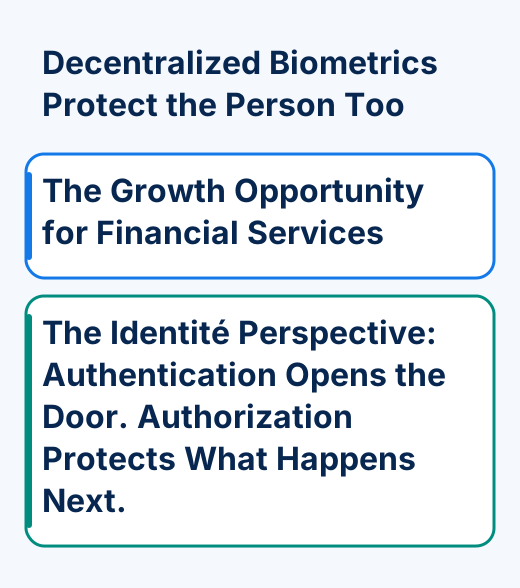
Decentralized Biometrics Protect the Person Too
If biometrics are used as part of strong authentication, another question becomes important:
Where is the biometric information stored?
Identité uses a decentralized model.
Biometric verification occurs on the user's trusted device.
The biometric data does not need to leave that device or be maintained in a centralized Identité biometric repository for matching.
This matters because biometric information is different from a password.
A password can be replaced.
A fingerprint cannot simply be changed.
Avoiding an unnecessary centralized biometric repository reduces another concentration of highly sensitive identity information.
The philosophy remains consistent:
Increase confidence while reducing unnecessary risk and friction.
The Growth Opportunity for Financial Services
When we put all of these elements together, Zero Trust begins to look very different.
It is no longer simply a cybersecurity architecture designed to restrict access.
It becomes an architecture designed to enable trusted activity.
Strong authentication can help financial institutions establish who the customer is.
Authorization can determine what that customer is permitted to do.
Transaction thresholds can automatically invoke stronger authorization when risk increases.
Least privilege can limit employee and administrator access.
Intent can help establish that the person actually requested the transaction.
Context can help identify unusual behavior.
Full Duplex Authentication® can help establish trust in both directions.
Continuous verification can prevent a single login from becoming unlimited trust.
And all of this can happen while legitimate customers are given greater freedom to conduct business digitally.
That is the growth opportunity.
A customer can potentially perform more banking activities from a mobile device.
An employee can work more productively.
A bank can introduce new digital services with greater confidence.
The institution can retain greater control over high-risk activities without creating unnecessary friction around everything else.
The Identité Perspective: Authentication Opens the Door. Authorization Protects What Happens Next.
Zero Trust should not be a strategy for making legitimate customers prove themselves over and over again.
It should be a strategy for establishing the right level of trust for the action taking place.
That is an important difference.
Authentication is essential.
But authentication is only the beginning.
Once the user is inside, the institution still needs to know:
What are they allowed to access?
What are they allowed to change?
What transactions are they allowed to perform?
When does the value or risk of an action require additional authorization?
Did they actually intend to perform it?
And:
Are they interacting with the legitimate institution?
When those questions can be answered confidently, something interesting happens.
Security can become more precise.
And when security becomes more precise, it does not have to create maximum friction everywhere.
Routine activities can remain easy.
Higher-risk activities can receive stronger protection.
Customers gain greater freedom.
Institutions retain greater control.
That is why authentication and authorization should not be viewed simply as additional layers of security.
Together, they can become business enablers.
The future of financial services will require institutions to give customers increasingly powerful digital capabilities without surrendering control over risk.
The institutions that accomplish both will have an enormous advantage.
Because the goal of Zero Trust should not be to make banking more difficult.
It should be to make more banking possible, securely.
And that is where cybersecurity stops being merely a defensive expense.
It becomes a catalyst for growth.