


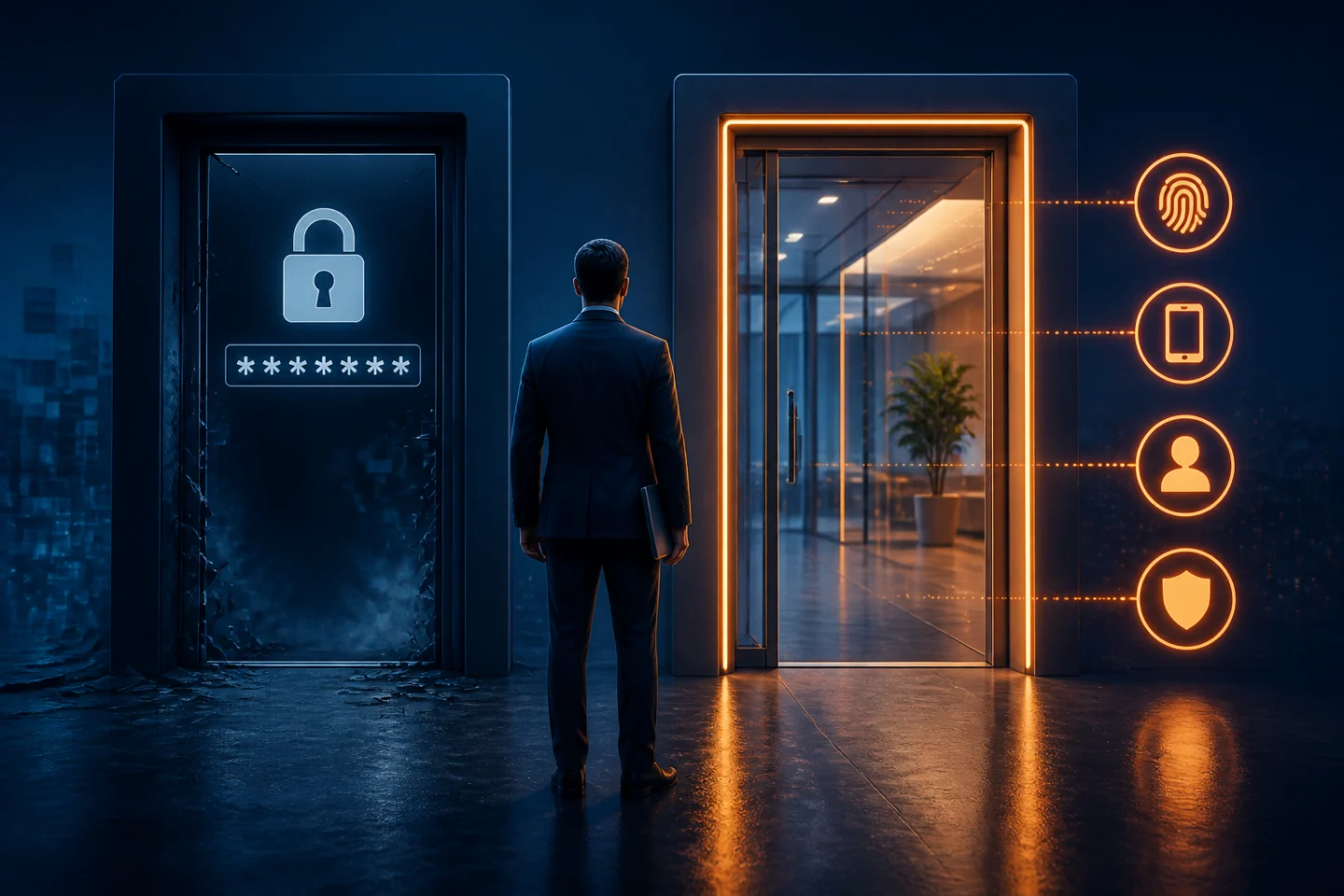
For decades, the password was the front door to our digital lives.
Enter the right username.
Enter the right password.
You're in.
That approach made sense when employees accessed a handful of applications from computers located inside a corporate network. Today, the average organization operates in an entirely different environment.
Employees access email, cloud applications, financial systems, healthcare records, customer databases, and corporate networks from virtually anywhere.
Meanwhile, cybercriminals have become remarkably effective at stealing passwords.
So when an employee asks:
"Why can't I just use my password?"
the answer is straightforward:
Because a password proves that someone knows your password. It doesn't necessarily prove that someone is you.
That's the fundamental weakness MFA was designed to address.
But there's an even bigger evolution underway.
Rather than continually adding security measures on top of passwords, modern authentication is increasingly asking:
Why are we depending on passwords at all?
The Fundamental Problem With Passwords
Passwords are what security professionals call a shared secret.
You know the password.
The system you're accessing has information that allows it to verify that password.
If an attacker obtains what they need to impersonate you, the system may have difficulty distinguishing between the legitimate user and the criminal.
From the application's perspective:
Correct password = authorized user.
Unfortunately, attackers have many ways to obtain passwords.
They can be:
Phished
Stolen
Guessed
Reused
Shared
Exposed in data breaches
Captured by malware
Obtained through social engineering
The problem isn't necessarily that users choose terrible passwords.
The bigger problem is that passwords themselves are transferable credentials.
If someone else gets yours, they can attempt to become you.
"But I Have a Really Strong Password"
That's certainly better than having a weak one.
A long, unique password is more resistant to guessing and credential-stuffing attacks than something like:
Password123
But password complexity doesn't solve every problem.
Imagine your password is:
38 random characters long.
It could be extraordinarily difficult to guess.
Now imagine entering that password into a convincing fake website.
The attacker doesn't have to crack anything.
You just gave it to them.
That's why password strength and authentication strength aren't the same thing.
A strong password helps protect against some attacks.
It cannot protect you from every way a password can be stolen.
Data Breaches Changed the Password Equation
Another problem is that passwords don't exist in isolation.
Billions of compromised credentials have circulated through criminal marketplaces and breach collections over the years.
Attackers use those credentials in automated attacks known as credential stuffing.
The strategy is simple:
Obtain credentials exposed by one service.
Attempt those credentials against other services.
Exploit users who reused passwords.
This is why security professionals repeatedly tell users not to reuse passwords.
But organizations face a larger question:
Why build critical security around a credential that becomes dangerous the moment someone else obtains it?
That's Why MFA Was Created
Multi-Factor Authentication improves security by requiring additional evidence before granting access.
Authentication factors generally fall into categories such as:
Something You Know
Password
PIN
Something You Have
Trusted device
Hardware security key
Authentication token
Something You Are
Fingerprint
Facial recognition
Other biometrics
The idea is that compromising one factor shouldn't automatically compromise the account.
If an attacker steals your password but doesn't possess the required additional authentication factor, access can still be denied.
That's why MFA represents such an important improvement over password-only security.
But Traditional MFA Still Has a Password Problem
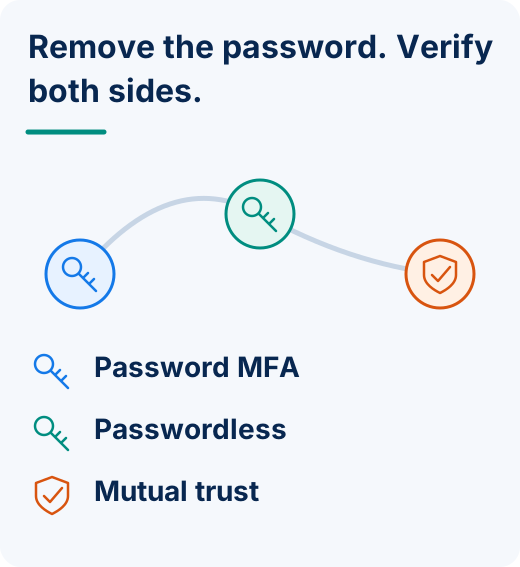
Here's where the conversation gets more interesting.
Traditional MFA often works like this:
Password + Something Else
That "something else" might be:
SMS code
Authenticator application
Push notification
Hardware token
Security improves substantially.
But the password remains.
And therefore many password-related problems remain too.
Employees still:
Forget passwords
Reset passwords
Reuse passwords
Enter passwords into phishing sites
Get locked out
Contact help desks
Organizations strengthen authentication while continuing to maintain the credential responsible for much of the original problem.
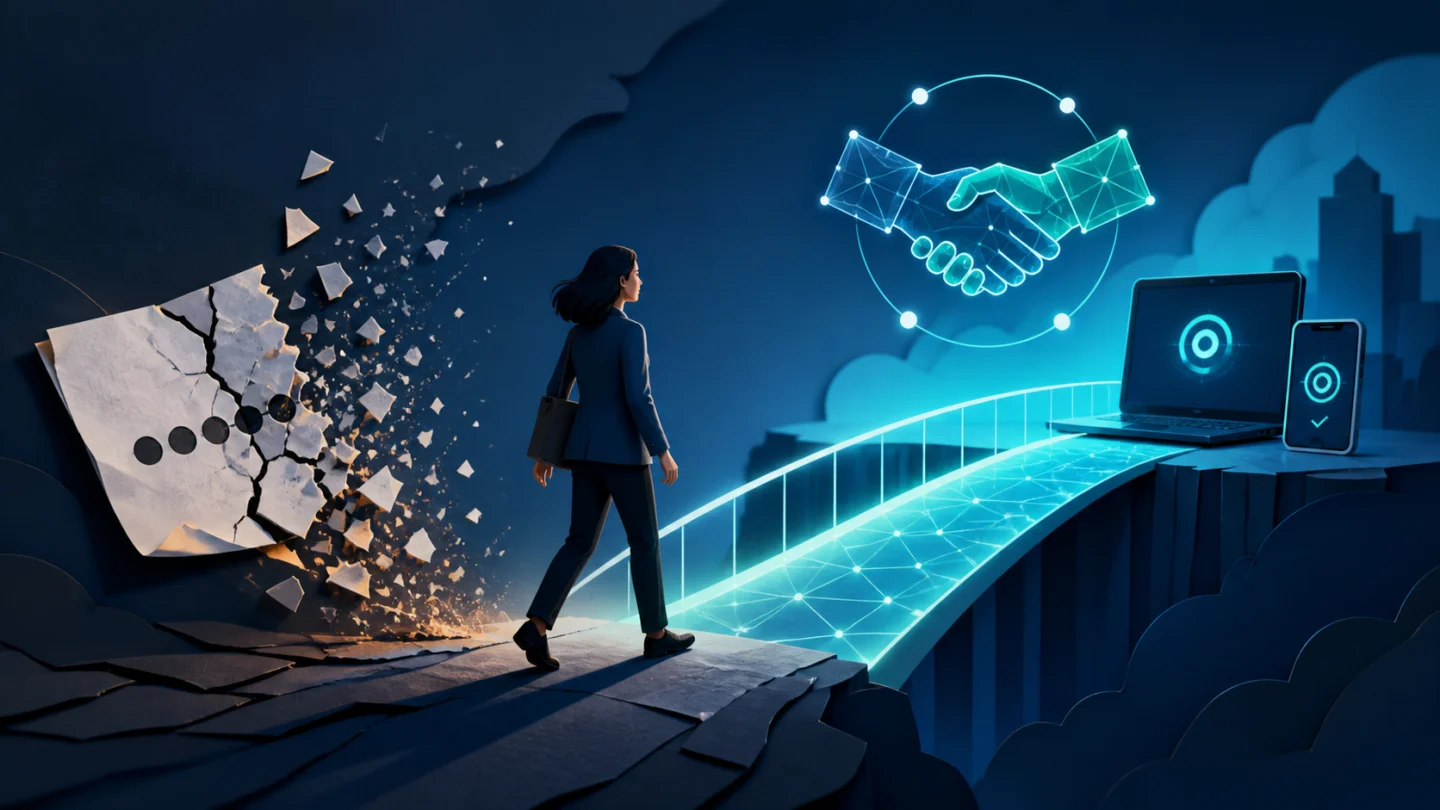
This is why authentication is evolving again.
The Better Question: Why Not Eliminate the Password?
Passwordless authentication changes the security model.
Instead of continually strengthening a password with additional authentication steps, passwordless systems seek to remove password dependency altogether.
That can provide several benefits:
No password to forget
No password to reuse
No password to reset
No password to share
No password to phish
Fewer password-related help desk calls
The objective isn't simply making passwords stronger.
It's making them unnecessary.
There's Another Problem: What If You're Logging Into the Wrong Website?
Even MFA doesn't automatically solve every phishing problem.
Cybercriminals increasingly create highly convincing:
Imposter websites
Lookalike domains
Cloned corporate portals
Fake cloud login pages
Fraudulent banking websites
Imagine receiving an email that appears to come from your employer.
You click the link.
The login page looks perfect.
You enter your password.
Then you enter your MFA code.
The attacker may relay those credentials to the legitimate site in real time.
The user successfully proved their identity.
But nobody sufficiently established an equally important fact:
Was the website legitimate?
This is where conventional authentication can leave an important trust gap.
What Is Full Duplex Authentication®?
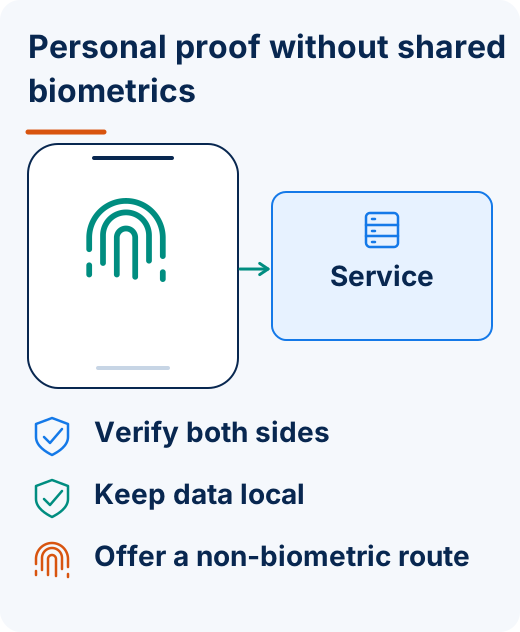
Full Duplex Authentication® (FDA) is the patented authentication technology powering PasswordFree®, Identité's Software-as-a-Service (SaaS) authentication solution, and NoPass™, its PaaS solution that can be deployed on premises or in the cloud.
Rather than relying on a password-centric, one-way authentication relationship, FDA establishes mutual authentication. The user must authenticate to the legitimate application or website, while that application or website must also authenticate itself as legitimate.
In other words, authentication isn't complete simply because the system recognizes the user. Both sides of the relationship must establish trust.
That's an important distinction.
Traditional authentication asks: "Are you the legitimate user?"
Full Duplex Authentication® additionally asks:
"Are you connecting to the legitimate destination?"
Why Mutual Authentication Matters
Consider an imposter website.
A cybercriminal may be able to copy:
The logo
The colors
The website design
The login screen
The company's branding
They may even register a domain differing from the legitimate domain by only one character.
But copying appearance isn't the same as establishing identity.
The imposter site cannot successfully perform the legitimate website's side of Full Duplex Authentication®.
The site may look legitimate to the user.
It cannot authenticate as the legitimate site.
That's an important shift in the authentication model.
Instead of placing the entire burden on the user to recognize a fake website, the authentication architecture itself participates in establishing whether the destination can be trusted.
What About Biometrics?
Passwordless authentication can incorporate convenient mechanisms such as:
Fingerprint recognition
Facial recognition
Trusted devices
Compatible hardware security keys
Biometrics offer an important advantage over passwords:
You don't have to remember them.
But biometric privacy matters enormously.
You can replace a password.
You cannot simply replace your fingerprint or face.
Your Biometric Data Should Stay With You
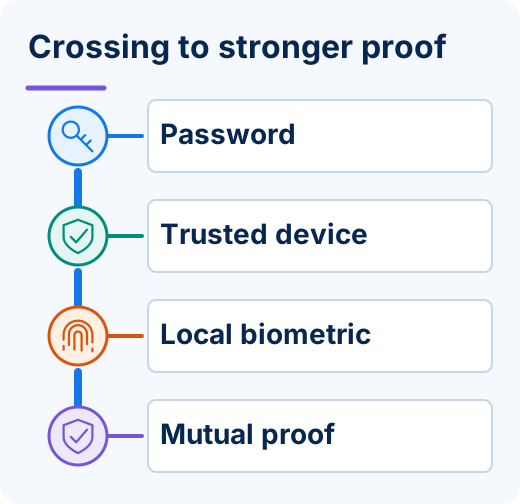
Identité utilizes a decentralized authentication architecture designed so that biometric data remains on the user's trusted device.
The user's biometric data does not need to be transmitted to Identité, the employer, or a centralized biometric database for matching.
Your biometric data stays on your device.
That helps avoid creating a centralized repository containing the biometric information of potentially thousands of users.
This is particularly important because centralized databases can become valuable targets for attackers.
A fundamental security principle applies:
Sensitive information that isn't centralized cannot be stolen from a centralized repository.
What If I Don't Want to Use Biometrics?
Passwordless doesn't have to mean biometric-only.
Different users and organizations have different requirements.
Identité is also compatible with supported third-party hardware tokens, including security keys such as YubiKey®.
Hardware keys can be especially valuable for:
Privileged administrators
Financial institutions
Healthcare environments
Government organizations
Secure facilities
Users who prefer physical authentication devices
The objective is not forcing everyone into one authentication method.
It's establishing strong identity without returning to password dependency.
What Happens If I Lose My Phone?
This is another common objection to modern MFA and passwordless authentication.
"What happens if my authentication device disappears?"
Traditional authentication systems can turn a lost phone into a lost workday.
Identité approaches the problem as a matter of business continuity.
Emergency PIN Authentication
When organizational policy permits, authorized users can authenticate using an Emergency PIN when their primary authentication device is temporarily unavailable.
The Emergency PIN isn't intended to become another everyday password.
It serves as a controlled continuity mechanism so an unexpected device problem doesn't unnecessarily prevent an authorized employee from working.
Secure Backup & Restore
If a phone is permanently lost or replaced, authentication shouldn't have to be rebuilt from scratch.
With PasswordFree® and NoPass™, users can securely back up their authentication profile, according to organizational configuration, to:
Secure cloud storage
The corporate network
When a replacement phone is available, the authentication profile can be restored to the new device.
The restore process can be completed in less than two minutes.
That means less downtime for employees and fewer recovery calls for IT.
PasswordFree® — SaaS Simplicity
Organizations seeking a cloud-delivered passwordless solution can choose PasswordFree®, Identité's SaaS offering.
PasswordFree® is designed to provide:
Passwordless authentication
Mutual authentication powered by FDA
Reduced exposure to password theft
Protection against imposter websites
Decentralized biometric verification
Emergency PIN Authentication
Secure Backup & Restore
Support for compatible third-party authentication options
Reduced help desk workload
The objective isn't making employees perform more authentication.
It's making authentication more secure with less unnecessary friction.
NoPass™ — Enterprise Authentication Without Compromise
Enterprises requiring greater control can choose NoPass™, powered by patented Full Duplex Authentication®.
NoPass™ can be deployed on premises or in the cloud and is designed for organizations requiring integration with environments such as:
Microsoft Active Directory
Microsoft Entra ID
Microsoft 365 / Office 365
Microsoft Azure
For banks, healthcare organizations, government agencies, and other highly regulated enterprises, an on-premises deployment provides an option for maintaining authentication infrastructure within the organization's controlled environment.
Security Isn't the Only Cost of Passwords
Password discussions frequently focus on cybersecurity.
But passwords also have an operational cost.
Consider what happens across a large organization when employees:
Forget passwords
Lock accounts
Call the help desk
Wait for resets
Reauthenticate repeatedly
Lose productivity
Multiply those interruptions across hundreds or thousands of employees.
Password management becomes a business expense.
Passwordless authentication can therefore address two problems simultaneously:
Security risk and operational friction.
That's an important reason organizations are moving beyond password-centric authentication.
Passwords Were Designed for a Different World
Passwords aren't inherently useless.
They helped protect computer systems for decades and remain widely used today.
But the environment surrounding them has fundamentally changed.
Today's organizations operate in a world of:
Cloud computing
Remote work
Mobile devices
Global workforces
Sophisticated phishing
Credential marketplaces
Automated cyberattacks
Lookalike domains
AI-enhanced social engineering
Authentication technology must evolve with that environment.
The progression isn't simply: Password → Password + MFA
The larger evolution is: Password → MFA → Passwordless → Mutual Authentication
And ultimately:
Authentication built around trust rather than shared secrets.
The Identité Perspective
When someone asks:
"Why can't I just use my password?"
the answer isn't that passwords suddenly stopped working.
The problem is that passwords were asked to do something they were never particularly good at:
Prove identity.
A password proves that someone knows a secret.
Modern authentication should establish considerably more.
Is this the authorized user?
Is this the authorized device?
Is this the legitimate application or website?
And can all of that happen without creating unnecessary friction or compromising user privacy?
That's the philosophy behind PasswordFree® and NoPass™, powered by patented Full Duplex Authentication®.
Through passwordless authentication, mutual authentication, decentralized biometric verification, compatible third-party hardware tokens, Emergency PIN Authentication, and Secure Backup & Restore, Identité approaches authentication as a complete trust relationship rather than another layer added to a password.
Because the future of cybersecurity isn't about inventing a better password.
It's about creating a world where you no longer need one.