




For years, cybersecurity was built around a fairly straightforward assumption: people use computers, people have identities, and organizations decide what those people are allowed to access.
That world is disappearing.
Today, the identity accessing a sensitive system may belong to an employee. Or a contractor. Or a customer. But it could just as easily belong to an application, API, service account, bot, automated workflow or increasingly, an autonomous AI agent acting on someone's behalf.
The number of identities inside the enterprise is expanding rapidly, while the distinction between human and machine activity is becoming less obvious.
And attackers have noticed.
Cybersecurity Dive's recent Trendline on identity and access management describes a security environment in which human identities are already being overwhelmed by machine and AI-generated identities. At the same time, attackers increasingly use stolen credentials, authentication tokens and legitimate access pathways to enter organizations without looking like attackers at all.
That combination should force us to reconsider a fundamental assumption about cybersecurity:
What happens when nearly everything has an identity, but we cannot be certain which identities deserve our trust?
Attackers Don't Always Need to Break In Anymore
For much of cybersecurity's history, we imagined an attacker trying to penetrate the walls surrounding an organization.
Firewalls were strengthened. Endpoints were protected. Networks were segmented. Vulnerabilities were patched.
Those protections remain essential.
But increasingly, the attacker doesn't need to defeat the wall.
They can walk through the door.
Cybersecurity Dive cites Unit 42 research based on more than 750 incident-response cases worldwide in which identity played a role in 90% of cases. Attackers are increasingly using stolen identities and tokens to gain access while appearing to systems as legitimate users.
The distinction matters.
An exploit often creates evidence that something abnormal is happening.
A valid credential may not.
When an attacker successfully assumes a trusted identity, many traditional security controls see what appears to be normal activity.
The attacker isn't necessarily breaking in.
They're logging in.

And once that happens, cybersecurity becomes an identity problem.
AI Is Multiplying the Identity Problem
Now add artificial intelligence.
AI agents increasingly perform tasks that previously required people. They interact with applications, retrieve information, communicate with other systems, initiate workflows and make decisions.
To do those things, they need access.
And access requires identity.
Cybersecurity Dive's Trendline points to a significant shift: non-human identities—including AI agents, service accounts and bots—can already outnumber human users by orders of magnitude in some environments. Yet many enterprise identity programs were designed around a world in which humans were the primary actors.
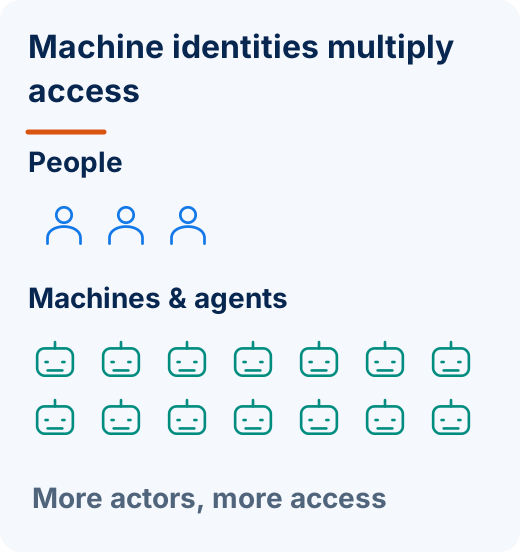
The problem isn't simply the number of identities.
It's what those identities can do.
An AI agent may need permission to read customer information, interact with business applications, access databases or execute transactions.
That raises questions organizations are only beginning to confront.
Who authorized the agent?
What identity is it operating under?
What systems can it access?
How long should that access remain valid?
Can its permissions change?
Can another agent instruct it to perform an action?
Can we trace its actions back to the person or system responsible for them?
And perhaps most importantly:
How does the system know the entity requesting access is still the entity it believes it to be?
These aren't theoretical questions anymore.
They are becoming basic questions of enterprise security.
Identity Sprawl Is Really Trust Sprawl
We often describe this problem as identity sprawl.
That's accurate, but incomplete.
What organizations are actually experiencing is trust sprawl.
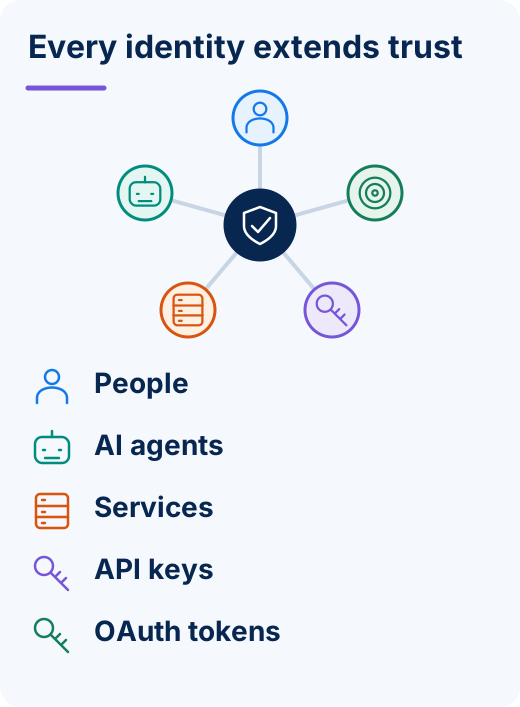
Every identity granted access represents an extension of organizational trust.
An employee credential represents trust.
A privileged administrator account represents greater trust.
An API key represents trust.
A service account represents trust.
An OAuth token represents trust.
An autonomous AI agent operating across multiple enterprise systems represents potentially enormous trust.
The more identities we create, the more places we distribute that trust.
And every one becomes something that must be verified, governed, monitored and eventually revoked.
Cybersecurity Dive highlights another important dimension of the problem: excessive privileges. Research cited in the Trendline reported that 99% of cloud identities were overprivileged. The same report advocated moving toward zero-standing-privilege approaches where permissions are granted as needed rather than permanently assigned.
That reinforces an important principle:
Identity should establish who or what is participating. Authorization should determine what that identity is permitted to do. Neither decision should automatically be considered permanent.
AI Is Also Making Impersonation Better
There is another side to the AI problem.
AI isn't only creating new identities that organizations must govern.
It is making existing identities easier to impersonate.
Generative AI dramatically reduces the effort required to create convincing phishing messages, executive impersonations and highly personalized social-engineering attacks.
Cybersecurity Dive cites Cloudflare research finding that identity deception accounted for 19% of the email-based threats it detected in the prior year, second only to malicious links. The researchers described these attacks as exploiting trust signals rather than technical vulnerabilities.
That phrase deserves attention.
Because it describes where cybersecurity is heading.
Attackers increasingly don't have to defeat technology if they can successfully counterfeit trust.
A convincing email appears to come from the CEO.
A login appears to come from an employee.
A request appears to originate from a trusted application.
An AI agent appears to be authorized.
A session token appears legitimate.
Each attack succeeds for essentially the same reason:
The system accepts the representation of identity without establishing sufficient confidence in the identity behind it.

MFA Helps. But We Need to Think Beyond Factors.
Multi-factor authentication has significantly improved security, and it remains an important defense against credential compromise.
But adding authentication factors doesn't by itself solve the larger trust problem.
If the future contains humans, machines and autonomous agents interacting continuously across interconnected systems, authentication cannot simply be treated as a gate we pass through once.
We need to think more deeply about the relationship between identity, authentication, authorization and trust.
The question cannot stop at:
Did this identity provide the correct credential?
We increasingly need to ask:
Is this really the identity it claims to be?
Is the service or system on the other side also legitimate?
Should this identity be permitted to perform this particular action?
Is the context consistent with what we expect?
And do we still have reason to trust it?
That is a much different security model.
Trust Must Work in Both Directions
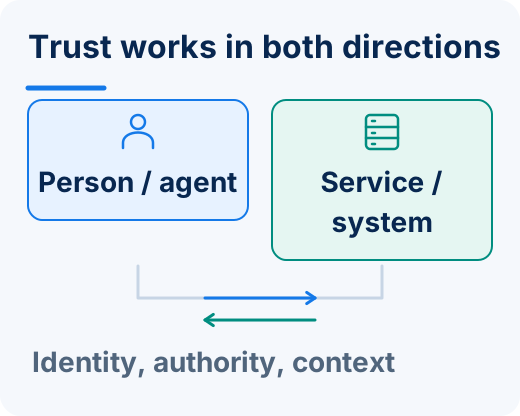
Traditional authentication is predominantly one-directional.
The service challenges the user:
Prove who you are.
The user provides the evidence.
But the user is rarely given equivalent assurance that the service requesting that evidence is itself legitimate.
That asymmetry has helped make phishing and impersonation so effective.
At Identité, this is the problem we set out to address with Full Duplex Authentication®.
Rather than requiring only the user to prove identity, Full Duplex Authentication establishes mutual verification between both sides of the interaction.
The principle is simple:
Don't just authenticate the participant. Verify the relationship.
This becomes even more important as digital interactions expand beyond human-to-application relationships.
The emerging environment will increasingly include:
human ↔ machine
machine ↔ machine
human ↔ AI agent
AI agent ↔ application
and eventually, AI agent ↔ AI agent
Each interaction creates a trust relationship.
Each relationship requires confidence in identity.
Verifiable Identity Becomes the Foundation
For me, this leads to a broader conclusion.
Verifiable Identity is the cornerstone of Digital Trust.
Not because identity replaces every other cybersecurity control. It doesn't.
Networks still need protection. Endpoints still need protection. Applications still need secure development. Data still needs encryption. Vulnerabilities still need remediation.
But all of those systems increasingly depend upon a fundamental assumption:
We know who—or what—is participating.
If that assumption is wrong, many of the controls built on top of it become less effective.
This is why identity is moving from an IT function to a strategic cybersecurity issue.
Cybersecurity Dive's Trendline makes that transition increasingly difficult to ignore. Identity-related attacks are becoming more prominent, AI is accelerating impersonation, machine identities are multiplying, and autonomous agents are creating an entirely new category of actors requiring access to enterprise resources.
The answer cannot simply be more identities, more passwords, more factors and more access rules piled onto an architecture designed for another era.
We need an identity architecture designed for the world we're entering.
The Human Side of Digital Trust
There is an irony in all of this.
The more automated our digital world becomes, the more important trust becomes.
Technology should quietly serve humanity.
People shouldn't have to become cybersecurity experts simply to determine whether the website, application, message or service in front of them is legitimate.
And organizations shouldn't have to assume that possession of a credential permanently establishes trust.
Good security should make the legitimate interaction simple while making impersonation extraordinarily difficult.
That was important when digital identities primarily represented people.
It becomes essential when identities represent people, devices, applications, services, bots and autonomous agents simultaneously.
The next chapter of cybersecurity will not simply be about protecting networks.
It will be about establishing trust among everything participating in them.
And that begins with knowing, with confidence, who—or what—is on the other side.