




There is a comforting assumption buried somewhere in the way most of us think about crime.
Commit a serious enough crime and eventually someone will come looking for you.
Police investigate.
Evidence is gathered.
The criminal is identified.
An arrest follows.
Then prosecution.
Then punishment.
Cybercrime has broken that familiar sequence.
A recent TechTarget article, The Prosecution Gap: Why Cybercrimes Go Unpunished, examines just how wide the divide has become between the enormous scale of cybercrime and the relatively small number of criminals who are ultimately prosecuted.
A couple of statistics immediately put the problem into perspective:
More than 1 million cybercrime complaints were reported to the FBI in 2025, the first time that threshold was crossed. Reported losses reached $20.87 billion, a 26% increase from the previous year.
Yet a U.S. Sentencing Commission analysis found that from 2014 through 2021, only 2,590 individuals were federally sentenced for offenses involving hacking, cryptocurrency or dark-web activity.
Another statistic demonstrates how quickly the criminal ecosystem continues to expand:
Researchers identified 138 ransomware groups claiming victims in 2025, up from 98 in 2024.
Those numbers are not directly comparable measures of crimes versus prosecutions, and they cover different periods and definitions. But together they illustrate the scale of the challenge.
Cybercrime is growing extraordinarily quickly.
The ability to arrest and prosecute the people behind it is not keeping pace.
That should change how businesses think about cybersecurity. citeturn0view0
Cybercrime Has a Geography Problem
Imagine a criminal walks into a bank in Miami, steals $10 million and drives away.
Law enforcement has jurisdiction.
There are cameras.
There may be witnesses.
The vehicle can potentially be traced.
Evidence exists in a physical location.
Now imagine the same bank loses $10 million to a cybercriminal.
Where did the crime happen?
Florida?
The country where the attacker lives?
The country hosting the command-and-control infrastructure?
The country where the stolen information was temporarily stored?
The jurisdiction through which the cryptocurrency moved?
The answer may be all of them.
Or none of them in a way that makes prosecution straightforward.
TechTarget describes how cybercriminals deliberately exploit this problem. Attack infrastructure can be distributed across jurisdictions that do not cooperate with one another. Extradition may be unavailable. Legal-assistance requests can move more slowly than digital evidence survives. Some attackers may even operate from countries where the government has little interest in helping Western authorities arrest them.
The Internet eliminated borders for the attacker.
The legal system still has them.
That is an extraordinary strategic advantage for cybercrime.
The Attacker Factors Prosecution Into the Business Model
Perhaps one of the most interesting points in the TechTarget article is that criminals themselves understand the prosecution gap.
This is not merely something law enforcement complains about afterward.
Attackers can structure operations around it.
Where should infrastructure be hosted?
Which countries should be targeted?
Where should stolen funds move?
Which jurisdictions cooperate with each other?
Where is extradition possible?
Where is it unlikely?
Cybercrime has become sophisticated enough that avoiding prosecution can effectively become another part of operational planning.
Think about what that means.
The criminal is not simply asking:
"Can I breach this organization?"
They can also ask:
"If I do, what are the chances anyone can actually do anything about it?"
That changes the economics considerably.
Cybercrime Is a Business

We sometimes make cybercriminals sound almost mythical.
Shadowy hackers.
Dark rooms.
Complex code.
Foreign adversaries.
But much of modern cybercrime behaves like a business.
There is specialization.
There are suppliers.
There are affiliates.
There are marketplaces.
There are service providers.
There are revenue-sharing arrangements.
There is infrastructure.
There are customers.
There are business models.
Malware-as-a-service has lowered the technical barrier to entry. An attacker does not necessarily need to develop every component of an attack. Criminal capabilities can be rented, purchased or obtained through an ecosystem of providers and affiliates.
In other words:
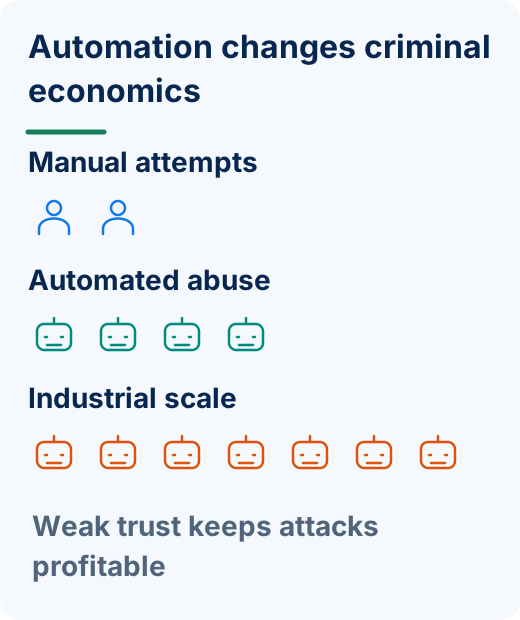
Cybercrime has industrialized.
And when something becomes industrialized, scale changes everything.
AI Is Lowering the Cost Again

Now add artificial intelligence.
The TechTarget article cites KnowBe4 research finding AI-generated elements in 85.76% of phishing emails examined in its 2026 report.
That matters because phishing historically contained a useful weakness.
Bad grammar.
Strange wording.
Awkward phrasing.
Poor spelling.
Messages that simply didn't sound right.
Those clues helped people recognize fraud.
Generative AI can remove many of them.
Now an attacker can produce polished communications.
Personalized communications.
Different versions for different targets.
Different languages.
Different executive personas.
And they can do it at scale.
The economics change again.
The cost of creating convincing deception falls.
The speed increases.
The number of potential targets increases.
And the skill required to produce a credible message can decrease.
AI does not magically create successful cyberattacks.
But it can make parts of the attack process cheaper and more scalable.
For criminals, that matters enormously.
So, What Happens to Deterrence?
Traditional law enforcement depends partly on deterrence.
If the probability and consequences of punishment are high enough, committing the crime becomes less attractive.
But what happens when the attacker believes the probability of prosecution is low?
The deterrent weakens.
If the potential reward is enormous, the cost of launching attacks continues to fall and the probability of punishment remains relatively small, the economics continue to favor the attacker.
That leads to an uncomfortable conclusion for business leaders:
You cannot build your cybersecurity strategy around the expectation that the person attacking you will eventually be caught.
They may not be.
They may never even be identified.
And even if they are identified, they may live somewhere they cannot realistically be arrested.
That means businesses have to concentrate on the part of the equation they can influence.
Make the attack harder to succeed.
Prevention Changes the Economics Too
Cybersecurity is often discussed as defense.
Protect the network.
Protect the endpoint.
Protect the data.
Protect the application.
But prevention does something else.
It changes the attacker's economics.
Imagine an attacker can successfully phish one out of every hundred employees.
That may be an attractive campaign.
What happens if stronger controls reduce that success rate dramatically?
The attacker needs more targets.
More infrastructure.
More time.
More attempts.
More money.
More exposure.
The return on investment falls.
Now apply that same thinking across:
Credential theft.
Account takeover.
Impersonation.
Fraudulent authentication.
Privilege escalation.
Unauthorized transactions.
Successful security does not merely stop an attack.
It makes attacking you less profitable.
That is an important distinction.
Law enforcement tries to increase the cost after the crime.
Cybersecurity can increase the cost of successfully committing it.
We need both.
Why Break In When You Can Log In?
This is where I see a particularly important connection to identity.
Attackers do not always need to defeat sophisticated security infrastructure.
Sometimes they simply need an identity the infrastructure already trusts.
Steal the credentials.
Capture a session token.
Phish the employee.
Convince someone to approve an MFA request.
Social-engineer the help desk.
Impersonate a trusted organization.
Take over an account.
Once the attacker possesses enough of the characteristics the system associates with a legitimate user, something dangerous happens:
The attacker begins to look legitimate.
The firewall may be working.
The encryption may be working.
The endpoint protection may be working.
The application may be functioning exactly as designed.
But the wrong person has been accepted as the right person.
This is why one of the most important questions in modern cybersecurity is becoming:
Who is actually holding the key?
The Castle Still Matters, but So Does the Person at the Gate

In a previous discussion, I compared modern cybersecurity to a medieval castle.
We build walls.
Dig moats.
Station guards.
Protect the gate.
But eventually an intelligent attacker asks:
Why climb the wall if I can convince someone to lower the drawbridge?
Identity attacks operate on the same principle.
The attacker may not need to defeat the perimeter.
They need someone inside to trust them.
A phishing email does that.
A stolen credential does that.
MFA fatigue attempts to do that.
Help-desk social engineering does that.
Account takeover does that.
The attacker is looking for someone or something capable of opening the gate.
And AI is helping attackers become considerably more convincing when they ask.
Authentication Has to Become Harder to Weaponize
Passwords were supposed to establish identity.
Attackers learned to steal them.
We added two-factor authentication.
Attackers adapted.
We expanded MFA.
Attackers developed techniques involving phishing proxies, push fatigue, social engineering and session theft.
This does not mean MFA is useless.
Far from it.
MFA remains an important improvement over password-only authentication.
But there is a larger lesson.
We cannot keep assuming that adding another authentication challenge permanently solves the underlying trust problem.
The attacker adapts.
That means authentication must evolve too.
The Missing Question: Who Is on the Other Side?
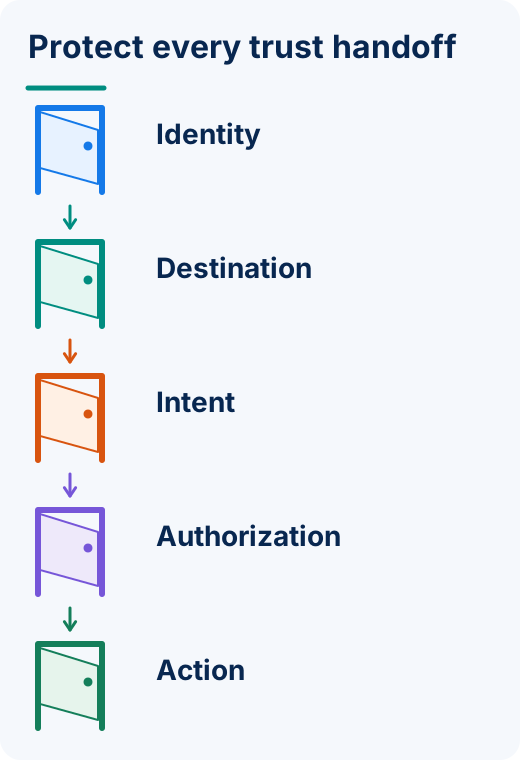
Most authentication systems concentrate overwhelmingly on one participant.
The user.
Who are you?
Enter your password.
Provide your code.
Approve the push.
Present your biometric.
Prove yourself again.
But phishing exploits something fundamentally different.
The attacker impersonates the destination.
A fraudulent website may look like your bank.
A fake Microsoft login may look legitimate.
A fraudulent corporate portal may reproduce the company's branding perfectly.
The employee believes they are authenticating to the organization.
The organization is asking the user to prove who they are.
But who proves the destination is legitimate?
That question becomes increasingly important as AI makes impersonation more convincing.
Full Duplex Authentication® Changes the Relationship
This is the problem Identité® addresses with our patented Full Duplex Authentication®.
Traditional authentication is primarily:
User → Destination
The user proves themselves to the service.
Full Duplex Authentication® establishes trust in both directions:
User ↔ Legitimate Destination
The user authenticates.
But the legitimate destination also participates in establishing its legitimacy to the user before the user's secure authentication is completed.
Why does that matter?
Because an attacker can copy appearance.
Logos.
Colors.
Language.
Web pages.
Branding.
Emails.
Even voices.
But looking like a legitimate organization should not be enough to become that organization in the authentication relationship.
That is the difference between recognition and authentication.
And as impersonation improves, that difference becomes more important.
Intent Matters Too
There is another attacker's advantage we should eliminate.
Confusion.
Suppose an employee receives an authentication request.
They weren't expecting it.
But authentication prompts are common.
Maybe they forgot they initiated something.
Maybe IT is doing something.
Maybe an application needs approval.
Maybe they receive five requests. Then ten.
Eventually they approve one simply to make the prompts disappear.
The authentication system may record:
Approved.
But did the user actually intend to initiate the session?
That is a different question.
At Identité®, authentication can explicitly establish intent by asking the user something as straightforward as:
"Did you request this authentication session?"
Context such as an image and three-digit number can further connect the authentication experience to what the user is actually doing.
This is not about adding more friction.
It is about adding meaning to the authentication decision.
Authentication Is Only the Beginning
Now suppose authentication succeeds legitimately.
The user really is the user.
Should that automatically authorize every action?
No.
This is where authentication and authorization must be separated.
Authentication answers:
"Who are you?"
Authorization answers:
"What are you permitted to do?"
Consider online banking.
A customer authenticates.
They check a balance. Low risk.
They review transactions. Low risk.
They transfer $100 between their own accounts. Potentially routine.
Then they attempt to wire $50,000 to a new recipient in another country.
Same identity.
Completely different risk.
That transaction may deserve additional authorization.
This is where intelligent security can improve protection without making every interaction painful.
More Security Does Not Have to Mean More Friction
One of cybersecurity's most damaging assumptions is that stronger security inevitably means a worse user experience.
Another password.
Another challenge.
Another code.
Another interruption.
Another approval.
That is not necessarily better security.
It may simply be more security friction.
The better approach is:
Apply the right security to the right identity around the right action at the right time.
Low-risk legitimate activity should remain easy.
Higher-risk activity should trigger stronger controls.
A consequential transaction may require specific authorization.
An unexpected authentication request should establish intent.
A destination asking for sensitive authentication should establish its own legitimacy.
Security becomes adaptive rather than indiscriminate.
That helps protect the organization while making legitimate users' lives easier.
And that is important because cybersecurity should not become the department whose answer is always "no."
Done properly, security enables the business to say:
"Yes, safely."
The Defender Has a Resource Problem Too
TechTarget points to another challenge that deserves attention.
Cybersecurity organizations themselves face skills shortages, and law enforcement faces similar pressure. The article cites an ISC2 study in which 88% of respondents reported at least one significant security consequence related to skills shortages. Organizations may also lack the logging, evidence preservation and forensic readiness needed to support attribution or prosecution after an incident. citeturn0view0
This makes prevention even more important.
Every successful attack consumes resources.
Incident response.
Forensics.
Legal counsel.
Regulatory reporting.
Customer notification.
System restoration.
Executive attention.
Reputational repair.
Potential litigation.
Business interruption.
A prevented attack avoids far more than the direct loss.
It avoids the enormous organizational machinery required after the compromise.
Prosecution Isn't the Only Way to Hurt the Criminal
There is some encouraging news in the TechTarget article.
When authorities cannot arrest the people behind cybercrime, they increasingly target the infrastructure those criminals depend on.
Operation Cronos disrupted LockBit infrastructure across 10 countries in 2024, after which ransom payments to the group fell 79%.
Operation Endgame has targeted botnets and infostealer infrastructure, with a November 2025 phase taking down 1,025 servers.
Operation Talent shut down the Cracked and Nulled cybercrime forums, which together had more than 10 million users. citeturn0view0
This illustrates an important principle.
If you cannot immediately arrest the criminal:
Disrupt the business model.
Take away infrastructure.
Freeze money.
Increase operating costs.
Reduce success rates.
Make the ecosystem less reliable.
Cybersecurity teams should think similarly.
Our job is not to arrest attackers.
Our job is to make their business model fail when they target us.
Prevention and Prosecution Are Two Sides of the Same Economic Battle
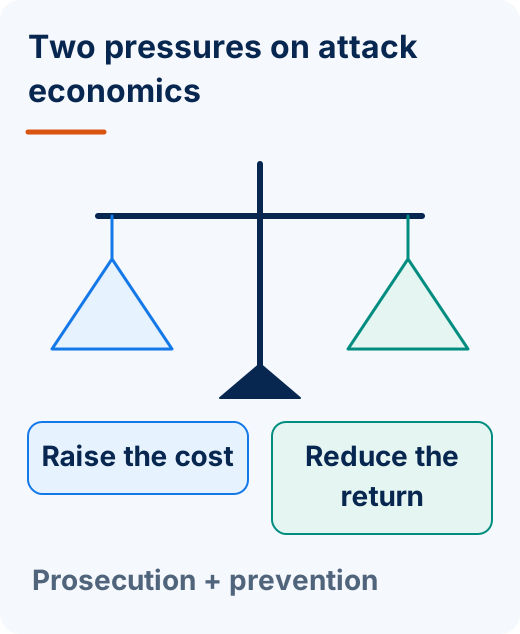
Law enforcement and cybersecurity teams approach the problem from different directions.
Law enforcement asks:
How do we identify, disrupt, arrest and prosecute the attacker?
Security teams ask:
How do we prevent the attacker from succeeding?
But economically, both are trying to accomplish something similar.
Make cybercrime less attractive.
Raise the cost.
Reduce the reward.
Increase uncertainty.
Decrease the probability of success.
That is ultimately how the equation changes.
And the TechTarget article provides a good example of prevention working at the law-enforcement level too. The FBI's Operation Level Up has notified more than 8,000 potential crypto-fraud victims and prevented more than $500 million in losses since its January 2024 launch. The FBI's Recovery Asset Team froze $679 million in 2025 through rapid reporting, with a 58% success rate for its Financial Fraud Kill Chain.
Notice what happened.
The most valuable outcome wasn't necessarily prosecuting someone years later.
It was preventing the money from disappearing in the first place.
The Identité Perspective: Make Trust Harder to Exploit
There is no authentication technology that can solve international extradition.
No identity platform can eliminate ransomware.
No security vendor can prevent every cyberattack.
Those are not realistic claims.
But organizations can control something critically important:
How easily attackers can exploit trust.
Can stolen credentials alone provide access?
Can an attacker impersonate a legitimate destination?
Can an unexpected authentication request be approved without establishing intent?
Does successful authentication provide excessive authority?
Can one compromised identity open too many doors?
Those are architectural decisions.
And they matter because attackers increasingly search for the cheapest path to success.
If stealing a password works, they steal passwords.
If phishing MFA works, they phish MFA.
If social-engineering the help desk works, they call the help desk.
If impersonating the organization works, they impersonate the organization.
If compromising one identity provides access to everything, that identity becomes extremely valuable.
The objective should therefore be straightforward:
Make the trusted identity a much harder weapon to steal, manipulate or misuse.
Passwordless authentication can reduce dependence on reusable passwords.
Full Duplex Authentication® can establish trust in both directions.
Authentication intent can help determine whether the user actually initiated the session.
Authorization can limit what happens after authentication.
Least privilege can reduce the damage one compromised identity can cause.
Context can determine when risk has changed.
Together, these controls begin to attack the attacker's economics.
Assume the Attacker Is Not Afraid of the Courtroom
Governments need stronger international cooperation.
Law enforcement needs resources.
Organizations need better forensic readiness.
Criminal infrastructure should be disrupted.
Stolen funds should be frozen.
Attackers should be prosecuted whenever possible.
All of that matters.
But CISOs, CIOs and business leaders cannot base today's security decisions on what may happen to the criminal tomorrow.
Your responsibility begins much earlier.
Before the breach.
Before the ransomware deployment.
Before the account takeover.
Before the fraudulent transaction.
Before the attacker successfully becomes someone your systems trust.
That is where organizations have the greatest opportunity to change the outcome.
Because there is an uncomfortable reality behind the prosecution gap:
The person attacking your organization may be thousands of miles away, operating behind layers of infrastructure, protected by borders, anonymity or even a government that has no intention of helping prosecute them.
They may never be arrested.
They may never be extradited.
They may never be convicted.
They may never see the inside of a courtroom.
So perhaps our security strategy should begin with that assumption.
The person attacking you may never see the inside of a courtroom. Our job is to make sure they don't see the inside of our systems either.