





For most of cybersecurity's history, we have measured success by what didn't happen.
The breach that was prevented. The account that wasn't compromised. The data that wasn't stolen. The regulatory problem that never materialized.
Those are important outcomes. But they are no longer enough.
As businesses become more digital, security increasingly sits directly in the path of customers, employees, transactions and innovation. That means cybersecurity has another responsibility:
It should help the business move forward.
A recent CSO Online article makes a compelling case for this evolution. Cybersecurity leaders, it argues, need to move beyond defending technology and become strategic partners who help their organizations innovate, modernize and grow. Security becomes far more valuable when it is built into business strategy from the beginning rather than appearing as a final checkpoint before something can move forward.
I agree with that premise. But I believe it leads to an even larger question:
What if we stopped thinking about security as a necessary friction in doing business and started designing it as a catalyst for doing more business?
That change in perspective has profound implications, particularly for identity and authentication.
The False Choice Between Security and Experience
For decades, cybersecurity has operated under an assumption that deserves to be challenged:
More security requires more effort from the user.
When passwords proved insufficient, we made them longer and more complex.
When that wasn't enough, we added security questions.
Then tokens.
Then one-time passcodes.
Then authenticator applications.
Then push notifications.
Each generation addressed legitimate threats. But with every additional layer, we quietly transferred more of the security burden to the legitimate user.
Our presentation, The Human Side of Digital Trust, asks a question that gets to the heart of the problem:
Why do honest people have to work so hard to prove they are honest?
It describes how users have progressively been asked to remember another password, carry another device, retrieve another code and approve another notification, often repeatedly throughout the day.
Somewhere along the way, inconvenience became associated with security.
It shouldn't be.
Friction is not proof of security.
And eliminating friction does not have to mean reducing security.
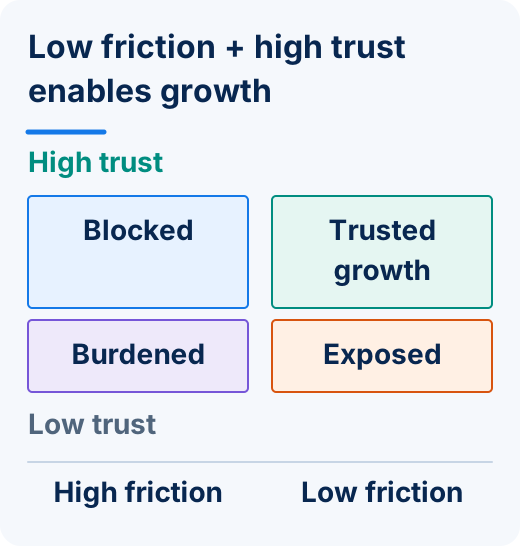
In fact, when we identify the person with greater confidence, we have an opportunity to do both:
Increase security while reducing the burden on legitimate users.
That is where security begins to look less like overhead and more like a business strategy.
Friction Has a Business Cost
Consider what happens every time security interrupts a legitimate person.
An employee stops working to find a password.
A physician turns away from a patient to authenticate again.
A customer retrieves a phone to receive a code.
Someone attempting to make a purchase abandons the process because another verification step has appeared.
A help desk handles another password reset.
Each event may seem insignificant when viewed individually.
Across thousands, or millions, of interactions, they are not.
They represent lost time, interrupted workflows, support costs, frustrated customers and, in some cases, lost revenue.
This is why cybersecurity cannot be evaluated exclusively through the lens of threat prevention.
The better question is:
What does this security control enable, or prevent, the business from accomplishing?
That is one of the important ideas in the CSO article. Business leaders think about growth, customer expectations, continuity and results. Security leaders become more valuable when they can connect cybersecurity decisions to those outcomes rather than discussing security solely in terms of vulnerabilities, controls and compliance.
Authentication is a perfect example.
If we can authenticate a person with greater certainty while asking that person to do less, the benefit extends far beyond cybersecurity.
We can improve productivity.
We can reduce support requirements.
We can remove barriers from customer journeys.
We can make digital services easier to use.
We can accelerate transactions.
We can create confidence without creating inconvenience.
Less friction becomes a business advantage.
The Goal Isn't More Authentication. It's More Confidence.

This brings us to what I believe is one of the most important distinctions in cybersecurity.
We have become very good at authenticating things.
Passwords.
Devices.
Tokens.
Credentials.
Phones.
But none of those is actually the thing we ultimately care about.
What we really want to know is:
Who is requesting access?
That distinction is central to The Human Side of Digital Trust. As the presentation explains, nearly every major security investment rests on the assumption that the organization knows who is requesting access. Firewalls, monitoring, AI and Zero Trust can become increasingly sophisticated, but their effectiveness still depends on confidence in identity.
That changes the objective.
The objective isn't to create more authentication.
The objective is to create greater confidence in identity.
Once we think about the problem that way, something interesting happens.
Complexity stops being a proxy for security.
As we say in the presentation:
Trust does not increase because complexity increases. Confidence in identity does.
That is an enormously important distinction for businesses trying to grow.
Because complexity creates friction.
Confidence can remove it.
Great Security Should Become an Invisible Enabler
Some of the best technology I've encountered during my career has one thing in common:
Eventually, people stopped noticing it.
That may sound like an odd measure of technological success, but I believe it is one of the most important.
Technology is not the destination.
People are.
Our presentation describes the outcome as the "Invisible Enabler."
When technology moves quietly into the background, physicians can concentrate on patients, teachers on students and bankers on customers.
The security hasn't disappeared.
The interruption has.
Think about what that means from a business perspective.
The best authentication experience isn't necessarily the one with the most visible security.
It may be the one the legitimate user barely notices.
Security is still working.
Identity is still being established.
Access is still being controlled.
Risk is still being managed.
But the customer or employee remains focused on what they came to accomplish.
That is not merely better user experience.
That is better business.
Security Designed Around People Creates Opportunity
There is another lesson I've learned that extends beyond convenience.
Poorly designed security doesn't just frustrate people.
Sometimes it excludes them entirely.
Years ago, while working with the Government of Mexico on a nationwide healthcare initiative, we encountered a problem that fundamentally changed how I thought about identity.
Traditional identity systems expected people to possess documents.
But many of the citizens we were trying to serve had no birth certificate. No government-issued ID. No utility bill. Some lived in communities where electricity had never reached their homes. Some could neither read nor write.
Requiring documents, they had never possessed wasn't stronger security.
It was exclusion.
Biometric identification offered a different approach. A fingerprint required no password, paperwork or literacy. According to our presentation, that helped remove barriers while dramatically reducing fraud and helping healthcare resources reach their intended recipients.
That experience taught me something that applies equally to commercial technology today:
Every security requirement determines not only who is protected, but who can participate.
That makes friction a strategic issue.
A cumbersome customer authentication process can reduce conversion.
An inaccessible process can exclude potential customers.
An overly complicated employee authentication environment can reduce productivity.
A security architecture designed around yesterday's assumptions can make tomorrow's business model harder to achieve.
Remove those barriers, and security starts opening doors rather than closing them.
Build Security Into Growth, Not Around It
Another important argument in the CSO article is that security works best when it participates early in business decisions rather than arriving at the end to approve or reject them.
When cybersecurity teams understand operational goals and help shape technology decisions from the beginning, risks can be addressed before they become expensive obstacles.
That same principle should apply to identity.
Don't build a digital experience and then ask:
How do we secure the login?
Start by asking:
How can we establish trust while creating the easiest possible experience for the legitimate person?
Those are very different design philosophies.
The first adds security to a process.
The second makes security part of the process.
And when identity is designed correctly from the beginning, organizations don't necessarily have to choose between security and usability.
They can pursue both.
Growth Requires Trust
Digital business ultimately depends on trust.
A bank needs confidence that the person moving money is the account holder.
A hospital needs confidence that someone accessing a medical record is authorized to see it.
An enterprise needs confidence that the individual entering a critical system is an employee with the appropriate permissions.
A consumer needs confidence that the organization requesting information really is the organization it claims to be.
And as AI makes digital impersonation increasingly convincing, establishing that trust will only become more important.
This is also why I believe authentication ultimately needs to evolve beyond the traditional one-way model.
Most authentication asks the organization to verify the individual:
Are you really you?
But users rarely receive an equally strong answer to another important question:
Is this really the organization I intended to connect with?
That principle is behind Identité's patented Full Duplex Authentication®, which creates mutual authentication where both sides of the digital relationship participate in establishing trust.
The user authenticates to the organization.
The legitimate organization authenticates as part of the relationship with the user.
This becomes especially important in a world of phishing, lookalike domains and increasingly sophisticated AI-assisted impersonation.
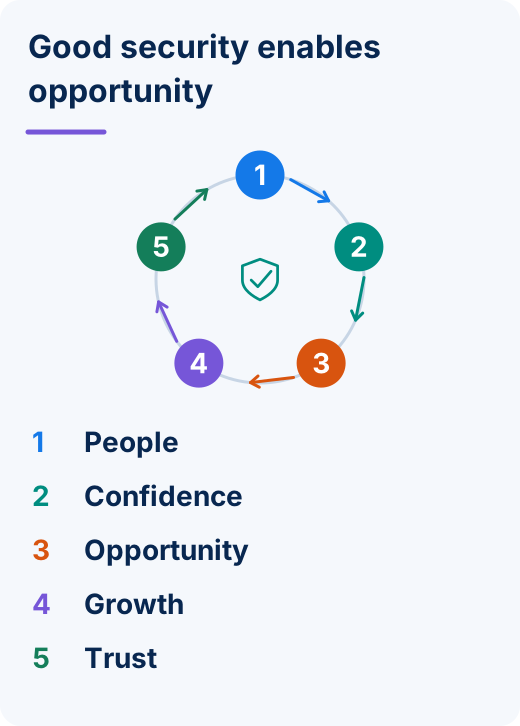
Because growth in a digital economy requires transactions.
Transactions require confidence.
And confidence requires trust.
Less Friction Does Not Mean Less Security
This deserves emphasis because it contradicts decades of conventional thinking.
The objective should not be to make authentication easier by removing security.
The objective should be to make authentication easier because we have found better ways to establish identity.
That is a very different proposition.
Identité's approach is designed around that philosophy.
Instead of depending on reusable passwords as the foundation of trust, authentication can use the trusted device and locally verified biometrics.
Biometric information remains decentralized and on the user's device rather than being maintained in a centralized Identité biometric repository.
And Full Duplex Authentication® adds mutual authentication to address another fundamental weakness in traditional authentication: the legitimacy of the destination.
The result is not security sacrificed for convenience.
The goal is:
Stronger identity assurance with less friction.
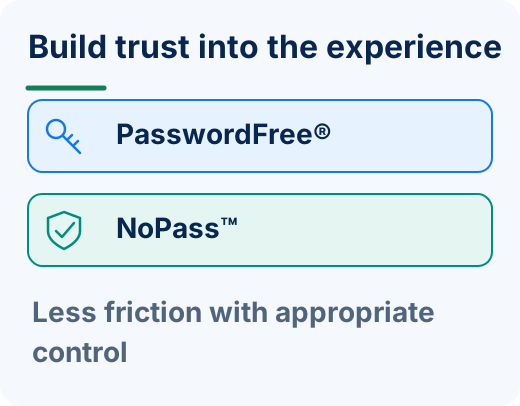
PasswordFree®: Security Designed for the SaaS Experience

This philosophy is reflected in Identité's PasswordFree®, our SaaS passwordless authentication solution.
PasswordFree® is designed to reduce dependence on passwords while providing a simpler authentication experience for legitimate users.
That has obvious security implications.
But it also has business implications.
Fewer passwords can mean fewer forgotten passwords.
Fewer resets.
Less help desk involvement.
Less employee interruption.
Less customer frustration.
And fewer opportunities for traditional credential phishing.
PasswordFree® also incorporates our patented Full Duplex Authentication®, trusted-device authentication, decentralized biometric verification, contextual authentication and authentication intent.
For organizations delivering SaaS applications, the objective is not simply to secure another login screen.
It is to make trust part of the customer experience.
NoPass™: Enterprise Security Without Sacrificing Control
For enterprise organizations requiring deeper infrastructure integration, Identité offers NoPass™, our PaaS solution powered by Full Duplex Authentication®.
NoPass™ can be deployed in the cloud or on premises and can integrate with environments involving Microsoft Active Directory, Microsoft Entra ID, Microsoft 365 / Office 365 and Microsoft Azure.
That deployment flexibility is particularly important for highly regulated organizations.
Banks, for example, frequently prefer on-premises implementations because they want maximum control over sensitive customer and authentication environments.
This illustrates another dimension of security as an enabler.
Security architecture should adapt to the business rather than forcing the business to adapt to the security architecture.
A Different Way to Measure Cybersecurity
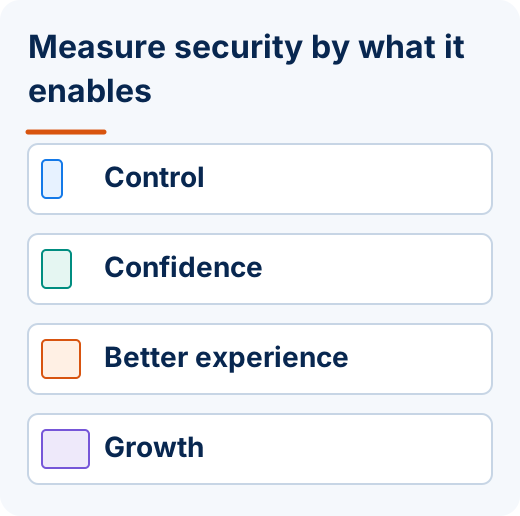
Perhaps it is time to expand how we measure security success.
Of course we should continue measuring attacks prevented, vulnerabilities eliminated and incidents contained.
But we should also ask:
How much employee time did we give back?
How many unnecessary authentication steps did we eliminate?
How many password resets disappeared?
How much easier did we make it for customers to transact with us?
How many people can now access services who previously encountered barriers?
How much faster can the organization introduce new technology because trust has already been designed into the infrastructure?
And perhaps most importantly:
Did security help the organization do something it could not confidently do before?
That is security as a growth strategy.
From Gatekeeper to Growth Catalyst
The CSO article describes the future security organization as one that helps the business say yes with confidence rather than simply being the department that says no.
I would take that one step further.
The future of cybersecurity should not simply be about permitting innovation.
Security should make innovation easier.
It should remove unnecessary barriers.
It should make trust simpler.
It should allow employees to spend more time working and less time proving they are allowed to work.
It should allow customers to transact with confidence without making them navigate an obstacle course.
And it should allow businesses to move faster precisely because they have greater confidence in the people participating in their digital environment.
That requires us to abandon one of cybersecurity's oldest assumptions:
Security and convenience are not opposing forces.
When identity is designed correctly, stronger security can create less friction.
Less friction creates better experiences.
Better experiences can improve productivity, adoption and customer engagement.
And those outcomes can contribute directly to growth.
Perhaps that is the real opportunity facing cybersecurity leaders today.
Stop asking only:
How do we protect the business?
And start asking:
How can better security help the business grow?
Because when security becomes effortless for honest people, difficult for attackers and nearly invisible in the moments that matter, it has become something much more valuable than another layer of defense.
It has become a catalyst for growth.