




For years, many organizations treated cybersecurity as a specialized responsibility.
The CEO ran the business.
The CFO managed financial strategy.
The COO managed operations.
The CIO managed technology.
The CISO protected information and systems.
On an organizational chart, that division of responsibilities makes sense.
In practice, the boundaries have become increasingly difficult to maintain.
A new digital product is also a cybersecurity decision.
A cloud migration is also an identity decision.
A merger or acquisition is also an access-control decision.
An AI initiative is also a data-security decision.
A customer mobile application is also an authentication and authorization decision.
A new financial transaction capability is also a fraud and risk-management decision.
Cybersecurity is no longer something that can be added after the business strategy has been developed.
Security has become part of the business strategy itself.
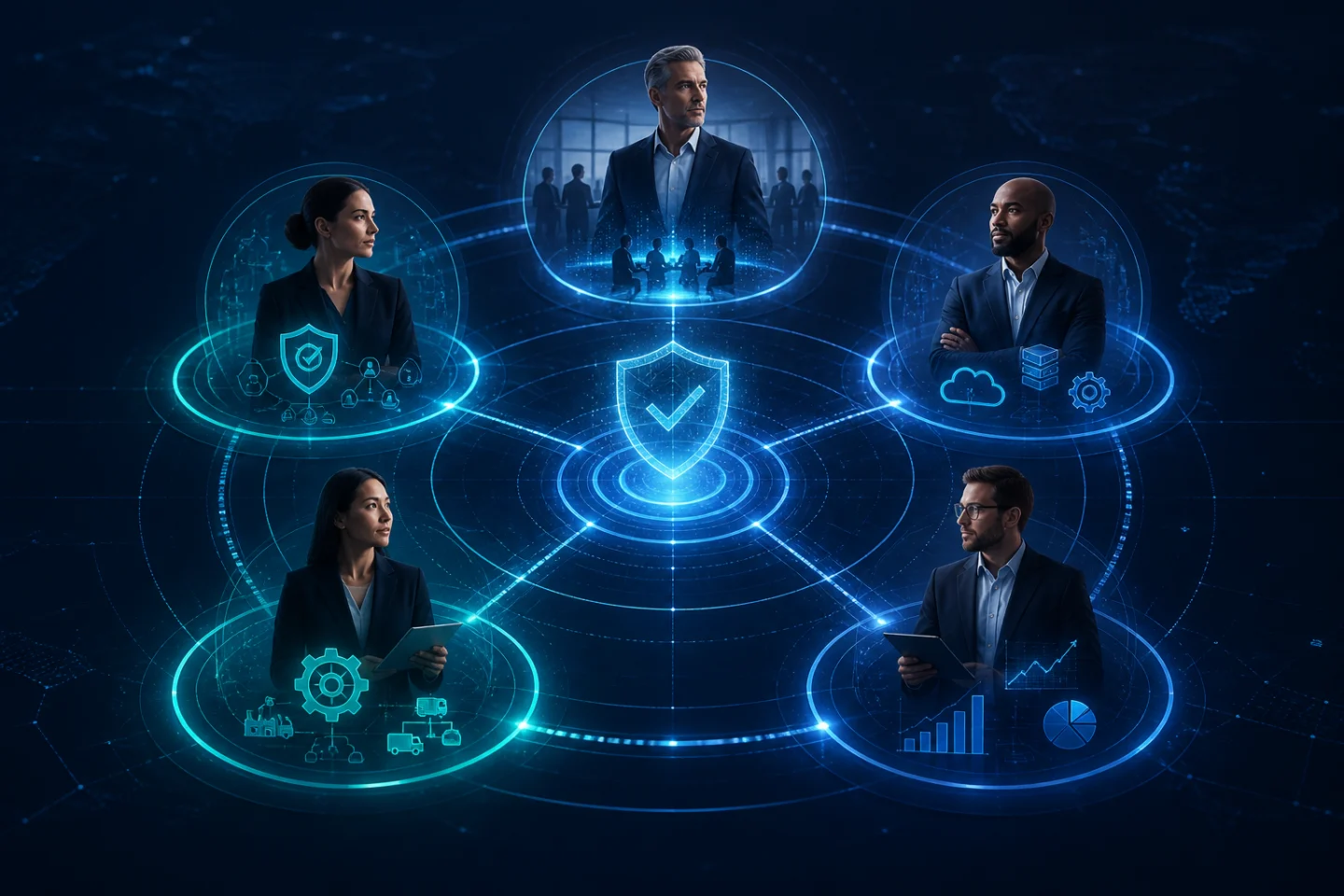
That is where the concept of a digital C-suite becomes important.
A digital C-suite does not simply mean adding another technology executive to the leadership team. It represents a different operating model where business, technology, cybersecurity, data, risk and customer experience are integrated much earlier in strategic decision-making.
For organizations embracing digital transformation, that can fundamentally change security from something that slows projects down into something that helps the organization move forward with confidence.
What Is a Digital C-Suite?
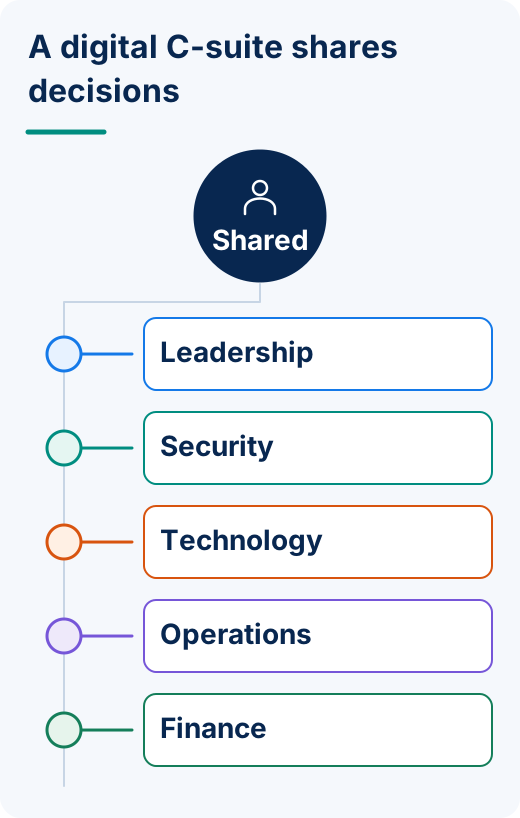
A traditional executive structure divides responsibility largely according to function.
A digital C-suite still requires accountability, but it encourages much closer collaboration across functions whose decisions have become inseparable.
The CEO considers growth.
The CFO considers investment and financial risk.
The COO considers execution and efficiency.
The CIO considers technology and infrastructure.
The CISO considers cybersecurity and resilience.
Data and AI leaders consider information, analytics and automation.
Customer and revenue leaders consider experience and market opportunity.
The important change is not eliminating those responsibilities.
It is recognizing that digital decisions increasingly require all of them.
Consider something as straightforward as introducing a new mobile financial service.
The business team sees a revenue opportunity.
Technology sees an application.
Marketing sees customer acquisition.
Operations sees a new service channel.
Compliance sees regulatory obligations.
Cybersecurity sees potential attack surfaces.
Identity teams see authentication and authorization requirements.
The customer sees none of those departments.
The customer sees one experience.
A digital C-suite attempts to make leadership operate with the same perspective.
Security Integration Should Begin Before the Security Review
One of the biggest problems with the traditional model is timing.
A business unit develops an initiative.
Technology designs it.
Developers build it.
The organization prepares to launch it.
Then someone asks:
"Has security approved this?"
That is far too late.
If the security team discovers a fundamental problem at that point, the organization faces several bad choices.
Delay the launch.
Redesign the application.
Accept additional risk.
Spend more money.
Introduce cumbersome security controls at the last minute.
Or cancel the initiative.
Security then gets blamed for slowing the business down.
But security was not necessarily the problem.
Late security integration was the problem.
A digital C-suite changes the sequence.
Security becomes part of the conversation when the opportunity is being defined, not simply when the finished product needs approval.
Instead of asking:
"Can security approve what we built?"
the organization asks:
"How should we build this so we can deliver the business objective securely?"
That is a profoundly different relationship.
Security Becomes an Enabler Rather Than a Gatekeeper

This connects directly to something we have emphasized throughout our discussions of digital trust.
The best security should not force legitimate people to work around it.
It should help them accomplish what they came to do.
That applies equally to the business.
When security enters too late, its role frequently becomes restrictive.
No, you cannot deploy that.
No, you cannot connect those systems.
No, customers cannot perform that transaction remotely.
No, employees cannot access that information outside the office.
No, the organization cannot use that new platform.
When cybersecurity participates from the beginning, the conversation can change.
Yes, and here is how we can do it safely.
That is the difference between security as a checkpoint and security as a catalyst for growth.
Identity Should Be a C-Suite Conversation
One of the areas where this integration matters most is identity.
Identity is sometimes treated as an IT infrastructure issue.
It shouldn't be.
Consider how many business outcomes depend on knowing who is requesting access.
A bank needs to know who is moving money.
A hospital needs to know who is accessing a medical record.
An enterprise needs to know who is accessing intellectual property.
An e-commerce business needs to know who is conducting a transaction.
An AI system needs to know who authorized an agent to perform an action.
A customer needs confidence that the website or application requesting authentication is legitimate.
Every one of those situations has technical implications.
But they also have financial, operational, regulatory and customer-experience implications.
Identity is a business issue.
And therefore, identity strategy belongs in the digital C-suite conversation.
Authentication Is Only the Beginning
A digital C-suite also helps organizations recognize that authentication alone does not solve the access problem.
Authentication answers:
"Who are you, and can you prove it?"
But once someone has successfully authenticated, another question immediately follows:
"What are you authorized to do?"
That is authorization.
The distinction is critical.
An employee who successfully authenticates should not automatically have access to every system.
An administrator should not necessarily have unrestricted authority everywhere.
A customer who authenticates to a bank account should not automatically be permitted to execute every conceivable financial transaction without additional controls.
Authentication establishes identity.
Authorization establishes boundaries.
This is where integrated leadership becomes especially valuable because those boundaries should not be defined by cybersecurity alone.
The business understands the transaction.
Finance understands the financial exposure.
Compliance understands regulatory requirements.
Operations understands the workflow.
Cybersecurity understands the threat.
Technology understands implementation.
Together, they can determine the appropriate authorization policy.
Banking Provides a Perfect Example
Consider a bank developing new mobile transaction capabilities.
The business objective is straightforward:
Allow customers to perform more banking from their mobile devices.
That can be a growth opportunity.
Customers gain convenience.
The bank expands digital services.
Branch dependency can decrease.
Transactions can occur around the clock.
But the security team has legitimate concerns.
Should a customer who successfully authenticates be able to wire any amount of money without additional authorization?
Probably not.
A digital C-suite can approach the problem differently.
Instead of choosing between:
Mobile convenience
or
Stronger security
the institution can design both into the experience.
Suppose the bank establishes a policy requiring additional authorization for wire transfers exceeding $1,000.
The exact threshold is determined by the bank.
The customer authenticates and enters the mobile application.
They review balances.
They examine transactions.
They perform ordinary activities with minimal friction.
Then they attempt a $5,000 wire.
The risk changes.
The bank's policy automatically invokes authorization for that specific transaction.
The customer is now asked:
"Do you authorize this transaction?"
Security appears precisely when the risk warrants it.
The bank retains control.
The customer retains convenience.
And the mobile service becomes more capable because security was designed into the business opportunity rather than placed in front of it.
That is digital C-suite thinking.
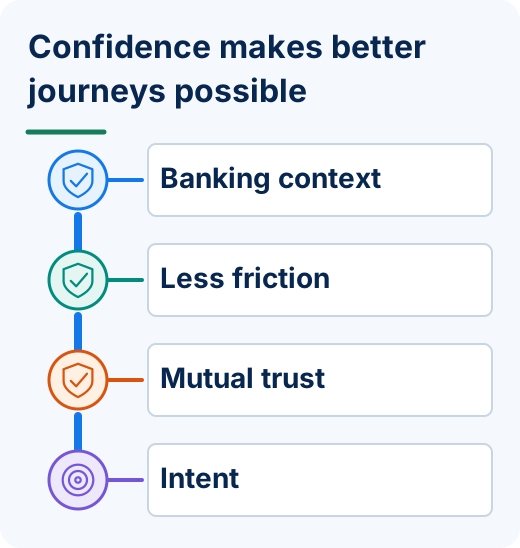
Less Friction Should Be a Security Objective
For decades, security and convenience were frequently treated as opposing forces.
Want more security?
Add another password.
Another code.
Another token.
Another authentication step.
Another approval.
But friction itself is not proof of security.
And unnecessary friction has a measurable business cost.
Employees lose productive time.
Customers abandon transactions.
Help desks process password resets.
Physicians are interrupted while treating patients.
Bankers spend time authenticating instead of serving customers.
Users develop workarounds.
Security fatigue increases.
A digital C-suite creates an opportunity to make user experience part of the security conversation.
Instead of asking only:
"Is this control secure?"
leadership can also ask:
"What does this control do to the customer or employee experience?"
And then:
"Can we achieve greater security with less friction?"
That last question is especially important.
Greater Confidence Can Create Less Friction
The goal should not be to reduce security so the experience becomes easier.
The goal should be to establish identity and authorization more effectively, allowing unnecessary security interactions to disappear.
That is a central principle behind our approach at Identité.
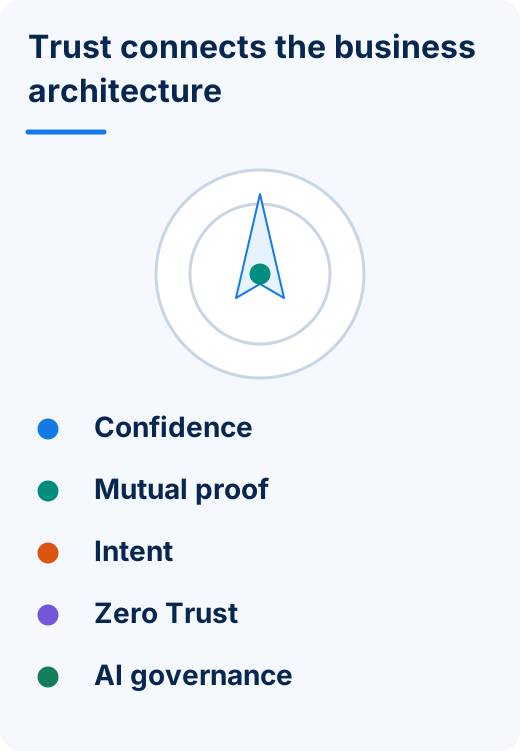
When an organization has greater confidence in identity, the trusted device, authentication intent, authorization and the legitimacy of the destination, security decisions can become more precise.
Routine legitimate activity does not necessarily require maximum friction.
Higher-risk activity can trigger stronger controls.
This creates a more intelligent model:
Low uncertainty can mean low friction.
Higher uncertainty can invoke additional verification.
Higher-risk actions can invoke additional authorization.
Security responds to the circumstances instead of treating every interaction as equally dangerous.
Full Duplex Authentication® Adds Mutual Trust
A digital C-suite should also recognize that modern identity risk exists on both sides of the transaction.
Organizations spend enormous resources asking:
"Is this really our customer or employee?"
But users increasingly need an answer to another question:
"Is this really the organization I intended to connect with?"
That matters because phishing, lookalike domains, fraudulent websites and AI-assisted impersonation are becoming increasingly convincing.
A fake website may reproduce the logo.
The colors.
The language.
The authentication page.
Even the customer-service experience.
Identité's patented Full Duplex Authentication® approaches authentication as a mutual trust relationship.
The user participates in establishing legitimacy.
The legitimate destination participates in establishing legitimacy.
Both sides matter.
That is particularly relevant to a digital C-suite because customer trust is no longer simply a cybersecurity issue.
It is a brand issue, customer-experience issue and growth issue.
Intent Adds Another Layer
There is also a difference between proving someone's identity and establishing what they intended to do.
Suppose an employee receives an unexpected authentication request.
Or a banking customer receives a request associated with a financial transaction.
A generic message saying:
"Approve?"
provides limited information.
Approve what?
Did the person initiate the request?
Was it expected?
Identité can provide contextual information during the authentication experience, including a message asking:
"Did you request this authentication session?"
An image and three-digit number can provide additional context on the same screen.
This moves the decision away from reflexive approval toward confirmation of intent.
For the digital C-suite, this matters because intent connects cybersecurity with fraud prevention, transaction integrity and customer experience.
Again, the boundaries between executive responsibilities begin disappearing.
Zero Trust Becomes a Business Architecture
The same thinking applies to Zero Trust.
Zero Trust should not mean making every employee and customer repeatedly prove themselves throughout the day.
It should mean eliminating assumptions.
Do not assume that successful authentication creates unlimited authority.
Use authorization.
Do not assume that being inside the corporate network means someone should be trusted.
Evaluate identity and context.
Do not assume that an employee needs unrestricted access.
Apply least privilege.
Do not assume that an authenticated customer intended every transaction.
Establish intent.
Do not assume that a familiar-looking website is legitimate.
Establish destination trust.
Do not assume that a previous trust decision applies indefinitely.
Continuously evaluate risk.
That gives the digital C-suite a much more useful framework:
Identity + Authentication + Authorization + Intent + Context + Destination + Least Privilege + Continuous Verification
This is not simply a security architecture.
It is a digital trust architecture.
AI Makes C-Suite Integration Even More Important
Artificial intelligence makes this integrated model even more necessary.
AI agents can potentially access information, communicate with applications, initiate workflows and execute transactions.
That creates questions that cannot belong exclusively to the CIO or CISO.
Who owns the AI agent?
Who authorized it?
What information can it access?
What systems can it interact with?
What transactions can it initiate?
When must it stop and request human authorization?
How do we authenticate the person providing that authorization?
What financial threshold requires additional approval?
Who is accountable when something goes wrong?
These questions cross technology, security, finance, operations, compliance, legal and executive governance.
Agentic AI therefore makes the case for the digital C-suite even stronger.
The technology is integrated. Leadership needs to be integrated too.
PasswordFree®: Making Security Part of the Experience

For SaaS environments, Identité's PasswordFree® reflects this philosophy.
PasswordFree® is our SaaS passwordless authentication solution designed around capabilities including passwordless authentication, patented Full Duplex Authentication®, mutual authentication, trusted-device authentication, decentralized biometric verification, authentication intent, contextual authentication, Emergency PIN Authentication and Secure Backup & Restore.
The objective is larger than removing a password.
It is to establish greater confidence while reducing unnecessary friction for legitimate users.
That has cybersecurity benefits.
But it can also create business benefits.
Fewer password problems.
Fewer resets.
Less employee interruption.
Less customer frustration.
Fewer opportunities for conventional credential phishing.
A better digital experience.
That is why authentication should not be evaluated only by the security organization.
Its impact reaches across the business.
NoPass™: Enterprise Control and Integration
For organizations requiring deeper infrastructure integration and deployment control, Identité offers NoPass™, our PaaS solution powered by patented Full Duplex Authentication®.
NoPass™ can be deployed on premises or in the cloud and supports enterprise environments involving Microsoft Active Directory, Microsoft Entra ID, Microsoft 365 / Office 365 and Microsoft Azure.
That deployment flexibility can be particularly valuable for financial institutions, healthcare organizations, government agencies and other highly regulated enterprises.
Banks in particular frequently prefer on-premises deployments because of their sensitivity to placing customer or critical information in cloud environments.
This is another example of why security architecture needs to reflect business requirements.
The CISO may understand the threat.
The CIO may understand the infrastructure.
Compliance may understand regulatory obligations.
The business understands operational requirements.
The right architecture emerges when those perspectives come together.
Decentralized Biometrics Protect Privacy by Design
The digital C-suite should also ask questions about the architecture underneath security technologies.
For example:
If biometrics are used for authentication, where does the biometric information reside?
Identité uses a decentralized model in which biometric verification occurs on the user's trusted device.
The biometric does not need to leave the device or reside in a centralized Identité biometric repository for matching.
That design decision has implications beyond cybersecurity.
It affects privacy.
Risk.
Compliance.
Customer confidence.
Architecture.
Brand trust.
Once again, what initially appears to be a technical security decision becomes a C-suite issue.
The Digital C-Suite Can Eliminate the Security Versus Growth Debate
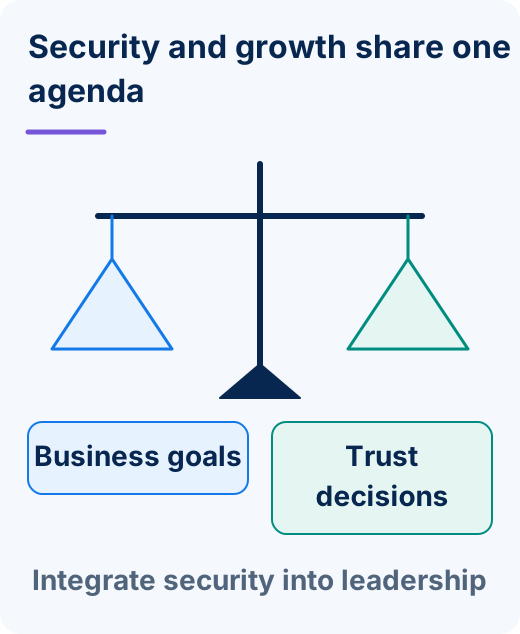
Perhaps the greatest advantage of the digital C-suite is that it can finally move organizations beyond one of the oldest debates in technology:
Business wants speed. Security wants control.
That framing is obsolete.
The business needs both.
The better conversation is:
How do we create enough security confidence that the business can move faster?
Strong identity can enable remote work.
Passwordless authentication can reduce friction.
Authorization can enable higher-value mobile transactions.
Least privilege can make broader digital access safer.
Mutual authentication can strengthen trust in online interactions.
Decentralized biometrics can improve authentication without creating an unnecessary centralized repository.
Zero Trust can allow the organization to operate beyond the traditional perimeter.
Security can make these capabilities possible.
That is not security competing with growth.
That is security creating the conditions for growth.
Security Integration Changes the Questions Leadership Asks
A mature digital C-suite begins asking different questions.
Instead of:
"Has security approved this?"
Ask:
"How is security helping us make this possible?"
Instead of:
"How many security controls can we add?"
Ask:
"How much confidence do we need, and what is the least intrusive way to establish it?"
Instead of:
"Did the user authenticate?"
Ask:
"Is the user authorized to perform this particular action?"
Instead of:
"Can customers perform this remotely?"
Ask:
"What authentication and authorization controls would allow them to do it safely?"
Instead of:
"How do we stop AI?"
Ask:
"How do we establish identity, authority and accountability so we can use AI confidently?"
Those are not simply better cybersecurity questions.
They are better business questions.
The Identité Perspective: Integrate Trust Into the Business
A digital C-suite can improve security integration because it removes the artificial boundary between cybersecurity and business strategy.
Security no longer arrives after the important decisions have been made.
Identity is considered when the customer experience is designed.
Authorization is considered when transaction capabilities are created.
Privacy is considered when data architecture is selected.
Zero Trust is considered when employees and partners need access.
Cybersecurity is considered when AI agents receive authority.
Customer trust is considered when authentication is designed.
And friction is considered because legitimate users are part of the security architecture too.
That produces a very different relationship between security and growth.
The objective is not:
Maximum security everywhere.
It is:
The right security, for the right person, around the right action, at the right time.
That means authenticating identity with confidence.
Authorizing actions according to policy and risk.
Establishing intent when it matters.
Verifying the legitimacy of the destination.
Applying least privilege.
Continuously reevaluating trust.
And removing unnecessary friction everywhere else.
When leadership approaches digital transformation this way, cybersecurity stops being the department waiting at the end of the process with a checklist.
It becomes part of the team designing what comes next.
And that may be the most important contribution a digital C-suite can make.
Because the strongest security integration does more than protect what the company already has.
It gives the company the confidence to build what comes next.