




For decades, cybersecurity has operated around a relatively simple assumption:
Authenticate the user, then grant access.
Enter the correct username.
Enter the correct password.
Complete MFA.
Authentication successful.
Welcome in.
But what if the person who successfully completed that login isn't actually the person we think they are?
And what if an authentication event that was legitimate five minutes ago no longer represents a trustworthy session?
That is the central issue raised in a recent TechRadar Pro article, “Cybersecurity’s identity crisis: why trust can no longer begin and end at login.”
The article argues that the traditional image of attackers "breaking into" networks is increasingly outdated. Today's attackers can enter through the front door using legitimate credentials and then operate inside an environment while appearing to be legitimate employees.
That's a profound shift.
Cybersecurity is moving from a world where we primarily asked:
“Did someone break in?”
to one where we increasingly have to ask:
“Is the person already inside really who we think they are?”
And that changes the identity-security conversation considerably.
The New Attacker Doesn't Always Break In
When most people picture a cyberattack, they imagine someone exploiting a vulnerability, bypassing a firewall, or deploying sophisticated malware.
Those attacks certainly still happen.
But criminals have discovered another method.
Why break down the door when you can obtain the key?
Passwords and credentials are stolen through:
Phishing
Infostealer malware
Credential harvesting
Social engineering
Previous data breaches
Session hijacking
Dark-web credential markets
TechRadar points to phishing, infostealers, session hijacking and credential harvesting as contributors to an environment in which legitimate account access has become increasingly available to attackers. The article cites the UK's Cyber Security Breaches Survey 2025, which found phishing was the most common cyber threat among businesses reporting a breach or attack.
Once an attacker possesses legitimate credentials—or in some cases an authenticated session—the security problem changes.
The attacker may no longer look like an attacker.
They look like an employee.
Authentication Is a Moment in Time
One of the strongest observations in the TechRadar article is that authentication provides a snapshot in time.
A person successfully authenticates at 9:02 a.m.
What exactly have we established?
We've established that the authentication requirements were satisfied at approximately 9:02.
But what happens afterward?
At 9:17, the account accesses a sensitive database.
At 9:24, it downloads information it has never accessed before.
At 9:31, it attempts to enter an administrative system.
At 9:38, it accesses a new application.
Should the original authentication event continue to establish unlimited trust?
That's the problem.
As the TechRadar article puts it, the important question is increasingly not simply whether someone authenticated correctly, but whether the activity that follows continues to make sense.
That's an excellent way to think about modern identity security.
Zero Trust Was Supposed to Address This
The concept isn't entirely new.
Zero Trust has been telling organizations for years:
Never trust. Always verify.
The basic principle recognizes that trust shouldn't automatically be granted merely because a user or device is inside a corporate network.
But the same principle needs to extend to identity.
A successful authentication shouldn't mean:
Trusted forever.
It should mean:
Trust established for this interaction under these circumstances.
And when circumstances change, security controls should be capable of reevaluating that trust.
From Authentication to Continuous Trust
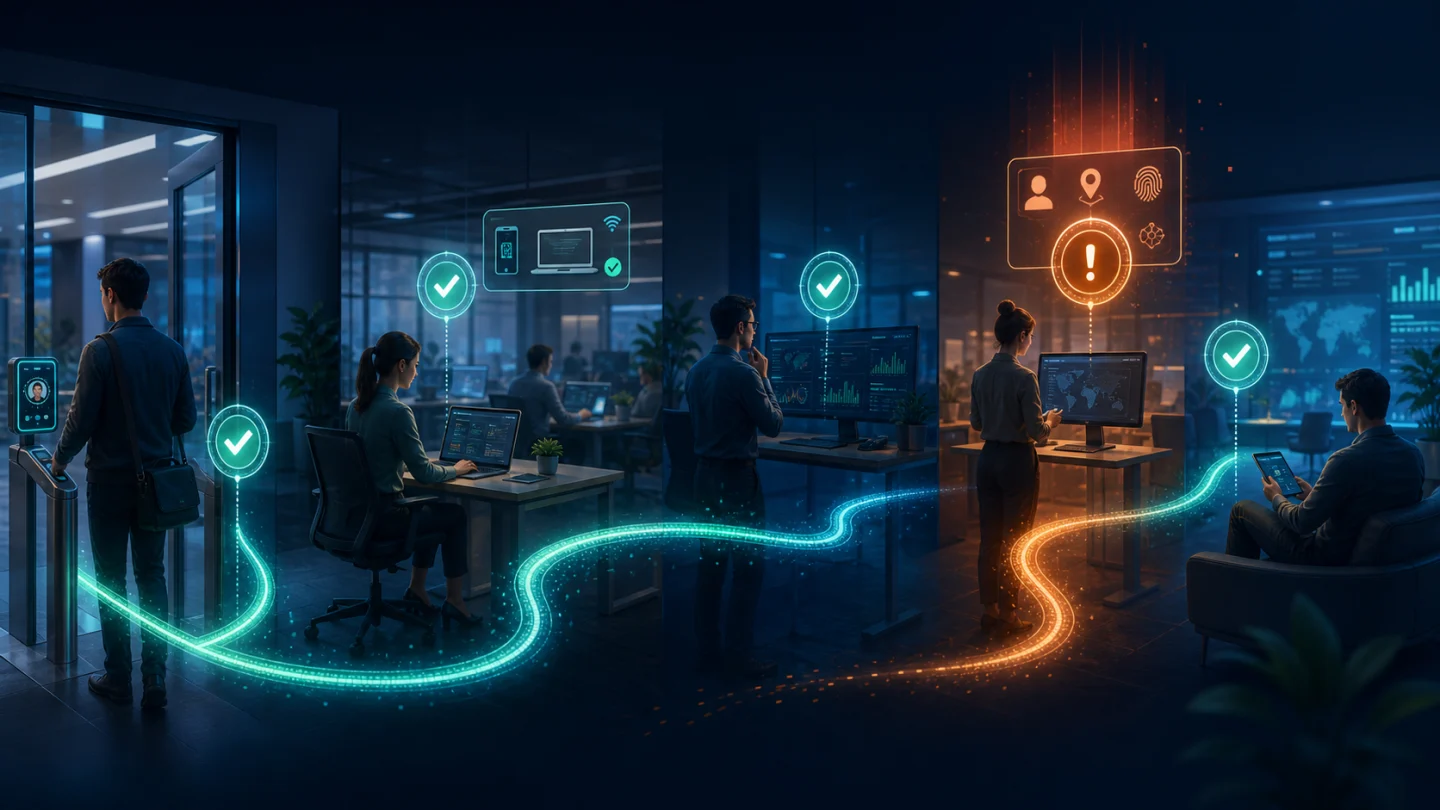
The TechRadar article describes the rise of continuous trust models.
Rather than making a single security decision at login, these approaches continually evaluate context and behavior.
For example, suppose an employee normally:
Works from Miami
Logs in between 8:00 a.m. and 6:00 p.m.
Uses three specific applications
Accesses particular datasets
Performs predictable business functions
Now the account suddenly:
Connects from an unusual environment
Accesses an unfamiliar application
Requests sensitive information
Changes security settings
Attempts privileged operations
Each action individually might be technically permissible.
Together, however, they may tell a different story.
The TechRadar article describes how behavioral analytics and machine learning can help identify deviations from established patterns and recognize situations in which activity no longer aligns with the expected identity.
This is an important security layer.
But there's another part of the identity problem that deserves equal attention.
We Shouldn't Wait Until After Login to Question Identity
Continuous monitoring helps answer:
“Does this authenticated identity continue to behave like the legitimate user?”
That's important.
But we should also improve what happens during authentication itself.
Because the stronger our confidence at the beginning of the relationship, the better our starting point becomes.
This means moving beyond:
Username + Password = Identity
and even beyond implementations that amount to:
Username + Password + Approve Button = Identity
Modern authentication should establish greater confidence in:
The person
The device
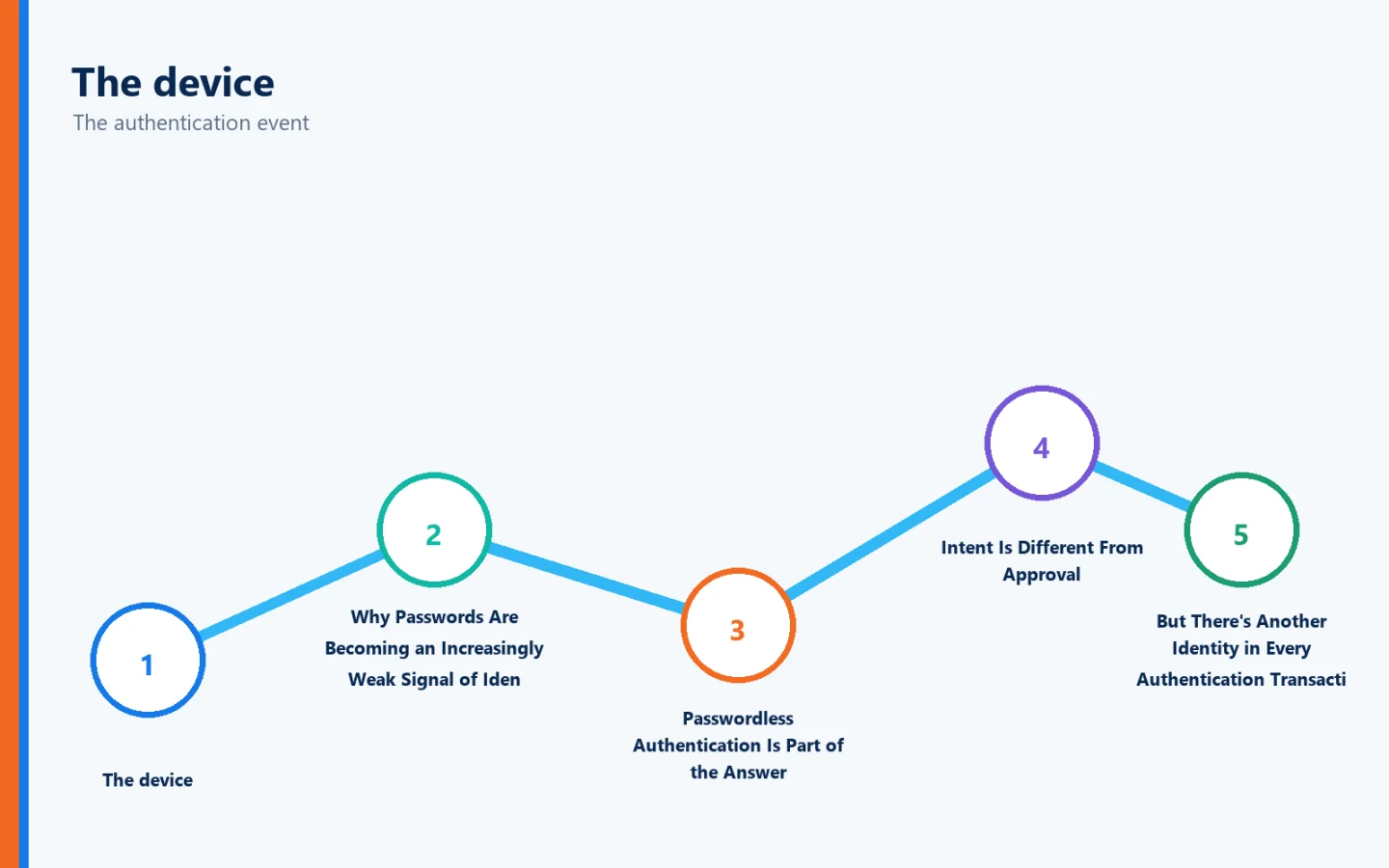
The authentication event
The user's intent
and, importantly:
The destination.
Why Passwords Are Becoming an Increasingly Weak Signal of Identity
A password doesn't prove identity.
It proves knowledge of a secret.
Those aren't the same thing.
If I know your password, a conventional authentication system may treat me as you.
That's precisely why stolen credentials are so valuable.
And adding MFA improves security significantly—but the strength depends heavily on the method being used.
Attackers have developed techniques including:
MFA fatigue
Push bombing
Social engineering
SIM swapping
Adversary-in-the-middle phishing
Session-token theft
Fake authentication portals
The authentication industry therefore needs to ask a more fundamental question:
How do we establish identity without depending so heavily on reusable secrets?
Passwordless Authentication Is Part of the Answer
Passwordless authentication changes the equation by removing the conventional password from the authentication process.
Instead of proving identity through something the user remembers and types, authentication can involve:
Something the user has
such as a trusted device,
combined with:
Something the user is
such as a fingerprint or facial biometric.
That means passwordless authentication can still provide multiple authentication factors.
It simply eliminates the reusable password.
For attackers, that's important.
You can't steal a password that doesn't exist.
But eliminating the password alone doesn't solve every identity problem.
Intent Is Different From Approval
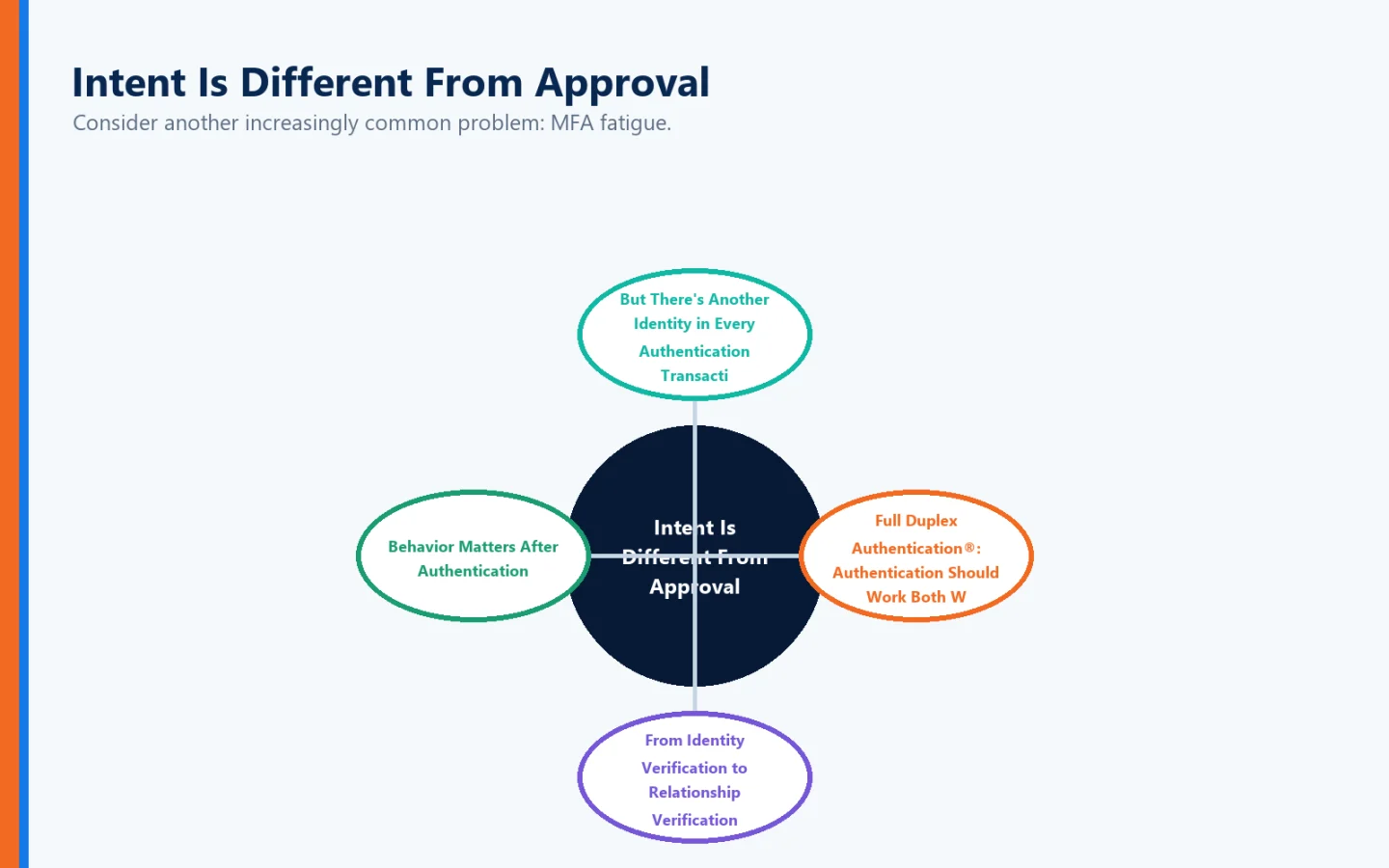
Consider another increasingly common problem: MFA fatigue.
An attacker already has a user's credentials and repeatedly generates authentication requests.
The employee's phone displays:
Approve?
Again.
And again.
And again.
Eventually, the attacker hopes the employee will approve one through confusion, distraction, or frustration.
This demonstrates an important distinction:
Approval isn't necessarily intent.
Identité addresses this differently.
Rather than relying solely on an unexplained Approve/Deny prompt, an authentication experience can explicitly ask:
“Did you request this authentication session?”
On that same screen, Identité can also present an image and three-digit number providing additional authentication context.
The goal is to move the user away from:
See prompt → Tap approve
toward:
Look → Confirm intent → Authenticate
That matters because the user isn't simply being asked:
“Will you approve this?”
They're being asked:
“Did YOU initiate this authentication event?”
But There's Another Identity in Every Authentication Transaction
This is where the identity conversation becomes particularly interesting.
We spend enormous amounts of time asking:
“Is this really the user?”
But there's another participant in the authentication relationship.
The website.
The application.
The service.
The destination.
Why aren't we equally concerned about establishing its identity?
Attackers don't only impersonate employees.
They impersonate:
Banks
Healthcare portals
Microsoft 365
Corporate applications
SaaS platforms
Government services
VPN portals
E-commerce sites
A fraudulent website can reproduce almost everything users depend on visually to determine legitimacy.
The logo.
The fonts.
The colors.
The login screen.
The company name.
Even the domain can be deceptively similar.
The user may authenticate successfully because they genuinely believe they're communicating with the legitimate organization.
The problem isn't that the user failed authentication.
The problem is that the destination was never required to authenticate itself.
Full Duplex Authentication®: Authentication Should Work Both Ways
This is the principle behind Identité's patented Full Duplex Authentication® (FDA).
Traditional authentication primarily asks:
“Are you the legitimate user?”
Full Duplex Authentication® adds:
“Is this the legitimate destination?”
Both sides participate in establishing trust.
The user authenticates.
The legitimate destination authenticates.
That's mutual authentication.
An imposter website may be able to duplicate the appearance of a legitimate organization.
But copying appearance doesn't make the imposter cryptographically or authentically equivalent to the legitimate destination.
This creates a fundamentally different trust relationship.
From Identity Verification to Relationship Verification
This distinction becomes even more powerful when combined with the central argument in the TechRadar article.
The future of identity security isn't merely:
Authenticate harder.
It's:
Establish more meaningful trust.
Consider the questions a modern authentication architecture should address:
Is this the authorized user?
Is this the authorized device?
Did the user actually initiate this authentication session?
Is this the legitimate destination?
And after access has been granted:
Does the subsequent activity continue to make sense?
Now we're moving from a single authentication event toward something much broader:
A trusted relationship.
Behavior Matters After Authentication
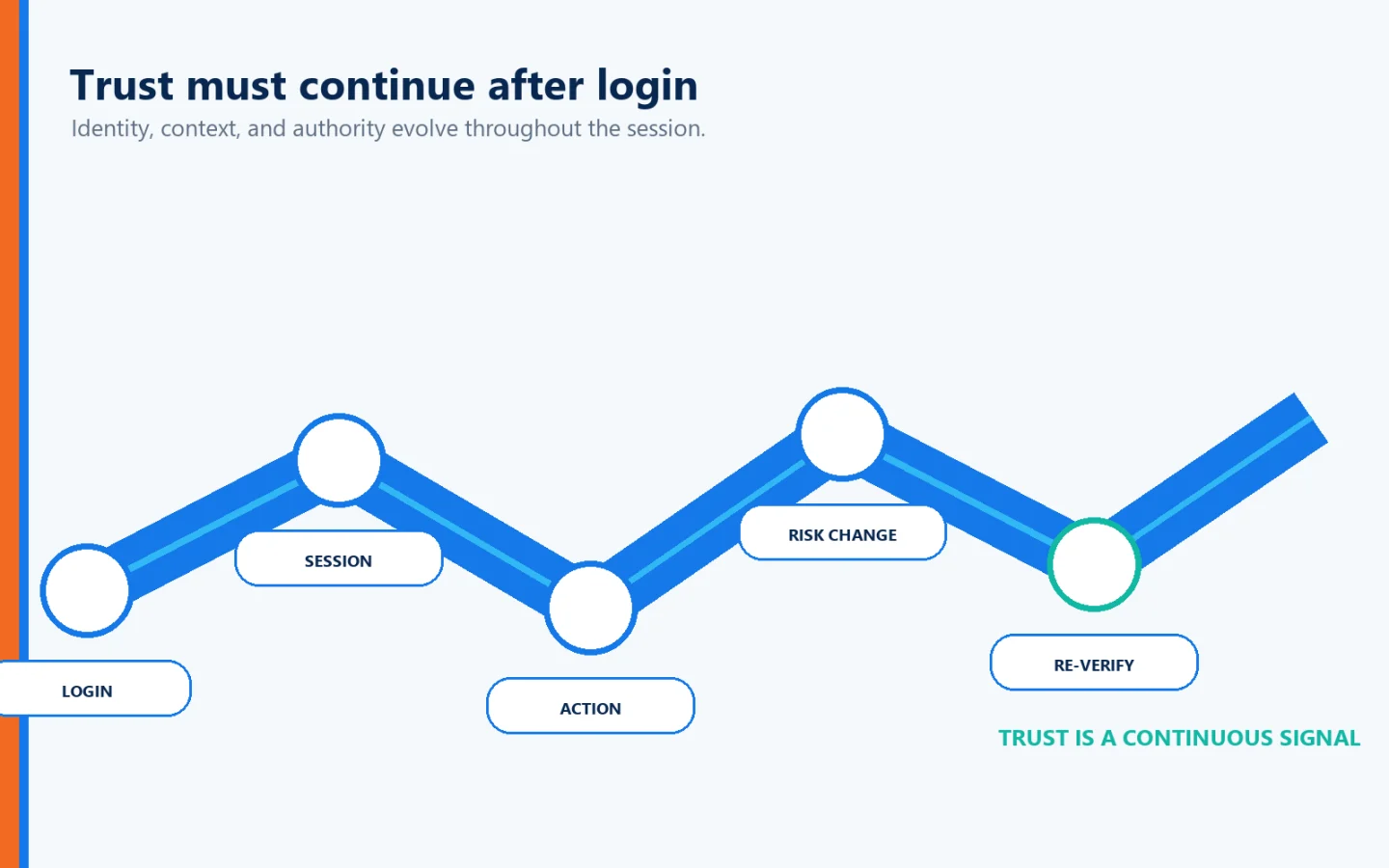
This is where the TechRadar article's emphasis on behavioral intelligence becomes especially important.
Even strong authentication can't guarantee that every subsequent action remains legitimate.
Accounts change.
Devices can be compromised.
Sessions can potentially be hijacked.
Privileges change.
Employees change roles.
Risk changes.
The article argues that identity should be understood as a living system rather than a static credential database.
That's a particularly useful concept.
Identity isn't simply:
Username: Jane Smith
**Password: **********
MFA: Passed
Identity exists within context.
What does Jane normally access?
What is Jane authorized to do?
What device does she normally use?
What application is she accessing?
What action is she attempting?
Does the activity correspond with her role?
Does the transaction make sense?
Modern identity security increasingly needs to combine strong authentication at entry with intelligent evaluation afterward.
Decentralized Biometrics Can Strengthen Identity Without Creating Another Centralized Target
Biometrics can significantly improve authentication convenience and confidence.
But biometrics introduce an important privacy question:
Where is the biometric data stored?
Identité uses a decentralized architecture designed so biometric information remains on the user's trusted device.
The biometric doesn't need to be sent to Identité or stored in a centralized Identité biometric repository for matching.
The user's biometric stays on the user's device.
That's important because biometric information is fundamentally different from a password.
If a password is compromised, you can change it.
You cannot issue yourself a new fingerprint.
Avoiding unnecessary centralized biometric repositories can therefore provide an important security and privacy advantage.
PasswordFree®: SaaS Passwordless Authentication

Identité's PasswordFree® is our SaaS passwordless authentication solution.
PasswordFree® is designed around capabilities including:
Passwordless authentication
Patented Full Duplex Authentication®
Mutual authentication
Trusted-device authentication
Decentralized biometric verification
Authentication intent
Contextual authentication
Emergency PIN Authentication
Secure Backup & Restore
Compatible third-party authentication options
The objective isn't simply to remove the password.
It's to increase confidence in the authentication relationship while reducing unnecessary friction for legitimate users.
NoPass™: Enterprise Authentication With Deployment Control
For enterprises requiring deeper integration and control, Identité offers NoPass™, our PaaS solution powered by patented Full Duplex Authentication®.
NoPass™ can be deployed on premises or in the cloud and supports enterprise environments involving:
Microsoft Active Directory
Microsoft Entra ID
Microsoft 365 / Office 365
Microsoft Azure
This flexibility can be particularly valuable to:
Financial institutions
Healthcare organizations
Government agencies
Regulated enterprises
Organizations with strict data-control requirements
For organizations such as banks that prefer to retain authentication infrastructure within their own controlled environment, NoPass™ can be deployed on premises.
What Happens When the Trusted Device Is Lost?
A modern identity architecture also has to address recovery.
Phones get lost.
Phones break.
Phones get replaced.
Employees forget them.
A strong authentication system can't simply be secure when everything works perfectly.
Identité provides Emergency PIN Authentication, subject to organizational policy, as an alternative when the user's primary device isn't available.
Identité also provides Secure Backup & Restore, allowing the authentication profile to be backed up to approved cloud or corporate-network infrastructure according to organizational configuration.
If the phone needs to be replaced, the user's authentication environment can be restored to the new device in less than two minutes.
Strong identity security needs strong identity recovery.
Identity Is Becoming the New Security Perimeter
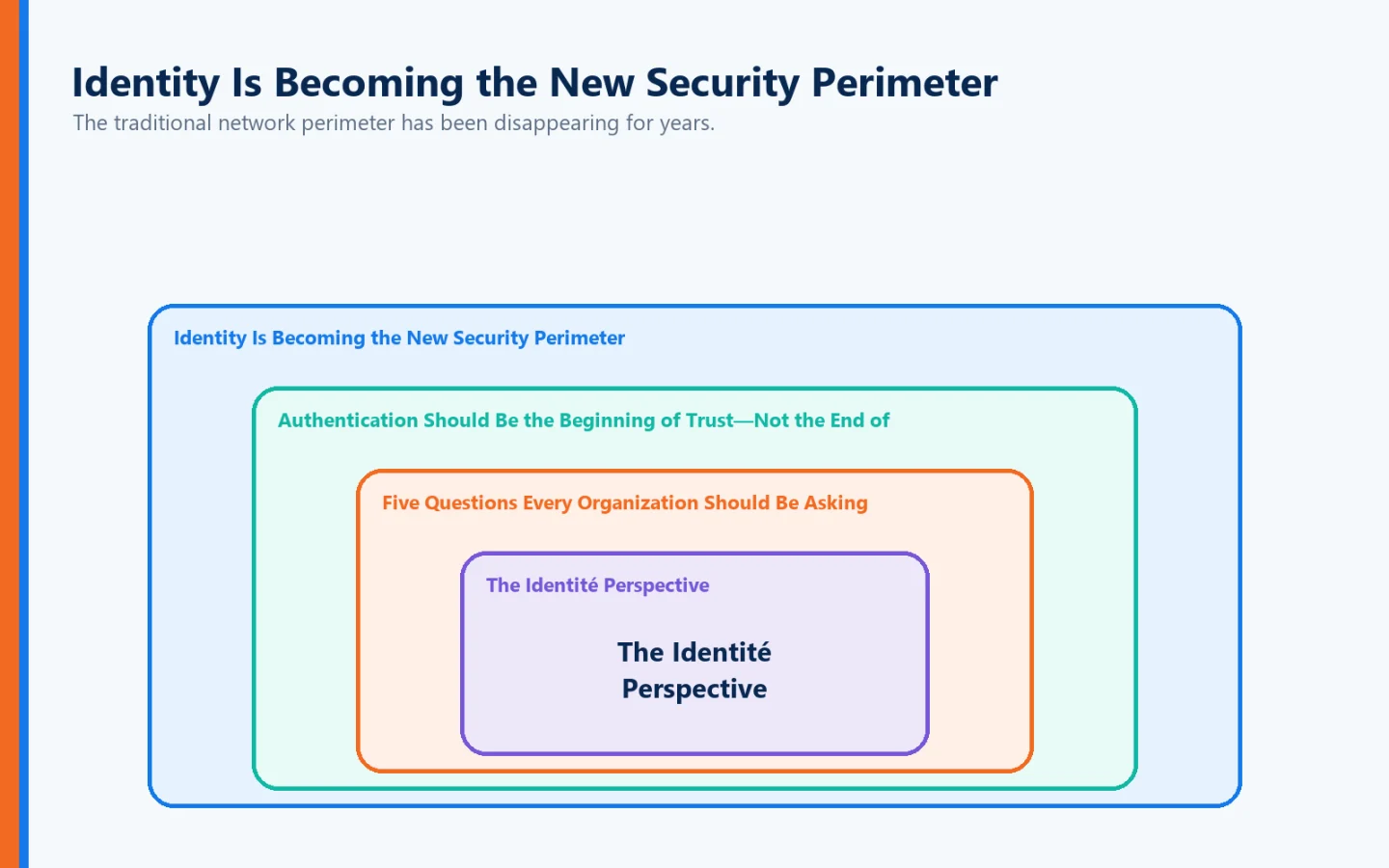
The traditional network perimeter has been disappearing for years.
Employees work remotely.
Applications live in the cloud.
Data exists across multiple environments.
Contractors connect from outside the corporate network.
Customers access services globally.
SaaS applications interact with other SaaS applications.
AI agents are beginning to perform activities previously performed only by people.
So where is the perimeter?
Increasingly:
Identity is the perimeter.
And if identity is the perimeter, authentication cannot be treated as a routine login function.
It becomes part of the organization's core cybersecurity architecture.
Authentication Should Be the Beginning of Trust—Not the End of Security
Perhaps the most important statement in the TechRadar article comes at its conclusion:
Authentication should be viewed as the beginning of the security conversation, not its conclusion.
That's exactly right.
But we can take the idea one step further.
Trust shouldn't simply be continuous.
It should also be mutual.
At authentication:
Verify the user.
Verify the device.
Establish intent.
Verify the destination.
After authentication:
Evaluate behavior.
Monitor risk.
Limit privilege.
Reevaluate trust when circumstances change.
That's a much more complete identity-security model.
Five Questions Every Organization Should Be Asking
As identity becomes increasingly central to cybersecurity, organizations should reconsider what "authenticated" actually means.
Are we authenticating a person—or merely verifying that someone possesses the correct credentials?
Can stolen passwords, tokens, or sessions allow attackers to impersonate legitimate users?
Do users consciously establish intent when authenticating, or are they conditioned to press Approve?
Are we authenticating the destination as well as the user?
After authentication, do we continue evaluating whether the activity still makes sense?
If an organization's entire identity strategy ends with:
Login successful
then its security model may be ending precisely where the modern identity-security problem begins.
The Identité Perspective
The TechRadar article makes an important argument:
Trust can no longer begin and end at login.
We agree.
But the evolution of authentication should address both what happens during authentication and what happens afterward.
At Identité, our approach begins by trying to establish stronger trust at the authentication event itself.
The biometric can help establish:
“I am the authorized user.”
The trusted device participates in establishing:
“This is the authorized device.”
Contextual authentication can ask:
“Did I initiate this authentication session?”
The image and three-digit number provide additional context.
Patented Full Duplex Authentication® addresses:
“Is this the legitimate destination?”
And after authentication, organizations can complement that stronger starting point with Zero Trust principles, least privilege, behavioral analytics, continuous monitoring, and risk-based controls.
The future of cybersecurity isn't simply about building higher walls.
Attackers increasingly don't need to climb over them.
They walk through the front door pretending to be someone we already trust.
That's why identity security needs to evolve from:
Credentials → Identity
to:
Identity → Intent → Context → Mutual Trust → Continuous Trust
Because in today's threat environment, the most dangerous attacker may not look like an intruder at all.
They may look exactly like an authenticated user.