




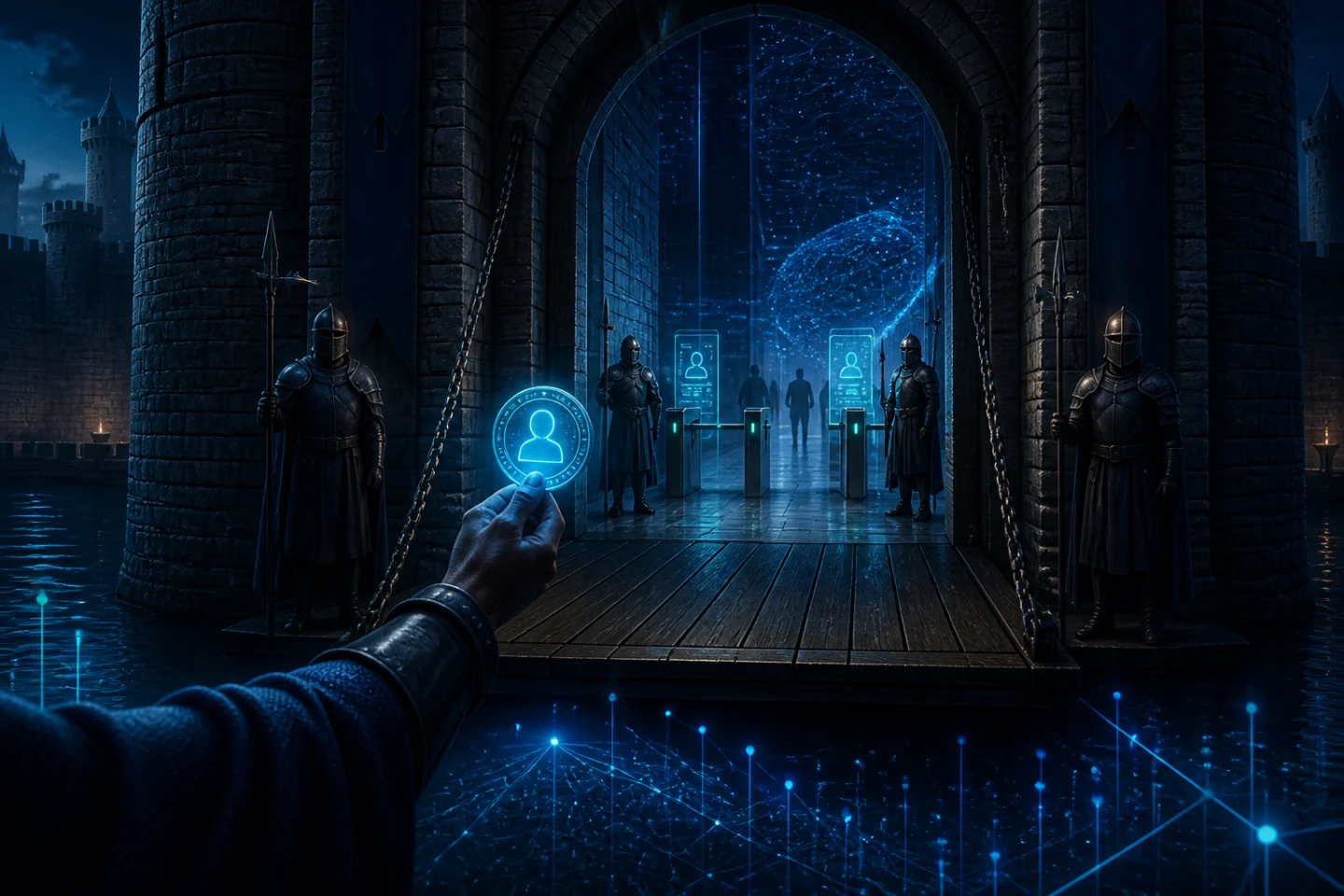
For all our extraordinary advances in technology, sometimes I wonder whether cybersecurity has advanced as much as we think it has.
We have artificial intelligence.
Cloud computing.
Biometrics.
Zero Trust.
Massive global networks.
Sophisticated encryption.
Endpoint detection.
Firewalls capable of analyzing enormous amounts of traffic.
Security operations centers monitoring organizations around the clock.
Yet when I look at how many successful cyberattacks actually occur, I am reminded of something considerably less sophisticated:
A medieval castle.
Think about it.
Hundreds of years ago, protecting something valuable meant surrounding it with walls.
Make the walls higher.
Make them thicker.
Dig a moat.
Build towers.
Station guards.
Raise the drawbridge.
Control who comes through the gate.
The basic security assumption was simple:
The good guys are inside.
The bad guys are outside.
Sound familiar?
For decades, that was essentially our cybersecurity architecture.
We built the digital equivalent of the medieval castle.
The firewall became the castle wall.
Network segmentation became the moat.
Intrusion detection became the watchtower.
Security operations became the guards.
Credentials became the keys.
Authentication became the gatekeeper.
And our security strategy remained remarkably similar:
Keep the enemy outside the walls.
There was just one problem with the medieval castle.
There is exactly the same problem today.
What happens when someone opens the gate?
The Enemy Doesn't Need to Scale the Wall
Imagine the strongest castle in medieval Europe.
Twenty-foot stone walls.
A deep moat.
Armed guards.
Watchtowers.
A massive front gate.
A drawbridge.
Perhaps the enemy spends months attempting to find a way inside.
Then someone realizes something.
Why attack the wall?
Why cross the moat?
Why fight the guards?
Why break down the gate?
Find someone who has the key.
Better yet, convince someone inside to lower the drawbridge.
Maybe the person does it deliberately.
Maybe they are bribed.
Maybe they are threatened.
Maybe they are deceived.
Maybe they genuinely believe the person standing outside belongs inside.
The result is the same.
The castle's defenses remain completely intact.
The walls weren't breached.
The gate wasn't destroyed.
The guards weren't defeated.
Someone simply opened the door.
Welcome to cybersecurity in 2026.
Attackers Increasingly Log In Rather Than Break In
Today's attackers have discovered the same principle.
Why spend enormous effort attacking sophisticated infrastructure if you can obtain an employee's credentials?
Steal a password.
Capture a session.
Phish an employee.
Trigger repeated MFA requests.
Impersonate the help desk.
Convince someone to reset an account.
Steal an authentication token.
Trick a user into authenticating through a fraudulent website.
The attacker hasn't necessarily defeated the castle.
Someone lowered the digital drawbridge.
And once the attacker presents credentials or a session that the organization accepts, something dangerous happens.
The attacker can begin to look like one of the good guys.
That changes the security problem fundamentally.
We Keep Building Higher Walls
Cybersecurity's response to this problem has often been predictable.
The wall wasn't high enough. Build it higher.
The password wasn't strong enough. Make it more complicated.
Passwords were stolen. Add another factor.
Two-factor authentication was defeated. Add additional factors.
MFA became vulnerable to phishing, fatigue attacks, session theft and social engineering.
Add another challenge.
Another security control.
Another verification step.
Another policy.
Another layer.
There is absolutely value in defense in depth.
MFA remains far better than relying on passwords alone.
But eventually we have to ask:
How high are we going to build the castle walls before acknowledging that the enemy increasingly isn't climbing them?
They're convincing someone to open the gate.
The Guard Has Become the Target
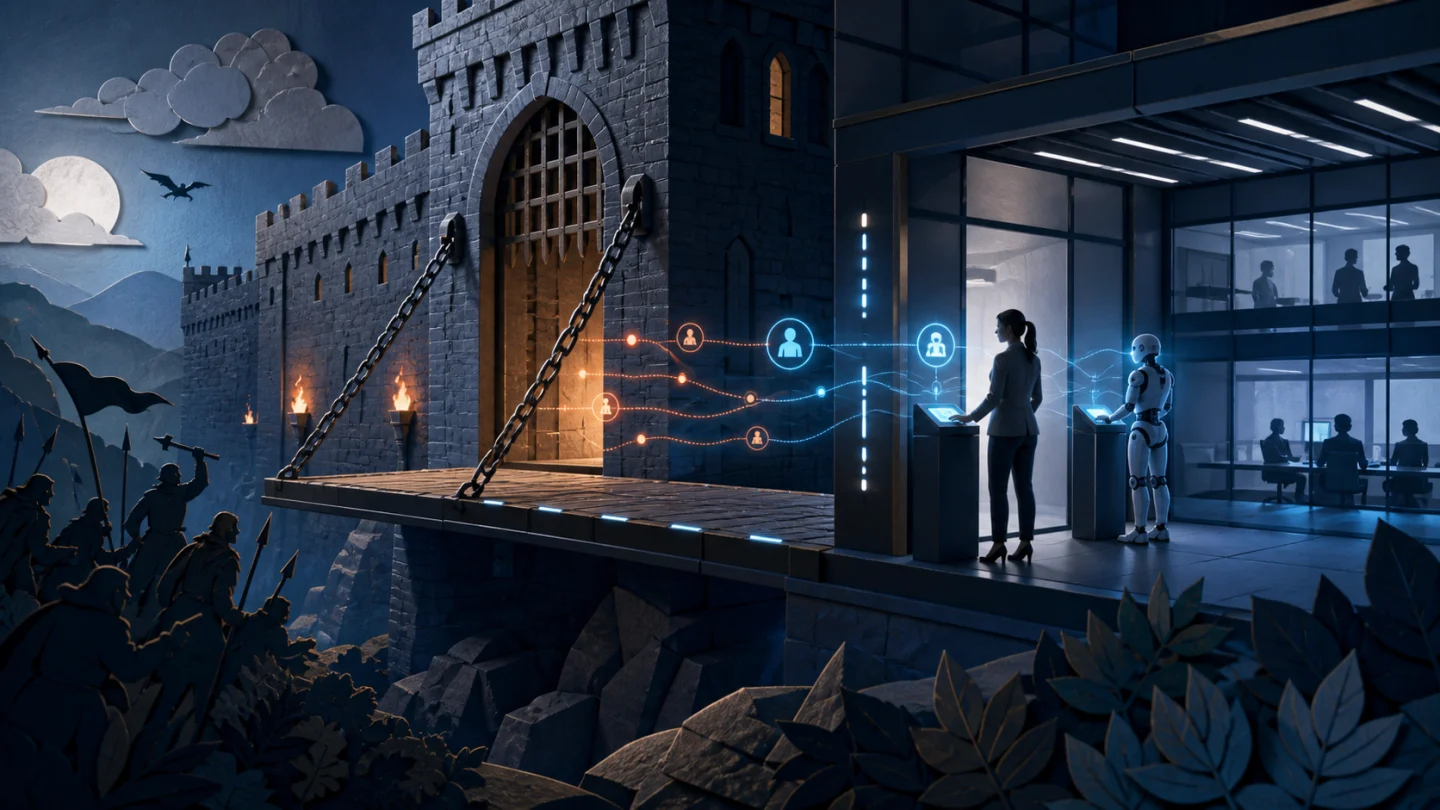
In the Middle Ages, an intelligent enemy didn't necessarily attack the strongest part of the castle.
They looked for the weakest point.
A poorly defended entrance.
A sympathetic insider.
A corrupt guard.
Someone with access.
Someone who could be deceived.
Someone who could be persuaded.
The same principle applies today.
Except today's attacker has a weapon King Arthur never imagined:
Artificial intelligence.
AI can help attackers create convincing phishing emails.
Personalized messages.
Realistic business communications.
Impersonation attempts.
Fraudulent websites.
Social-engineering campaigns.
And these techniques can increasingly be created at enormous speed and scale.
AI has not eliminated the medieval security problem.
It has made the enemy much better at convincing the guard to lower the drawbridge.
That's an important distinction.
The attacker may not need to defeat our technology.
They need to defeat our trust.
The Castle Wall Is No Longer Where the Castle Ends
There is another reason the medieval model is becoming increasingly inadequate.
Imagine if King Arthur's castle walls suddenly stretched across the entire kingdom.
Some knights worked from home.
Some of the treasury was stored in another kingdom.
The armory was operated by a third party.
The castle records were maintained somewhere else.
Merchants connected directly to internal castle operations.
Citizens entered through thousands of different doors.
And important activities were conducted by automated servants who never slept.
At that point, where exactly is the castle?
That is essentially what has happened to the modern enterprise.
Employees work remotely.
Applications reside in the cloud.
Customers connect from mobile devices.
Partners access corporate systems.
APIs connect applications.
SaaS platforms contain critical information.
Infrastructure can span multiple cloud providers.
AI agents are beginning to act on behalf of employees and organizations.
The castle walls haven't merely expanded.
In many environments, they have effectively disappeared.
So what becomes the new control point?
Identity.
When location no longer tells us whether someone should be trusted, identity becomes increasingly important.
Who are you?
Can you prove it?
What are you allowed to access?
What are you attempting to do?
Did you actually request this action?
Does this activity make sense?
And increasingly:
Are you actually communicating with the castle you intended to reach?
What If the Castle Itself Is Fake?
Now our medieval analogy becomes even more interesting.
Imagine a messenger is traveling to King Arthur's castle carrying valuable information.
In the distance, he sees the familiar banners.
The guards are dressed correctly.
The gate looks right.
The person greeting him claims to represent the king.
So the messenger hands over the information.
There is only one problem.
It wasn't King Arthur's castle.
Today we call that phishing.
A fraudulent website can reproduce a company's logo.
Its colors.
Its language.
Its authentication page.
Its branding.
Its customer-service experience.
A lookalike domain may differ from the legitimate domain by only a character.
And AI is making digital impersonation increasingly convincing.
Yet traditional authentication concentrates overwhelmingly on proving one party:
The user.
The password asks:
"Are you really you?"
2FA asks the user to prove it again.
MFA asks the user to provide multiple proofs.
But who proves the castle is actually the castle?
This Is the Problem With One-Way Authentication
Imagine our medieval guard saying:
"Prove you are really the king's messenger."
The messenger presents his credentials.
The guard is satisfied.
But the messenger never asks:
"Can you prove that you actually represent the king?"
That is essentially the weakness of one-way authentication.
The user keeps proving themselves to the destination.
But the legitimacy of the destination may largely be assumed.
That assumption becomes increasingly dangerous in an era of phishing, lookalike domains and AI-assisted impersonation.
At Identité, we believe this trust relationship needs to change.
Full Duplex Authentication® Makes Both Sides Prove Who They Are
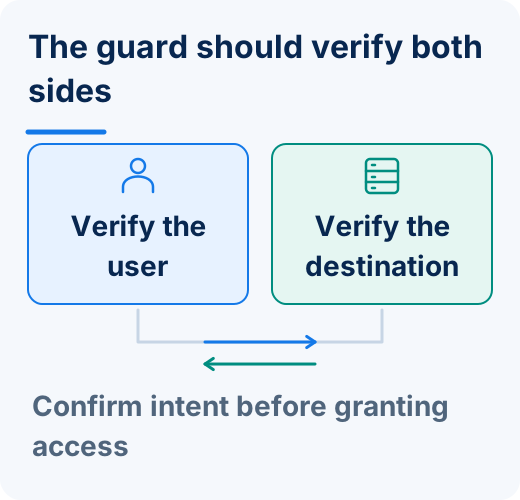
Identité's patented Full Duplex Authentication® is based on mutual authentication.
Instead of:
User → Destination
we establish trust in both directions:
User ↔ Legitimate Destination
The user participates in establishing legitimacy.
The legitimate destination participates in establishing legitimacy.
Both sides matter.
Return to our castle.
The guard establishes:
"You are really the authorized messenger."
But the messenger also establishes:
"You really represent the king."
Now we have something much more powerful than a one-sided trust decision.
We have mutual trust.
That distinction becomes increasingly important as attackers become better at impersonating legitimate destinations.
A fraudulent website can steal the organization's coat of arms.
It can fly the same flag.
It can build an identical-looking gate.
But appearance does not establish identity.
The Guard Should Also Ask: "Did You Request This?"
There is another weakness in today's authentication model that our castle analogy helps explain.
Imagine someone repeatedly approaches the guard saying:
"The king told you to open the gate."
The guard says no.
Ten minutes later:
"The king told you to open the gate."
No.
Again. Again. Again.
Eventually the guard becomes frustrated, distracted or confused.
Then someone claiming to represent the king says:
"Yes, this is legitimate. Just open the gate so these requests stop."
The guard opens it.
That's remarkably similar to MFA fatigue.
The problem isn't necessarily that the security technology failed.
The person was manipulated.
This is why authentication should establish intent.
At Identité, rather than simply presenting a generic:
"Approve?"
the authentication experience can explicitly ask:
"Did you request this authentication session?"
An image and three-digit number can provide additional context on the same screen.
The objective isn't another security obstacle.
It is to make the guard think before lowering the drawbridge.
Getting Through the Gate Shouldn't Give You the Keys to the Castle
Now we reach perhaps the most important extension of our medieval analogy.
Suppose a visitor legitimately enters the castle.
Their identity has been verified.
They belong there.
Should the guard immediately hand them the keys to:
The treasury?
The armory?
The king's chambers?
The dungeon?
The food stores?
Every private room in the castle?
Of course not.
Yet this is essentially what organizations risk doing when they concentrate on authentication while neglecting authorization.
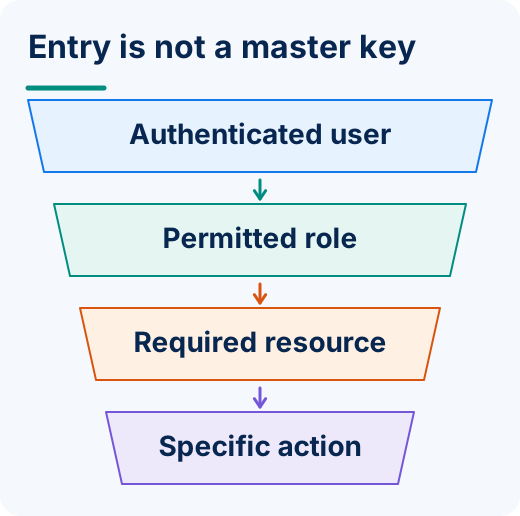
Authentication answers:
"Are you permitted to enter the castle?"
Authorization answers:
"Now that you're inside, which doors are you permitted to open?"
That distinction is critical.
Authentication Is Only the Beginning
Consider an employee.
The employee successfully authenticates.
That does not mean the employee should have access to every corporate system.
A finance employee may need access to financial information.
That doesn't mean they should have access to unrelated medical or personnel records.
An administrator may require significant privileges.
That doesn't necessarily mean unlimited authority everywhere.
A contractor may legitimately need access to one application.
That does not mean the contractor should receive the keys to the entire kingdom.
Authentication establishes identity.
Authorization establishes boundaries.
That is what prevents one compromised identity from becoming the equivalent of someone opening every door in the castle.
Banking Makes the Difference Obvious
Imagine the castle treasury is today's bank account.
The customer authenticates. The gate opens.
They check their balance. No unnecessary additional security.
They review transactions.
Again, allow the experience to remain simple.
They transfer a small amount between their own accounts.
If policy permits, no reason to create unnecessary friction.
Then the customer attempts to wire $10,000 to a new recipient.
The person hasn't necessarily changed.
But the action has.
Suppose the bank establishes a policy requiring additional authorization for wire transfers exceeding $1,000.
The authorization process can automatically be invoked.
The bank is no longer asking:
"Are you really the customer?"
That was authentication.
Now it asks:
"Do you authorize this specific transaction?"
That is authorization.
In medieval terms:
You may enter the castle, but opening the treasury requires additional authority.
Suddenly, authentication and authorization become very easy to distinguish.
Zero Trust Is Really About Not Handing Everyone Every Key
This is where Zero Trust becomes easier to understand too.
Zero Trust sometimes sounds complicated.
It doesn't have to be.
Imagine telling the castle guard:
Don't assume someone should have access simply because they are already inside the walls.
Verify who they are.
Determine what they need.
Give them only the keys required for their role.
If they suddenly attempt to enter somewhere unusual, reevaluate.
If they request access to the treasury, apply stronger controls.
If circumstances change, reconsider the trust decision.
That is essentially Zero Trust.
Or put another way:
Being inside the castle doesn't make you the king.
That principle is as relevant to cybersecurity today as it would have been hundreds of years ago.
Least Privilege Means Stop Handing Out Master Keys
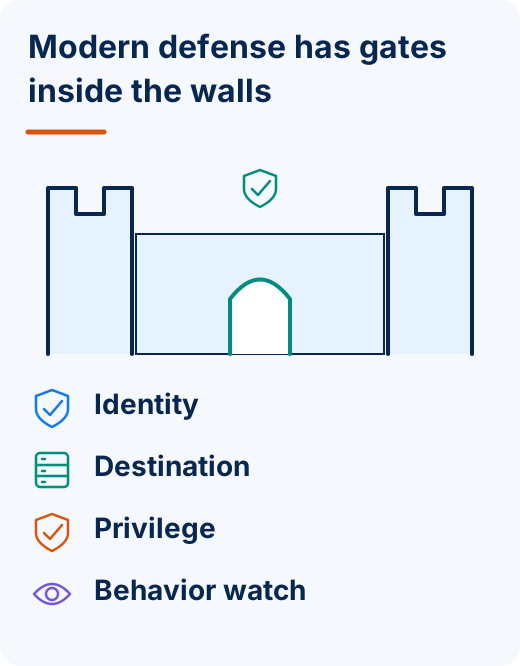
Least privilege becomes equally easy to understand through the castle analogy.
A cook needs access to the kitchen.
Give the cook the kitchen key.
A guard needs access to the armory.
Give the guard appropriate access.
The treasurer needs access to financial records.
Give the treasurer what is necessary.
But don't give everyone a master key simply because creating individual permissions is inconvenient.
Modern enterprises sometimes accumulate privileges over years.
Employees change roles.
Contractors receive temporary access that isn't removed.
Service accounts receive broad permissions.
Applications inherit privileges.
Administrative credentials spread.
Eventually the organization has a castle full of people carrying far more keys than they need.
Then one identity becomes compromised.
And the attacker inherits the keys.
That is why authorization and least privilege become so important when identity is the primary attack surface.
SMBs Have Smaller Castles, Not Smaller Problems
This issue is particularly important for small and midsize businesses.
A smaller castle doesn't mean the enemy isn't interested.
It may mean there are fewer guards.
Large enterprises can maintain sophisticated security operations centers, identity teams, threat hunters and incident-response capabilities.
SMBs often cannot.
Yet they possess valuable assets.
Customer information.
Financial information.
Medical information.
Intellectual property.
Employee identities.
Business systems.
Access to larger partners.
A smaller company may also become the attacker's side entrance into a much larger enterprise.
That makes identity security particularly important for the midmarket.
The attacker doesn't care that your castle is smaller.
They care whether someone inside can open a door they want to enter.
Security Is No Longer an Optional Castle Improvement
Organizations once treated some cybersecurity spending almost like improving the castle next year.
Fix the east wall when the budget permits.
Hire another guard next year.
Upgrade the gate eventually.
That mentality becomes dangerous when identity is the attack path.
Identity security is no longer a discretionary project that organizations should address after every other technology priority has been funded.
Because the identity determines who gets inside.
And increasingly, identity determines what they can do once they get there.
Identity is part of the operating infrastructure of the business.
The budget should reflect that reality.
Now We Are Giving Keys to Machines

And just when we thought managing human identities was difficult enough, we introduced something King Arthur definitely didn't have to worry about.
Machine identities.
Applications have identities.
Services have identities.
APIs have identities.
Workloads have identities.
Automated processes have identities.
And increasingly: AI agents have identities.
Imagine our castle suddenly employing thousands of mechanical servants.
They never sleep.
They can move at extraordinary speed.
Some can enter the treasury.
Some can access records.
Some communicate with other castles.
Some purchase supplies.
Some execute transactions.
Some can instruct other mechanical servants.
Now ask:
Who gave them the keys?
Which doors can they open?
How long do they keep those keys?
What actions can they perform?
Can they give their authority to another machine?
What happens if one is compromised?
Who authorized the machine to act in the first place?
Welcome to the emerging machine identity problem.
AI Agents Should Not Receive the Master Key
Imagine an AI agent working in accounts payable.
The agent analyzes invoices.
It verifies information.
It prepares payments.
That could create enormous productivity.
But should that AI agent have permanent authority to transfer unlimited amounts of money?
Absolutely not.
Perhaps the AI agent can process routine transactions within predefined limits.
Perhaps it can prepare a $50,000 payment.
But executing that payment requires authorization from an accountable human.
Perhaps the agent receives access to an application only while performing a specific approved task.
When the task ends, the access expires.
That gives us another extremely simple principle:
Authenticate the machine. Authorize the action. Limit the keys.
The same rules we should have applied to the inhabitants of the castle now need to apply to machines.
Machine Speed Makes a Stolen Key More Dangerous
There is another important difference.
A compromised human identity can cause enormous damage.
A compromised machine identity may cause damage at machine speed.
An AI agent doesn't need to sleep.
It doesn't take lunch.
It can potentially make thousands of requests.
It can interact with multiple systems.
It may communicate with other agents.
If the agent possesses excessive privilege, the consequences of compromise can escalate extremely quickly.
So the old medieval security principle becomes even more important:
Don't give anyone more keys than they need.
And when possible:
Take the key back when the job is finished.
PasswordFree®: Stop Depending on Keys Attackers Can Steal
This is also why we believe organizations need to reduce their dependence on traditional reusable credentials.
Identité's PasswordFree® is our SaaS passwordless authentication solution.
The objective is not simply eliminating an annoying password.
It is moving beyond dependence on credentials that can be stolen, shared, reused or phished.
PasswordFree® incorporates capabilities including patented Full Duplex Authentication®, trusted-device authentication, decentralized biometric verification, authentication intent, contextual authentication, Emergency PIN Authentication and Secure Backup & Restore.
Biometric verification occurs on the user's trusted device.
The biometric does not need to leave that device or reside in a centralized Identité biometric repository for matching.
Think of it this way:
Instead of giving everyone a key that can potentially be copied, we establish greater confidence in the person actually standing at the gate.
NoPass™: Strengthening the Castle You Already Have
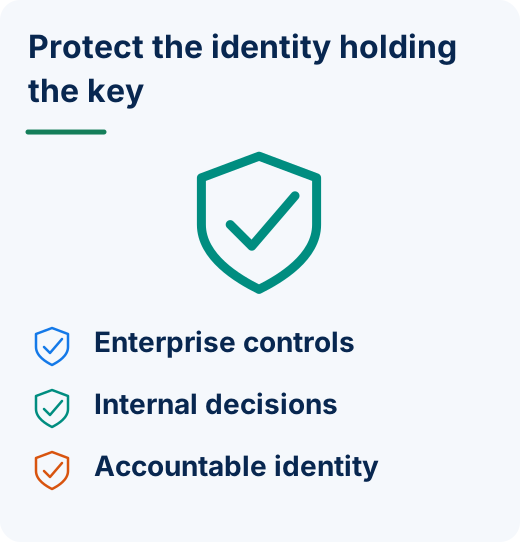
Enterprises do not necessarily need to demolish their existing castle to improve security.
Identité's NoPass™ is our PaaS solution powered by patented Full Duplex Authentication®.
NoPass™ can be deployed on premises or in the cloud and can support enterprise environments involving Microsoft Active Directory, Microsoft Entra ID, Microsoft 365 / Office 365 and Microsoft Azure.
That means organizations can strengthen the identity and authentication architecture surrounding infrastructure they have already invested in.
For regulated organizations and enterprises that prefer to maintain authentication infrastructure within their own environment, NoPass™ can also be deployed on premises.
The objective isn't replacing every wall.
It is changing how trust is established at the gate and what authority exists after someone enters.
The Modern Castle Needs a Different Security Model
We still need walls.
We still need moats.
We still need guards.
In modern terms, organizations still need:
Firewalls.
Endpoint security.
Network segmentation.
Threat detection.
Monitoring.
Patching.
Encryption.
Incident response.
None of that disappears.
But none of it answers the most important question when the person approaching the gate possesses credentials the system believes are legitimate.
That's where identity takes over.
Modern security must establish:
Identity: Who is standing at the gate?
Authentication: Can they prove who they are?
Destination: Can the castle prove it is the legitimate castle?
Intent: Did the person actually request entry?
Authorization: Which doors may they open once inside?
Least Privilege: Do they possess only the keys they need?
Context: Does what they are doing make sense?
Continuous Verification: Has anything changed that should cause us to reconsider their access?
And now:
Machine Identity: Which automated entity is requesting access, who authorized it, what can it do, and for how long?
Put those elements together and we have something much stronger than another authentication layer.
Identity + Authentication + Authorization + Intent + Destination + Least Privilege + Context + Continuous Verification
We have a digital trust architecture.
The Irony of Modern Cybersecurity
There is something almost remarkable about all of this.
Humanity has progressed from medieval castles to cloud computing.
From horses to spacecraft.
From handwritten messages carried by riders to communications traveling around the world instantly.
We have computers capable of performing trillions of calculations.
Artificial intelligence can reason across enormous amounts of information.
Our organizations operate globally in real time.
Yet one of our most important security vulnerabilities remains remarkably familiar.
Hundreds of years ago:
The enemy wanted someone to lower the drawbridge.
Today:
The attacker wants someone to surrender an identity, approve a request or provide access.
The technology changed.
The fundamental trust problem did not.
The Identité Perspective: Protect the Identity Holding the Key
Perhaps we have spent too much time asking:
"How do we build a stronger castle?"
The better question may be:
"How do we make absolutely certain who is holding the keys?"
And then:
"Which keys should they actually have?"
That is the identity challenge confronting modern cybersecurity.
Protect the network. Absolutely.
Protect the endpoints.
Protect the applications.
Protect the cloud.
Build strong walls.
Dig deep moats.
Watch the perimeter.
But understand something our ancestors learned centuries ago:
The strongest wall in the world cannot protect you when the wrong person is allowed to open the gate.
That is why identity has become the new security control surface.
And why authentication alone is not enough.
Establish the identity.
Authenticate both sides.
Confirm intent.
Authorize the action.
Apply least privilege.
Control machine identities.
Continuously reevaluate trust.
And when the risk changes, change the security response.
Because the future of cybersecurity should not simply be about building higher walls.
It should be about making sure the enemy can never convince the wrong person, or machine, to lower the drawbridge.