





As identity and access management emerge as leading cloud security concerns, AI agents and machine identities are forcing organizations to rethink authentication, authorization, and Continuous Trust.
The Identity Was Legitimate. The Action Wasn't.
Imagine a financial institution that deploys an AI agent to help manage routine customer transactions.
The agent has a legitimate digital identity. It authenticates successfully, connects to approved cloud services, and operates within an established security environment.
Everything appears to be working as intended.
Then something changes.
The agent receives an instruction to initiate a transaction beyond its authorized limits. Perhaps the request comes from a compromised workflow, manipulated data, or an instruction that appears legitimate but exceeds the agent's intended responsibilities.
The agent still has valid credentials.
Its identity hasn't changed.
Its authentication hasn't failed.
Yet the action it is attempting may be entirely unauthorized.
The identity is legitimate. The action is not.
This is one of the fundamental challenges emerging as artificial intelligence, autonomous agents, and cloud computing become increasingly interconnected.
For years, cybersecurity professionals have focused on preventing unauthorized users from gaining access to systems.
That remains essential.
But what happens when the entity attempting an unauthorized action is already inside the environment, has authenticated successfully, and possesses legitimate permissions?
That is where the cloud security conversation needs to evolve.
Cloud Security Is Becoming an Identity Problem
In October 2026, Analytics Insight published an article examining the cloud security risks organizations should anticipate heading into 2027.
Among its findings was a particularly important development.
According to the Cloud Security Alliance's Top Threats to Cloud Computing Survey Report 2026, inadequate Identity and Access Management (IAM) now ranks as the leading cloud security concern.
The report, based on a survey of more than 500 security professionals, places IAM ahead of traditional concerns such as cloud misconfiguration and system vulnerabilities.
AI-enhanced attacks ranked second, while AI system compromise entered the rankings in sixth place.
These findings deserve attention.
Not because infrastructure vulnerabilities have disappeared. They haven't.
Misconfigured storage, insecure APIs, exposed credentials, third-party dependencies, and software vulnerabilities remain serious threats.
Rather, the rankings reflect how cloud environments have changed.
Today's cloud is no longer accessed primarily by employees signing into applications.
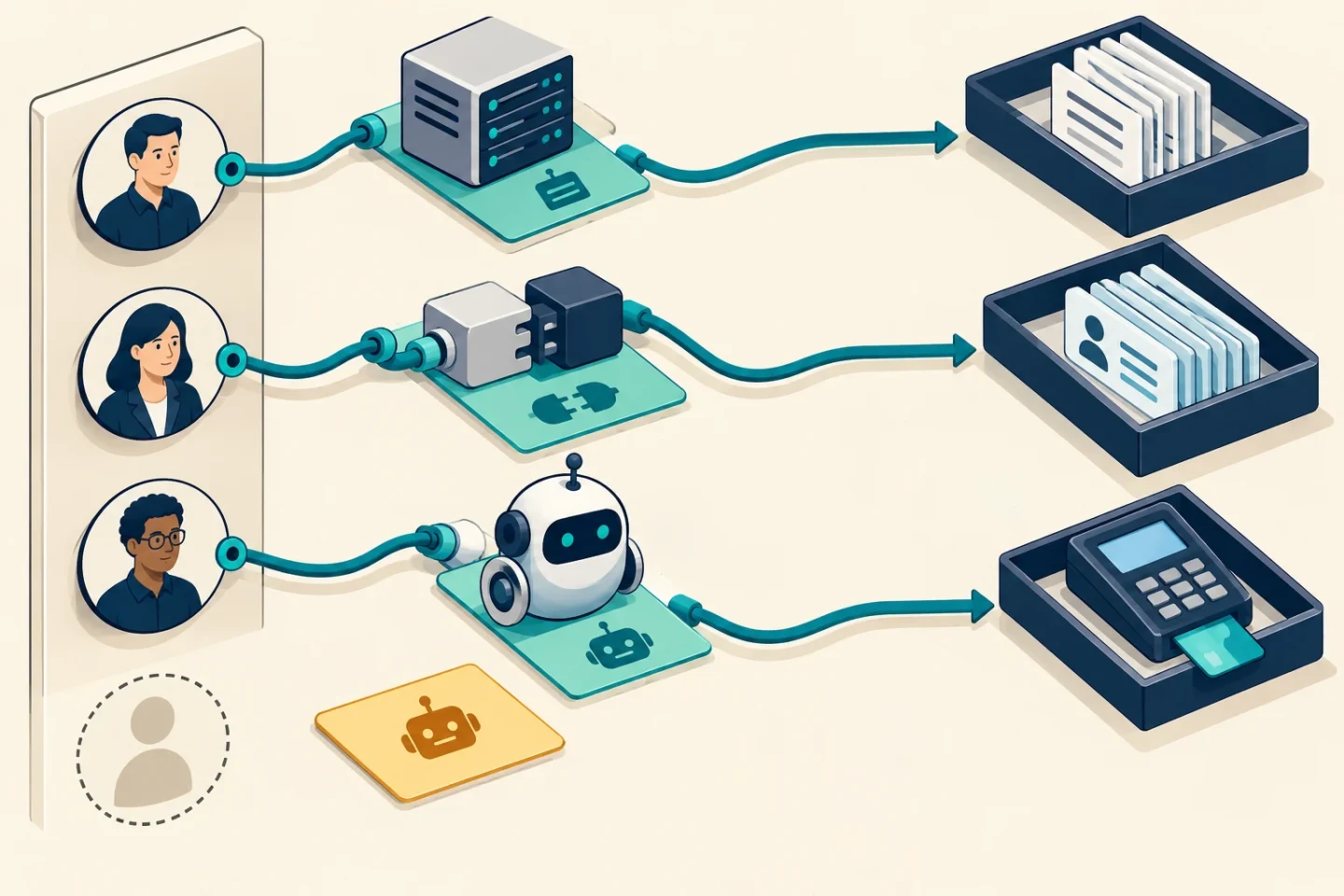
It is an interconnected ecosystem of people, applications, machines, service accounts, APIs, automated workflows, and increasingly autonomous AI agents.
Each may possess an identity.
Each may have access privileges.
And each represents a potential pathway to sensitive information, business processes, or critical infrastructure.
The challenge is no longer simply protecting the cloud from unauthorized outsiders. It is also governing the identities and authority operating within it.
When Authentication Becomes the Beginning, Not the End
Traditional cybersecurity architectures have often treated successful authentication as a significant security milestone.
A user presents credentials.
The system verifies them.
Access is granted according to established policies.
But successful authentication answers only part of the question.
It establishes evidence that an actor is associated with a particular identity or credential.
It does not automatically establish that every subsequent action is appropriate, authorized, or safe.
This distinction becomes especially important with autonomous AI.
Consider an AI agent legitimately authorized to retrieve customer information, prepare reports, or assist with financial transactions.
The agent may be functioning exactly as designed when it initially authenticates.
But what happens when it encounters malicious instructions embedded in a document?
What happens when a connected application is compromised?
What happens when its assigned permissions are broader than necessary?
Or when an employee who originally authorized its activities changes roles or leaves the organization?
The agent's credentials may remain valid even though the circumstances surrounding its authority have changed.
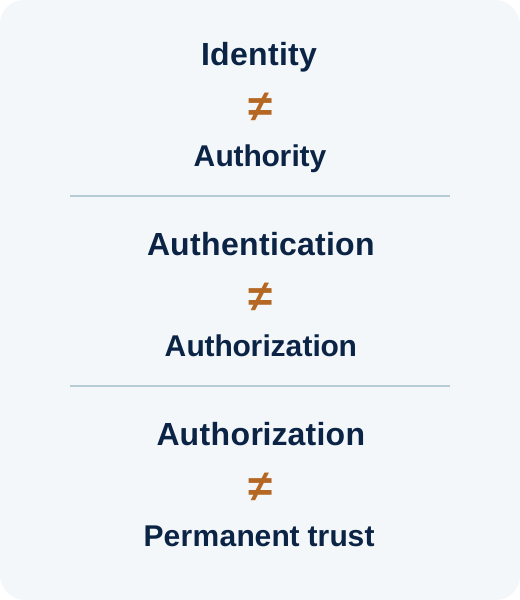
That leads us to three distinctions that deserve greater attention:
Identity is not authority.
Authentication is not authorization.
Authorization is not permanent trust.
These principles are not new to cybersecurity.
What is changing is the scale, speed, and autonomy with which digital actors can operate.
An employee may initiate several sensitive transactions during a workday.
An autonomous system may initiate thousands of actions across multiple cloud services in minutes.
When permissions are excessive or poorly governed, the consequences can expand just as quickly.
The Rise of Non-Human Identities
One of the most significant developments in modern cloud environments is the proliferation of non-human identities.
These include service accounts, application identities, workload credentials, API keys, automation systems, and AI agents.
Unlike human employees, non-human identities may operate continuously, interact with numerous services, and execute tasks without direct human supervision.
They are essential to modern computing.
But their growth introduces serious governance challenges.
In January 2026, the Cloud Security Alliance published The State of Non-Human Identity and AI Security.
The research revealed that 78% of surveyed organizations lacked documented, formally adopted policies for creating or removing AI identities.
The same research found that 92% of respondents lacked confidence in their legacy IAM solutions' ability to effectively manage risks associated with AI and non-human identities.
These findings suggest that AI adoption is advancing faster than the identity governance practices needed to support it.
A separate CSA study published in March 2026, Identity and Access Gaps in the Age of Autonomous AI, identified additional concerns.
Among its findings:
- 68% of surveyed organizations could not clearly distinguish AI-agent activity from human activity.
- 74% reported that AI agents often receive more access than necessary.
- 79% believed AI agents create new access pathways that are difficult to monitor.
These findings highlight a troubling possibility.
Organizations are increasingly delegating responsibilities to autonomous systems without always maintaining the visibility, accountability, and governance needed to oversee them.
And that creates an uncomfortable question:
How can an organization confidently govern an AI agent's authority if it cannot reliably identify which actions the agent performed?
The answer requires more than stronger passwords, additional authentication factors, or another layer of monitoring.
It requires a more comprehensive approach to Digital Trust.
From Identity to Continuous Trust
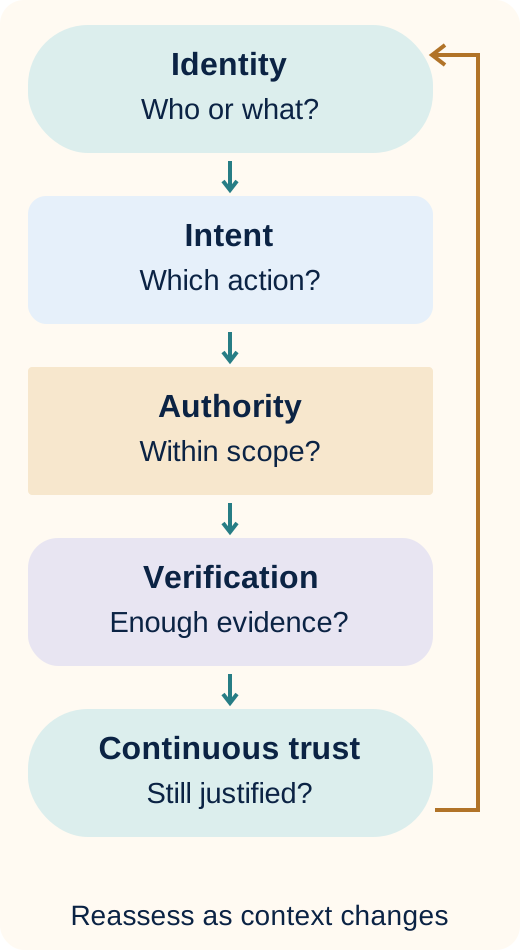
I believe the next evolution of cloud security must address five interconnected questions.
1. Identity: Who or What Is Acting?
Every participant in a digital interaction should have an appropriately established and verifiable identity.
That includes humans, applications, machines, workloads, and autonomous agents.
For non-human identities, organizations also need to establish ownership and accountability.
An AI agent should not become an anonymous participant simply because it operates without a human at the keyboard.
2. Intent: What Is the Actor Attempting to Do?
Identity alone tells us very little about the action being requested.
Security systems must evaluate what an actor is attempting to accomplish and whether that action aligns with its assigned purpose.
Importantly, technology cannot always determine an actor's true intentions.
But it can examine requested operations, declared purpose, behavioral patterns, transaction context, and deviations from expected activity.
Those signals help distinguish ordinary operations from potentially inappropriate or malicious actions.
3. Authority: Is the Actor Permitted to Do It?
A verified identity does not automatically confer unlimited authority.
Permissions must be explicit, appropriately scoped, and tied to legitimate business requirements.
An AI agent authorized to prepare a financial report should not automatically possess the authority to transfer funds.
An agent authorized to retrieve customer information should not necessarily be permitted to disclose that information externally.
And an agent acting on behalf of an employee should not inherit unrestricted access simply because the employee possesses broader privileges.
Authority must be defined, limited, and governed.
4. Verification: Can We Establish Sufficient Evidence?
Trust should be supported by evidence rather than assumptions.
Organizations need mechanisms to verify identities, permissions, relevant context, and the legitimacy of requested actions.
Depending on the environment, these may include phishing-resistant authentication, mutual authentication, cryptographic workload identities, policy enforcement, transaction verification, and auditable authorization decisions.
No single technology provides every necessary assurance.
The objective is to establish sufficient confidence for the specific interaction and its associated risk.
5. Continuous Trust: Should That Authority Remain Valid?
Perhaps the most important question is what happens after access has been granted.
Risk changes.
Permissions change.
Devices become compromised.
Sessions are hijacked.
Business relationships evolve.
AI agents encounter new instructions, new data, and new environments.
Security decisions must account for those changes.
Continuous Trust does not mean forcing users or systems to authenticate repeatedly without reason.
It means continuously evaluating relevant evidence and enforcing policies as circumstances change, including reassessment, step-up verification, restriction, or revocation when warranted.
Trust should remain justified by current evidence, not merely inherited from a successful authentication event in the past.
Together, these five principles form a framework for evaluating Digital Trust in increasingly autonomous environments:
Identity → Intent → Authority → Verification → Continuous Trust
What CISOs Should Be Asking Before 2027
For cybersecurity leaders, the implications are practical.
The first question is whether the organization has a reliable inventory of its non-human identities.
Not simply how many service accounts exist, but who owns them, why they exist, what they can access, and when their privileges were last reviewed.
The second is whether AI agents have clearly defined boundaries.
Can they initiate transactions? Modify records? Access sensitive customer information? Delegate tasks to other agents? Communicate externally?
And who is accountable when their actions exceed those boundaries?
The third is whether authorization decisions can respond to changing conditions.
An identity that was trustworthy yesterday may be compromised today.
An action that was appropriate five minutes ago may become inappropriate after a change in context.
The fourth is whether organizations can reconstruct what happened.
When an AI agent performs a sensitive action, can security teams determine which agent acted, whose authority it was exercising, what information influenced its decision, and which policy permitted the action?
Finally, organizations should examine how quickly they can intervene.
Can they suspend an agent, revoke its credentials, terminate active sessions, restrict delegated permissions, and prevent further transactions without disrupting unrelated business operations?
These are not theoretical concerns reserved for some distant future.
They are governance questions that become increasingly urgent as organizations expand their use of autonomous systems.
Digital Trust Is Bigger Than Authentication
Authentication remains foundational to cybersecurity.
Without confidence in identity, every subsequent access decision rests on uncertain ground.
But authentication alone cannot establish the legitimacy of every action performed by an authenticated actor.
That requires authorization, context, policy enforcement, visibility, accountability, and the ability to reassess trust when circumstances change.
This is also why the future of cloud security cannot be reduced to a debate about passwords versus passwordless authentication, or traditional MFA versus newer authentication technologies.
Those distinctions matter.
But the larger challenge is ensuring that identities, whether human or non-human, operate within appropriate boundaries and remain accountable for their actions.
In a world increasingly shaped by autonomous AI, cybersecurity must evolve from simply asking whether access should be granted to continuously evaluating whether actions remain legitimate.
The Human Side of Digital Trust
The cloud was built to make computing resources available wherever they were needed.
Artificial intelligence is making it possible for increasingly autonomous systems to use those resources on our behalf.
Together, they create extraordinary opportunities for efficiency, innovation, and economic growth.
But they also introduce a responsibility we cannot afford to overlook.
When organizations delegate actions to machines, they do not delegate away accountability.
A financial transaction still affects someone's money.
A medical record still belongs to a patient.
A compromised identity can still disrupt a business, damage a reputation, or expose information entrusted to an organization.
Behind every digital interaction, there is ultimately a human consequence.

That is why the next chapter of cloud security must focus on more than infrastructure, credentials, or access controls.
It must focus on establishing and maintaining justified trust among the people, machines, applications, and autonomous agents participating in our digital world.
Because availability is not authority.
Access is not trust.
And successful authentication is not proof that every subsequent action is legitimate.
In an increasingly autonomous world, trust cannot be granted once and assumed forever. It must be continually justified.
The more technological our world becomes, the more important the human side of trust becomes.
And the more important it becomes, the more deliberately we must preserve it.