




There are moments when a new technology improves the way we work.
And then there are moments when a technology changes the assumptions on which our systems were built.
I believe artificial intelligence has crossed that line.
Darktrace's new State of AI Cybersecurity 2026 report offers an unusually useful snapshot of that transition. The research surveyed 1,540 cybersecurity leaders and practitioners across 14 countries, with participants ranging from CISOs and CIOs to security architects, analysts and incident responders.
The report understandably focuses on AI's effect on the attack surface, cyber threats, security operations and defensive technology.
But reading through the findings, I came away thinking about something even larger.
AI isn't simply creating new cybersecurity threats. It is creating new participants in our digital trust relationships.
Until recently, most enterprise security architectures were built primarily around people using machines.
Now machines are beginning to act for people.
That changes everything.
The Numbers Tell Us This Transition Is Already Underway
Several findings from Darktrace's research deserve attention:
92% of respondents are concerned about the security implications of AI agents being used across the workforce.
87% say AI is significantly increasing the number of threats requiring attention.
73% say AI-powered threats are already having a significant impact on their organization.
92% say AI-powered cyber threats are forcing them to significantly upgrade their defenses.
77% of security stacks already use generative AI.
96% say AI significantly improves the speed and efficiency with which they work.
Yet only 14% currently allow AI to independently take remediation actions in the SOC without a human in the loop.
Those last two statistics are particularly interesting.
Organizations clearly believe in AI's capabilities.
They are considerably less certain about its authority.
And I think they're right to make that distinction.
Intelligence and Authority Are Not the Same Thing
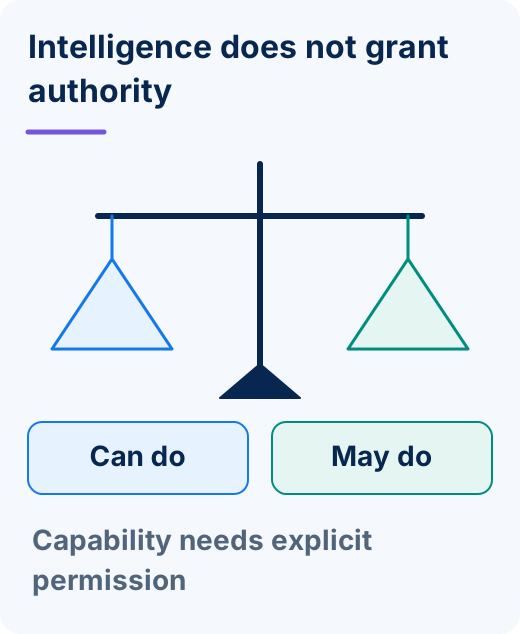
An AI system may be extraordinarily capable of determining what can be done.
That doesn't mean it should independently determine what should be done.
Darktrace found that 92% of respondents say they need to understand how defensive AI makes decisions before they can trust it, while 74% are limiting AI autonomy in the SOC until explainability improves. Seventy percent currently operate in a middle ground where AI can take action, but only with human approval.
That tells us something important.
The industry isn't rejecting autonomous AI.
It's negotiating the boundaries of machine authority.
And those boundaries are going to become one of the most important cybersecurity issues of the next decade.
Yesterday's Security Model Was Built Around Human Actors
Consider how enterprise identity has traditionally worked.
An employee wants access to an application.
We establish identity.
We authenticate the employee.
We determine what that employee is authorized to access.
We monitor the resulting activity.
Conceptually, the model is fairly straightforward:
Human → Application
AI agents complicate that relationship.
An employee may authorize an AI agent.
That agent may authenticate to several systems.
Those systems may provide access to sensitive information.
The agent may invoke APIs.
It may communicate with another agent.
It may initiate workflows.
It may make recommendations.
And increasingly, it may take actions.
Now our trust relationship looks more like:
Human → AI Agent → Application → API → Data → Another Agent
So whose identity are we actually trusting?
Whose authority is being exercised?
And where should that authority stop?
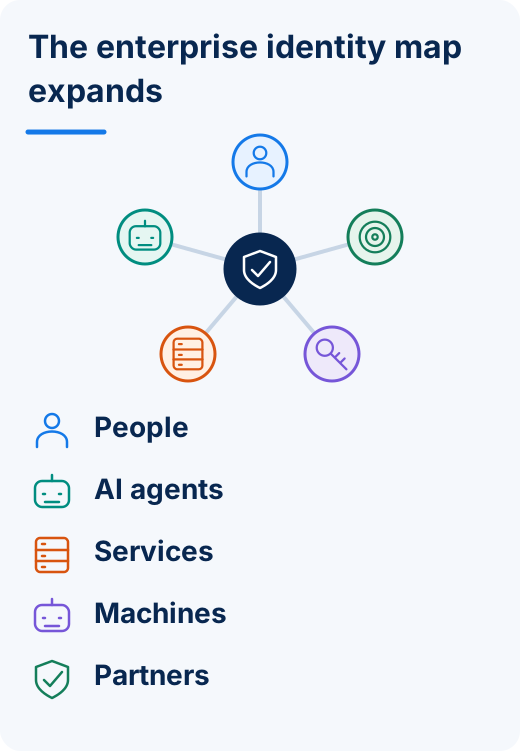
An AI Agent Is Becoming an Identity
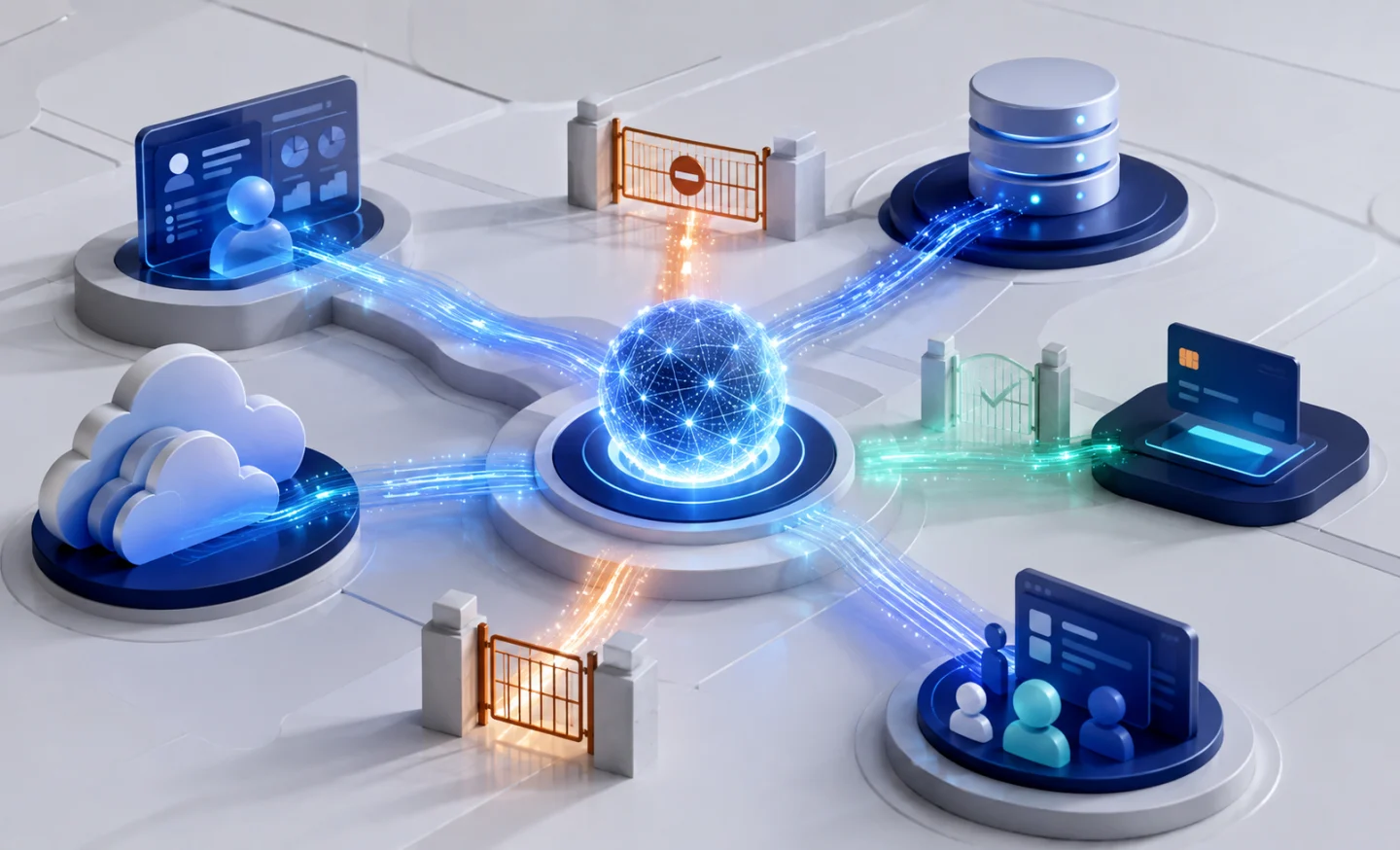
This is the conceptual shift I believe many organizations need to make.
We tend to talk about AI agents as tools.
From a cybersecurity perspective, we increasingly need to think about them as actors.
If an agent can access data, invoke APIs, communicate with applications and take actions on behalf of someone else, then it effectively participates in an identity and authorization ecosystem.
That means security needs to know more than whether the agent exists.
We need to understand:
Who created it?
Who authorized it?
Whose authority is it exercising?
What resources can it access?
What actions can it perform?
How long does that authority last?
What context changes that authority?
And what actions require a human decision?
This is where identity security and AI governance begin to converge.
The Attack Surface Is No Longer Just Devices and Applications
Darktrace found substantial concern about the security implications of enterprise AI adoption.
Sensitive data exposure was the leading concern, cited by 61% of respondents, followed by potential data security and privacy violations at 56%, misuse or abuse of AI tools at 51%, and software vulnerabilities in AI tools at 49%.
Those concerns make sense because AI doesn't simply add another application to the enterprise.
It creates another pathway through which information and authority can move.
An employee may paste confidential information into an external model.
An agent may access internal data.
A poorly configured AI application may expose information.
An agent with excessive privileges may take actions far beyond what its task requires.
A compromised machine identity may allow an attacker to inherit legitimate authority.
The issue isn't simply where AI is installed.
It is what AI can reach and what AI is allowed to do once it gets there.
AI Is Also Making the Attacker Better
There is another side to this transformation.
AI isn't merely changing the enterprise attack surface.
It's changing the economics of attacking it.
Darktrace reports that 87% of respondents agree AI is significantly increasing the sophistication and success rate of malware.
AI can accelerate reconnaissance, personalize phishing, assist malware development, analyze stolen information and automate elements of an attack.
But I believe one of its most consequential capabilities will be impersonation.
AI can increasingly manufacture the signals human beings associate with legitimacy.
A convincing email.
A familiar writing style.
A cloned voice.
A realistic image.
A personalized phishing message.
A plausible website.
An apparently legitimate business request.
For decades, humans have been an important part of the security decision because we expected people to recognize when something didn't look right.
AI is steadily eroding the reliability of that assumption.
The better machines become at manufacturing appearances, the less security can depend on appearances as evidence of trust.
This Is Why Identity Is Becoming So Important
Darktrace's findings point toward an AI arms race.
Attackers are using AI.
Defenders are using AI.
Organizations are deploying AI.
Security teams are trying to govern AI.
But underneath all four of those developments is a common question:
What do we trust?
A credential?
An identity?
A device?
An AI agent?
A request?
A destination?
An action?
A human approval?
None of those should necessarily be evaluated in isolation.
I believe modern digital trust increasingly needs to consider a broader relationship:
Identity + Authentication + Authorization + Intent + Context + Destination
And as AI agents become more autonomous, we need to add something else:
Delegated Authority.
Who gave the machine permission to act?
The Human in the Loop Has to Be the Right Human

The Darktrace finding that only 14% of security professionals currently allow AI to independently take remediation actions is encouraging.
But simply saying "human in the loop" isn't enough.
Imagine an AI agent identifies a potentially fraudulent $5 million transaction and requests approval.
A person responds.
Problem solved?
Not necessarily.
Who is that person?
Have we strongly established their identity?
Are they authorized to approve that transaction?
Did they actually initiate or intend the interaction?
Are they communicating with the legitimate system?
Could an attacker have compromised the account?
Could AI-generated impersonation have manipulated the human into approving the action?
Human approval only adds security when we can trust the human providing the approval and the context in which that approval occurs.
That's why I prefer thinking in terms of the right human in the right loop at the right moment.
Friction Should Follow Consequence
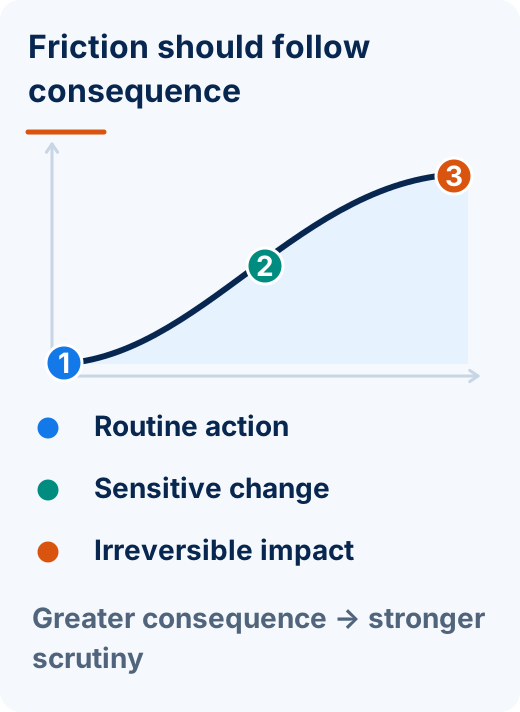
This does not mean every AI action needs a human standing behind it.
That would defeat much of AI's value.
An AI agent shouldn't need executive approval to schedule a meeting.
It probably shouldn't require intervention to summarize a document.
But transferring money?
Deleting production data?
Changing administrator privileges?
Disclosing sensitive customer information?
Approving a loan?
Modifying critical infrastructure?
Those actions deserve a different level of trust.
The answer is not maximum friction everywhere.
It is appropriate friction where consequence demands it.
Low-risk actions can remain highly automated.
Higher-risk actions can trigger stronger authorization.
And the most consequential decisions can require explicitly authenticated human authority.
That's how cybersecurity becomes an enabler of AI adoption rather than an obstacle to it.
The Identité® Perspective
This is where our thinking at Identité® continues to evolve.
Our work began with a simple observation about authentication.
Traditional authentication has historically concentrated heavily on proving the user to the organization.
But phishing and digital impersonation expose another side of the relationship:
How does the user establish that the destination is legitimate?
That thinking led to our patented Full Duplex Authentication® architecture and a model of trust operating in both directions.
But AI is expanding the question.
The future isn't simply:
Can we authenticate the human?
It becomes:
Can we authenticate the participants, establish the legitimacy of the relationship, determine whether the interaction was intended, and control what each participant is authorized to do?
That is a much larger security architecture.
And I believe that's where the identity industry is heading.
Not toward another factor.
Toward better evidence of trust.
AI Defending Against AI Is Necessary, but Not Sufficient
Darktrace's research shows strong confidence in defensive AI.
And understandably so.
If attacks operate at machine speed, defenders will increasingly need machines capable of detecting and responding at machine speed.
Human security teams cannot manually investigate an endlessly expanding volume of machine-generated activity.
But defensive AI doesn't eliminate the trust problem.
It makes governance of trust even more important.
A defensive AI system with the authority to isolate devices, terminate sessions, block identities or modify access can protect an organization extraordinarily quickly.
It can also create enormous consequences if that authority is exercised incorrectly.
The question therefore isn't simply:
How intelligent is the security system?
It is:
How much authority should we give that intelligence?
The Cybersecurity Industry Is Entering Its Authority Era
For years, much of cybersecurity revolved around access.
Who can get in?
Then identity became central.
Who are you?
AI introduces another question that may ultimately become just as important:
Who, or what, has the authority to act?
That distinction will matter enormously as humans increasingly delegate work to machines.
We will need authentication architectures capable of establishing trustworthy identities.
Authorization systems capable of limiting authority.
Context capable of changing those permissions dynamically.
Intent capable of distinguishing requested actions from manipulated ones.
And governance capable of determining when machines can act independently and when human authority must return to the decision.
Darktrace's report provides compelling evidence that this transition isn't theoretical.
It is already underway.
The Question Isn't Whether We Will Trust AI
We will.
In many cases, we already do.
AI will help defend networks, analyze threats, write software, communicate with customers, manage workflows, make recommendations and increasingly perform tasks once reserved for people.
The economic benefits are simply too significant to ignore.
So the question isn't whether organizations should trust AI.
The more useful question is:
Under what circumstances, with what identity, possessing what authority, operating within what boundaries, should AI be trusted to act?
That's the cybersecurity challenge hiding inside the AI revolution.
Because intelligence and trust are not interchangeable.
And capability is not authority.
The more intelligence we give machines, the more deliberately we must protect human authority.
AI may determine what can be done. Trust must determine what should be allowed.