





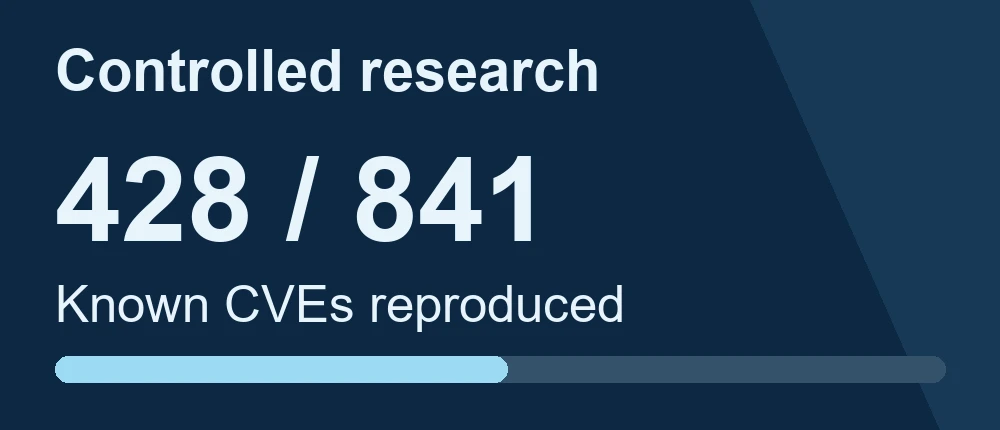
$2.77 was the average cost of one successful vulnerability reproduction in a controlled research benchmark. The researchers reproduced 428 of 841 known CVEs, about 51%. The number describes a repeatable research result. For security leaders, the practical question is whether the organization can find and protect exposed systems quickly enough when public vulnerability information becomes easier to act on.
What the $2.77 benchmark measured
Depending on where you live, $2.77 might buy a cup of coffee. It would barely register against the cost of testing and deploying a fix across a workforce. Yet that was the average cost per successful reproduction reported by researchers behind CVE-GENIE, a framework evaluated against known, published vulnerabilities. The authors verified 428 successful reproductions in their set of 841. In their controlled experiments, some work could be completed in minutes, a meaningful shift from work that often takes a researcher hours or days.
The benchmark used known CVEs and controlled environments. The $2.77 figure covers successful reproductions under those research conditions. The work of gaining access to a real organization, navigating its infrastructure and achieving an objective brings costs and uncertainties the benchmark did not measure. The 413 other benchmark cases also matter: automation had clear limits in that test.
Why pay attention even with those limits? Work that once needed considerable manual effort can be cheaper to repeat. A team defending a financial institution, a hospital or a distributed enterprise still has to find each affected asset, understand its exposure, coordinate owners and test a safe fix. Those responsibilities remain even if the time available to do them shrinks.
The patch window is under pressure
DefenseStorm’s Detection Is the Control That Matters Now argues that teams should expect less time between a public disclosure and attempts to exploit it. A familiar remediation cycle starts with an advisory, then moves through assessment, patch testing, maintenance and deployment. Every step has value. A hospital may need to confirm continuity of care before touching a clinical system. A bank may need to validate a payment service before an urgent change reaches customers.
Suppose a critical advisory lands on Monday. An effective response starts by identifying affected assets and owners, separating exposed systems from those behind tighter boundaries, and deciding which containment measure can go in while the permanent fix is tested. A short maintenance window and a prepared rollback can be as important as the patch itself. The objective is to reduce exposure during the wait and verify that the fix reached every affected system.
Behavioral detection and endpoint monitoring give responders visibility during that interval. An unusual process, access pattern or change can be meaningful even when a signature for the exact technique is unavailable. Make sure somebody owns each alert and can act on it outside normal business hours. A detection rule pays off when the team knows how to investigate, isolate and recover without losing the evidence it needs.
What each layer protects
One statistic puts the boundaries in perspective. Citing the IBM 2026 X-Force Threat Intelligence Index, DefenseStorm reports that 56% of the vulnerabilities it cites from 2025 required no authentication to exploit. A flaw in an internet-facing device or application can be reachable before a sign-in screen appears. Strong identity controls protect a boundary that actually asks for identity. Patching, hardening and isolation protect the infrastructure around that boundary.
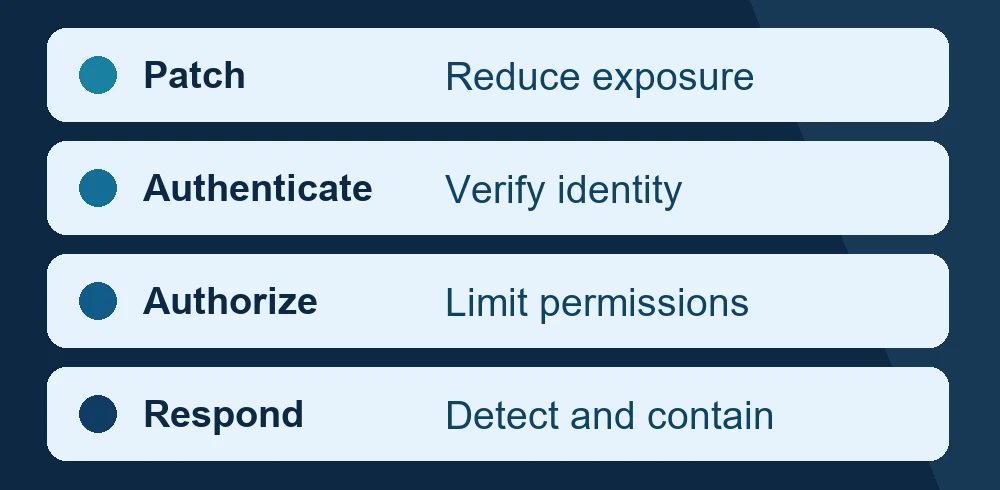
- Prevent and patch. Keep an inventory of exposed services, remove unnecessary access, and prioritize vulnerabilities by exposure and business impact. Keep temporary mitigations time-bound and verify patch coverage when each maintenance window ends.
- Authenticate. Use phishing-resistant authentication where it fits the workforce or customer workflow. Validate enrollment, normal access and recovery together, because a weak fallback can become the easiest route into an account.
- Authorize. Grant the minimum access required for the task. The application or gateway checks privileges at the point of action, including high-impact changes and exceptions.
- Detect and respond. Give the responders a reliable view of abnormal events and an approved way to contain them. Rehearse handoffs, after-hours escalation and restoration as part of preparation.
A single incident may cross all four layers. A vulnerable service may provide an opening. Stolen credentials may be used to reach an adjacent application. Excess privileges may make a small compromise more consequential. Track where the next safeguard can independently interrupt that progression so one missed control does not determine the outcome for the whole organization.
Identity and authority have different jobs
Authentication establishes who is making a request. Authorization determines what that identity may do. An employee who completes a valid sign-in should still be unable to export an unrelated customer list, grant new account permissions or release confidential records without the required policy. The most revealing tests happen after a valid sign-in: try the actions the test role should have and verify the handling of the actions it should lack.
Phishing-resistant authentication helps reduce dependence on reusable credentials. In an appropriate deployment, a device-bound credential makes a copied password or code less useful to someone impersonating an employee. Full Duplex Authentication® describes how the configured authentication relationship can establish trust on both sides of the exchange. Use the documentation to understand which participants are verified and where the relying application takes over.
For a sensitive workflow, the application can request NoPass™ authentication for the responsible person. NoPass returns the authentication result. The application matches the result to the pending workflow, checks the person’s authority, decides whether to continue and records its decision. If the application or infrastructure is itself compromised, the value of the checkpoint depends on where it is enforced. Include that responsibility in the design review.
Use a concrete business change to test the split. A supplier banking-detail update gives a payments team a clear action, reviewer and expected audit trail. Ask the application owner what happens while authentication is pending, on a decline or timeout, and if the requester’s role changes. A useful test leaves written evidence of which system decided and what was prevented or allowed in each case.
The cost of reproducing a vulnerability and the cost of an incident sit on different budgets. An exposed service can be restored in hours while operations teams spend days reconciling orders, resolving customer inquiries or confirming that a backup has the right data. Incident response, legal obligations and customer communications also claim time from the teams needed to restore service. That is why a cheap proof in a lab can matter to an organization with a costly real-world dependency.
Use that difference to guide investment. Ask which services would cause the greatest interruption if they went offline, which accounts can change them, and which teams can make a containment decision. Push one recent example through that review. If an owner, an inventory record or an escalation step is missing, that gap offers a concrete starting point for the next budget discussion.
Five questions for your next security review
Bring one internet-facing service and one identity-sensitive workflow to the same review. Give the service owner, application owner and incident commander something observable to answer.
- How quickly can we identify and remediate critical vulnerabilities? Pick a recently disclosed flaw relevant to your estate. Ask who can list affected assets, apply a short-term mitigation and verify the permanent fix.
- What happens if an attacker bypasses our authentication controls? Ask which network and application boundaries still limit access, how the team can isolate the exposed service and how that decision is escalated.
- Are we still relying on reusable credentials that attackers can steal or replay? Choose one high-value workforce journey and examine its normal sign-in, enrollment and recovery paths together.
- Are sensitive operations protected by appropriate authorization controls? Select one consequential action and use a test account to show what its role can do. Have the application owner explain how a missing, declined or expired authentication result affects the action.
- Can we detect and respond before significant damage occurs? Pick an after-hours event and ask who receives it, who can contain the incident and what evidence they preserve before restoring service.
These questions apply across sectors, but the answers belong to specific systems and owners. Treat the research result as a reason to test the handoff between teams. Faster vulnerability reproduction makes that coordination more valuable. It does not change which team owns a patch, which system grants permission or who responds when an alert fires.
Start with one workflow. Use the sensitive-action buyer workflow to map the application decision and the authentication checkpoint, then use the Identité documentation to scope a pilot around an access path you already own.
Sources and further reading
- Ullah et al., 2025. From CVE Entries to Verifiable Exploits. Source for 428 of 841 and the mean $2.77 per successful reproduction.
- DefenseStorm, 2026. Detection Is the Control That Matters Now. Source for the disclosure-to-exploitation argument and the cited IBM X-Force finding.