





Authentication, Impersonation, and Digital Trust in Financial Services
Imagine a customer receiving an urgent message from what appears to be their bank. This is a hypothetical example, not a delivery method confirmed by KELA.
There's a problem with the account. Suspicious activity has been detected. Immediate verification is required to prevent unauthorized access or a potentially fraudulent transaction.
The message includes a link to what looks like the bank's website.
The branding is familiar. The language sounds official. The web address even includes reassuring words such as secure, protect, or verify.
The customer enters their login credentials.
Unfortunately, the website doesn't belong to the bank.
And the information the customer just provided may now be in the hands of a criminal.
This is the fundamental challenge of banking website impersonation: Customers can be deceived into trusting an interaction before the institution has an opportunity to authenticate them.
For financial institutions, protecting against these attacks requires more than stronger passwords or another authentication prompt. It requires an approach that addresses service identity, customer authentication, account access, and transaction security as interconnected elements of digital trust.
A Coordinated Campaign of Fake Banking Domains
KELA’s investigation, updated on November 3, 2026, describes a coordinated bank-impersonation campaign.
The campaign impersonated U.S. financial institutions; the research does not establish that approximately 300 banks were targeted or breached.
The October 25, 2026 snapshot records 248 live domains and 189 impersonated institutions, with 183 institutions still having live lookalikes. The total of more than 300 counts domains identified since May, including those already offline.
The attackers used domain names combining banking brands with security-related words such as secure, disable, protect, and cancel.
The objective was to convince customers that they were visiting legitimate banking services and persuade them to disclose their account credentials.
Those credentials could potentially be used to facilitate unauthorized account access and fraudulent financial activity, including wire transfers and Automated Clearing House (ACH) payments.
The number of customers who actually fell victim remains unknown.
Importantly, the findings do not establish that hundreds of banks were breached. The campaign involved impersonation of their brands and targeting of their customers.
That distinction illustrates why website impersonation presents such a difficult problem.
Attackers don't necessarily need to compromise a bank's systems to exploit the trust customers place in that bank.
They can attempt to exploit the relationship itself.
Why Fake Banking Websites Are So Effective
Banking customers have been conditioned to recognize certain indicators of legitimacy.
A familiar logo. A recognizable login screen. A professionally designed website. A message that appears to reference a genuine security concern.
Unfortunately, these elements can be copied.
Attackers can also create domain names that appear related to a legitimate institution without actually being controlled by it.
For example, a fraudulent website might combine a bank's name with a security-related term to suggest that it is an official account protection portal.
The resulting page may look convincing enough to persuade a customer to enter sensitive information.
This creates a distinction that financial institutions must address:
Recognizing a brand is not the same as verifying the identity of the organization operating a website.
Modern browsers provide important protections, including TLS certificate validation and HTTPS connections. However, HTTPS alone does not establish that a website belongs to the financial institution a customer intended to visit.
A fraudulent website can also obtain a valid TLS certificate for a domain the attacker controls.
The encrypted connection may be genuine while the organization behind the website is not the one the customer believes it to be.
That is why website appearance, familiar terminology, and the presence of a padlock cannot serve as sufficient evidence of institutional identity.
What Makes This Campaign Particularly Concerning?
Kela's investigation identified an additional technique intended to interfere with phishing detection and takedown efforts.
When a visitor returned to certain malicious domains from the same IP address, the website could display a different page.
Instead of the fraudulent banking login screen, a repeat visitor might encounter an account suspension notice, a blocked page, or a redirect to an unrelated website.
This behavior could make an active phishing domain appear harmless or inactive when investigators attempted to examine it.
For financial institutions, the implication is significant.
A single inspection of a suspicious domain may not reveal the same content that a customer encountered earlier.
Security teams therefore need detection and investigation processes that account for evasive phishing infrastructure, changing website behavior, and the limitations of one-time automated checks.
The attack demonstrates that protecting customers involves both preventing fraudulent interactions and identifying malicious infrastructure that attempts to conceal itself.
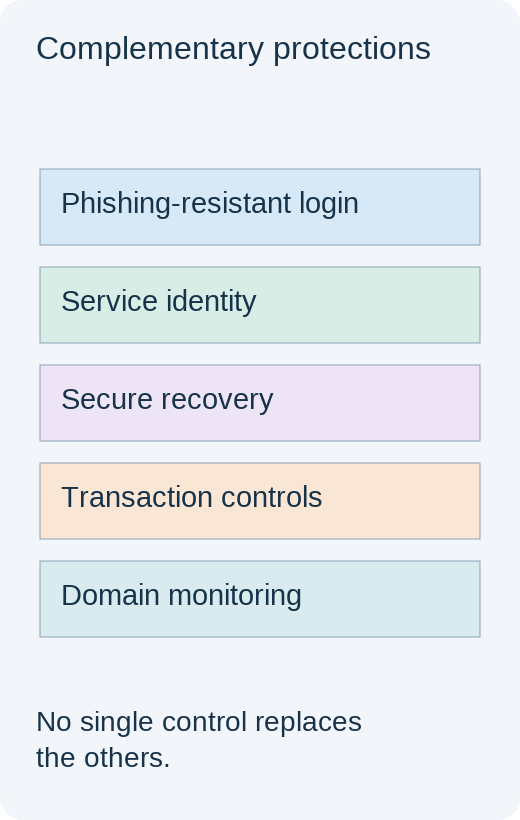
Five Areas Banks Should Strengthen to Reduce Website Impersonation Risk
No single security control can eliminate banking impersonation or every form of financial fraud.
However, financial institutions can substantially strengthen their defenses by addressing several complementary areas.
1. Adopt Phishing-Resistant Customer Authentication
Traditional passwords remain vulnerable to credential harvesting.
If a customer enters a password into a fraudulent website, an attacker may be able to capture it and attempt to use it against the legitimate service.
Some forms of multi-factor authentication also remain vulnerable to phishing, particularly when attackers can persuade users to disclose one-time codes or relay authentication challenges in real time.
Phishing-resistant authentication changes that equation.
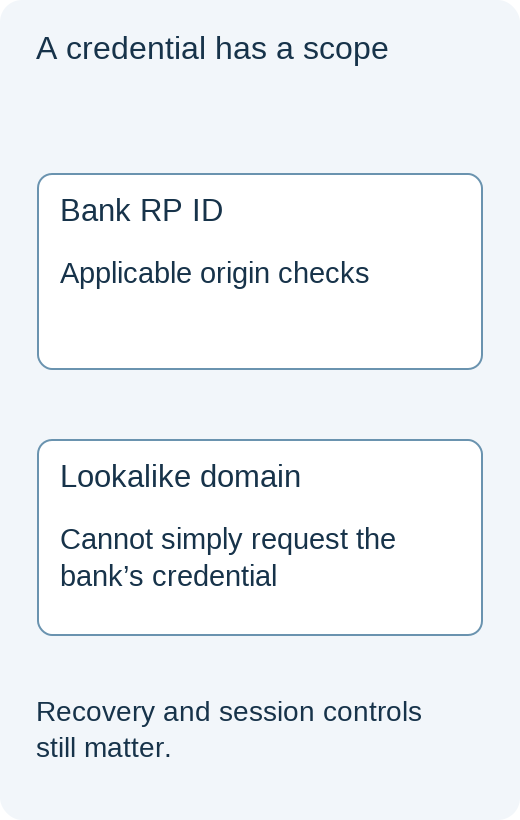
FIDO2/WebAuthn credentials are scoped to a relying party ID. Browser and relying-party origin checks help prevent a lookalike site from requesting or accepting authentication intended for the bank.
When properly implemented, these protections help prevent credentials from being used successfully on fraudulent lookalike websites.
This is an important improvement over authentication methods that depend on customers recognizing suspicious pages or manually entering reusable secrets.
For banks evaluating customer authentication modernization, phishing resistance should be a central consideration.
However, the specific protections depend on implementation, enrollment, recovery procedures, and the authentication flows actually used.
A phishing-resistant login process is only as effective as the surrounding security architecture.
2. Establish Confidence in Both Sides of the Authentication Relationship
Financial institutions devote considerable resources to determining whether the individual attempting to access an account is legitimate.
But customers also need confidence that the service requesting authentication is genuine.
These are related, yet distinct, security requirements.
Customer authentication answers:
Is this the authorized customer?
Service authentication addresses another essential question:
Is this the legitimate service the customer intended to access?
Mutual authentication recognizes that digital trust should not depend exclusively on verifying one participant.
It emphasizes establishing identity assurance between the parties involved in an interaction.
This principle is particularly relevant in financial services, where fraudulent websites, impersonated support personnel, and deceptive communications attempt to exploit customers' confidence in trusted institutions.
At Identité®, our patented Full Duplex Authentication® technology reflects this philosophy by emphasizing mutual authentication and bidirectional trust.
The objective is to move beyond an authentication experience in which one party is expected to demonstrate its identity while the legitimacy of the other is simply assumed.
It is important to recognize that mutual authentication is not unique to any single vendor or protocol. Properly implemented phishing-resistant technologies already provide important protections against fraudulent relying parties.
The broader security objective is to establish appropriate identity assurance throughout the interaction and avoid relying on appearances as evidence of legitimacy.
3. Protect Account Recovery and Authentication Fallbacks
Financial institutions can deploy strong authentication and still introduce unnecessary risk through weaker account recovery procedures.
Consider a customer who loses access to a registered device or authentication credential.
How does the institution restore access?
Can the customer revert to a password and an SMS code?
Can an attacker manipulate a support process to reset authentication credentials?
Could a fraudulent website persuade the customer to initiate an account recovery workflow?
These questions matter because attackers frequently look for alternative paths around otherwise effective security controls.
A strong primary authentication method should not be undermined by a significantly weaker recovery process.
Banks should evaluate how customers enroll, replace devices, recover accounts, and authorize changes to their authentication methods.
Recovery procedures should provide appropriate identity assurance, maintain auditability, and minimize opportunities for social engineering.
The goal is not simply to secure the front door. It is to ensure that the alternate entrances receive comparable scrutiny.

4. Separate Authentication From Transaction Authorization
Successfully authenticating a customer does not automatically establish that every subsequent transaction is legitimate.
An attacker may compromise a session, manipulate a customer, or induce an authorized user to initiate a fraudulent payment.
This distinction is especially important in business banking, where unauthorized wire transfers and ACH transactions can create substantial financial exposure.
Authentication establishes assurance about identity.
Authorization determines whether an identity is permitted to perform a particular action.
Transaction-level security evaluates whether sensitive financial activity should proceed under the circumstances.
For high-risk transactions, banks should consider controls such as risk-based verification, appropriate approval workflows, transaction-specific confirmation, and independent validation of unusual payment instructions.
Where practical, transaction confirmation should clearly identify the amount, destination, and other critical details being authorized.
The objective is to reduce the likelihood that a legitimate authentication session becomes the vehicle for an illegitimate financial transaction.
Strong authentication is essential.
But it must operate alongside effective transaction controls.
5. Strengthen Brand Impersonation Detection and Customer Education
Authentication technology is only one part of the defense.
Financial institutions must also monitor for fraudulent websites, lookalike domains, impersonated communications, and other attempts to misuse their brands.
This includes maintaining effective processes for identifying malicious domains, coordinating takedown requests, and sharing relevant threat intelligence.
The Kela investigation illustrates why those processes must account for evasive behavior.
A phishing website that changes its appearance after an initial visit may evade simplistic inspection methods.
Financial institutions should therefore consider multiple sources of evidence and repeated or varied investigation methods when assessing suspicious infrastructure.
Customer education remains important as well.
Banks should consistently explain how customers can safely access official services, report suspicious messages, and verify unexpected communications through independently established channels.
But customer education should support technical safeguards, not substitute for them.
Even knowledgeable customers can be deceived by sophisticated impersonation attempts.
A mature security strategy should not depend on every customer making the correct judgment every time.

Where Does Mutual Authentication Fit?
Mutual authentication is sometimes discussed as though it were simply another security feature to add to an existing login process.
Its significance is broader.
It reflects an architectural principle: trust should be established between participating parties rather than presumed from the context or appearance of an interaction.
In banking, that principle becomes especially relevant when customers are exposed to fraudulent services that claim to represent legitimate institutions.
At Identité®, our approach to authentication is grounded in the belief that digital trust must work in both directions.
Our patented Full Duplex Authentication® technology is designed around mutual authentication, supporting the broader objective of establishing confidence between parties involved in digital interactions.
That philosophy informs our approach to passwordless and customer-facing authentication.
For financial institutions considering authentication modernization, the discussion should extend beyond eliminating passwords.
It should also examine how authentication is initiated, how the legitimate service is established, how customers are enrolled, and how the overall experience maintains appropriate security assurance.
Passwordless authentication can reduce reliance on vulnerable credentials.
Phishing-resistant authentication can help prevent credential misuse against fraudulent websites.
Mutual authentication can reinforce the principle that both parties in a digital interaction require appropriate identity assurance.
These concepts are complementary, but they are not interchangeable.
And none should be presented as a complete substitute for fraud detection, transaction authorization, endpoint security, or ongoing threat monitoring.
Questions Financial Institutions Should Ask Their Authentication Providers
As banks evaluate their authentication strategies, several questions can help distinguish meaningful security capabilities from marketing terminology.
Does the authentication method resist phishing?
Organizations should understand whether credentials are cryptographically bound to the legitimate service and what protections exist against credential harvesting and authentication relay attacks.
How is the legitimate service authenticated?
Banks should examine how the authentication architecture establishes service identity and what assurance customers receive during the process.
What happens when customers lose access to their authentication method?
Recovery, device replacement, and fallback procedures should be evaluated as part of the security design rather than treated as secondary operational concerns.
How are authenticated sessions protected?
Institutions should assess session management, token protection, reauthentication requirements, and defenses against session compromise.
How are sensitive transactions authorized?
Authentication and transaction authorization should be considered separately, particularly for high-value payments and changes to account security settings.
Can the solution integrate with existing banking systems?
Financial institutions rarely operate in a single, uniform technology environment. Compatibility with existing identity platforms, customer applications, legacy systems, and operational processes matters.
These questions help move the conversation beyond whether an authentication product is described as passwordless, multifactor, or phishing-resistant.
They focus attention on the protections actually delivered.
Building a More Resilient Digital Banking Experience
The phishing campaign uncovered by Kela is a reminder that attackers are not limited to exploiting software vulnerabilities.
They also exploit familiarity, urgency, brand recognition, and the assumptions people make about digital identity.
A customer may believe a fraudulent website is legitimate because it looks like their bank.
An investigator may believe a malicious domain is inactive because it no longer displays the original phishing page.
In both situations, the attacker attempts to influence the trust decision by controlling what the observer sees.
Financial institutions cannot eliminate every opportunity for deception.
But they can reduce the consequences of that deception by strengthening authentication, service identity assurance, account recovery, transaction authorization, and impersonation detection.
The most effective approach is layered.
It combines strong technical controls with operational processes that recognize how attackers manipulate digital interactions.
And it treats trust as something that must be established and maintained rather than assumed.
Trust Starts Here™
At Identité®, we believe the future of authentication must address more than the question of whether a customer can prove their identity.
It must also recognize the importance of establishing confidence in the parties and services participating in the interaction.
That principle is central to our patented Full Duplex Authentication® technology and our broader approach to digital trust.
For banks and financial institutions, the objective is not simply to make login more secure.
It is to create digital relationships in which identity assurance, access controls, and transaction protections work together to reduce opportunities for impersonation and fraud.
Because protecting customers requires more than asking them to prove who they are.
It also requires giving them meaningful reasons to trust whom they're interacting with.
Trust Starts Here™.
And trust must work in both directions.
Frequently Asked Questions
How can banks protect customers from fake banking websites?
Banks can combine phishing-resistant authentication, secure account recovery, domain impersonation monitoring, customer education, and transaction-level fraud controls. These measures address different aspects of the threat and are most effective when implemented together.
Can multi-factor authentication prevent banking phishing attacks?
Some MFA methods provide stronger phishing protection than others. One-time codes can be captured or relayed. Properly implemented FIDO2/WebAuthn combines relying party ID scoping with origin validation to resist this misuse.
What is mutual authentication in digital banking?
Mutual authentication involves establishing appropriate identity assurance between both parties participating in an interaction. In digital banking, this includes the principle that customers should have confidence in the legitimacy of the service requesting authentication, not merely that the institution verifies the customer.
Does passwordless authentication eliminate banking fraud?
No. Passwordless authentication can reduce risks associated with reusable passwords, and phishing-resistant implementations provide additional protection. However, compromised sessions, social engineering, account recovery weaknesses, and fraudulent transactions require complementary safeguards.
Why are fake banking websites dangerous even when the bank itself has not been breached?
Attackers can impersonate legitimate financial institutions using fraudulent domains and convincing website designs. Customers who mistake these websites for authentic services may disclose credentials or sensitive information without the attacker ever compromising the bank's infrastructure.
Sources and Further Reading
DataBreachToday: Phishing Campaign Actively Targets Customers of 300 US Banks
https://www.databreachtoday.com/phishing-campaign-actively-targets-customers-300-us-banks-a-33282
Kela: Bank Phishing Campaign: Fake Takedown
https://www.kelacyber.com/blog/bank-phishing-campaign-fake-takedown/
Kela: Bank Phishing Check
https://www.kelacyber.com/resources/free-tools/bank-phishing-check/
Identité®: Authentication and Digital Trust Solutions
https://identite.us/