



For years, cybersecurity has had a familiar problem in the boardroom.
Security asks for money to prevent something everyone hopes will never happen.
A breach.
Fraud.
Ransomware.
Identity theft.
Regulatory penalties.
Reputational damage.
All legitimate concerns. But when budgets get tight, the conversation often becomes difficult because security is usually positioned as a cost of preventing loss, rather than an investment capable of creating value.
Artificial intelligence may be changing that conversation.
I came across an interesting question recently on CIO:
Can investing in AI trust actually drive business revenue growth?
My reaction was immediate.
Why wouldn't it?
We already know trust affects whether people are willing to hand an organization their money, their information, their health records and increasingly, their decisions.
AI simply raises the stakes.
The more businesses ask customers to interact with machines, rely on automated decisions and allow software agents to act on their behalf, the more important a very old question becomes:
Can I trust this?
And I believe companies that answer that question convincingly may discover that trust isn't merely a security requirement.
It's a competitive advantage.
We Have Been Treating Trust Like a Defensive Investment
Ask most executives why they invest in trusted or responsible AI and you'll hear sensible answers.
Compliance.
Privacy.
Risk management.
Governance.
Safety.
Reputation.
All important.
But notice something.
Almost every one of those answers is defensive.
What bad thing are we trying to prevent?
Perhaps we should add another question:
What good thing becomes possible when customers trust us enough to say yes?
That's where the economics get interesting.
A customer who doesn't trust an AI-powered financial service may not use it.
A patient who doesn't trust an AI healthcare interaction may refuse to share information.
An employee who doesn't trust an enterprise AI tool may work around it.
A business that doesn't trust an autonomous agent may never give it meaningful authority.
Trust doesn't simply prevent negative outcomes.
Trust permits transactions to happen.
And transactions are where revenue lives.
Think About What Customers Are Really Buying
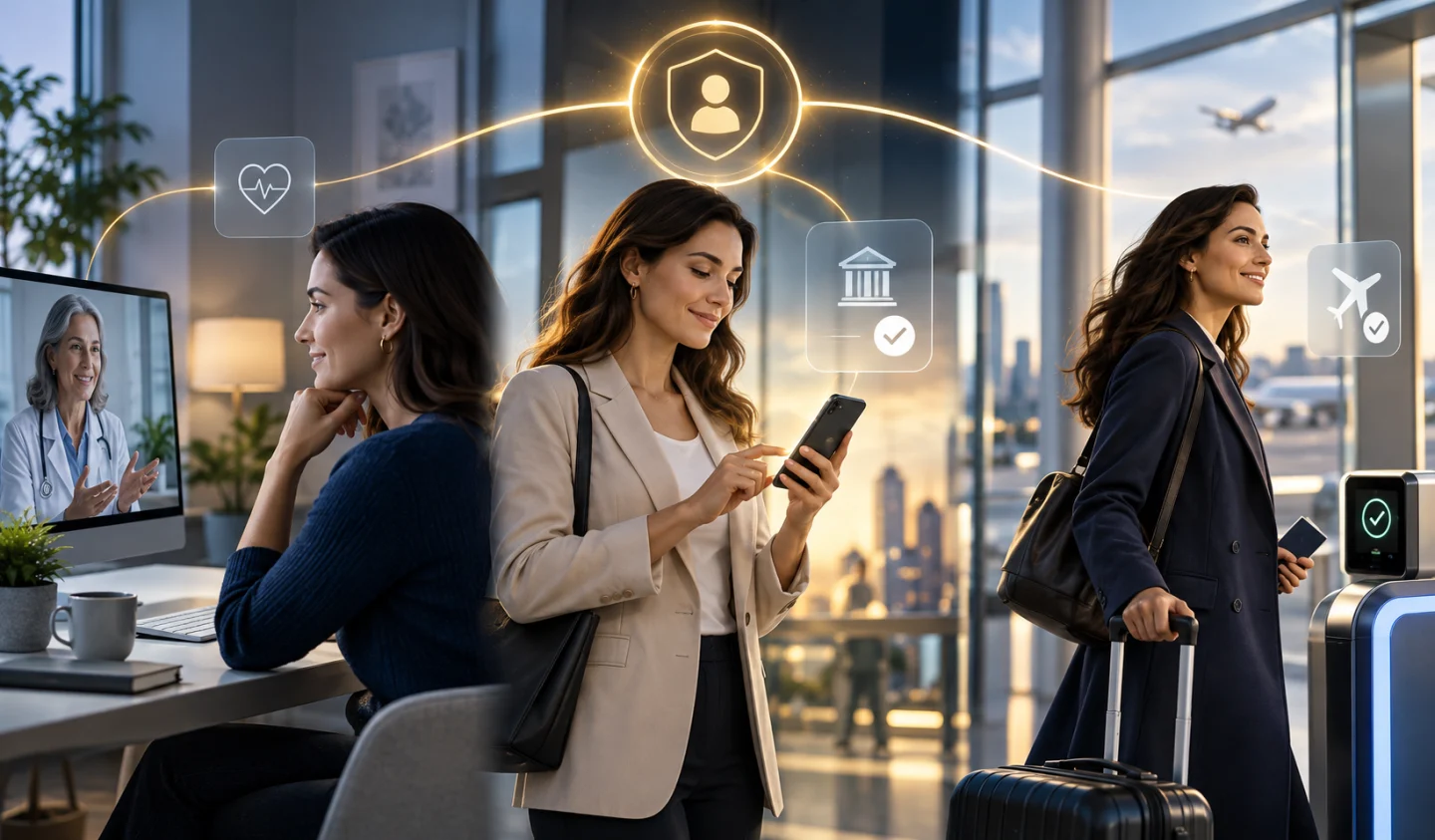
People rarely purchase technology simply because the technology exists.
They purchase an outcome.
A banking customer wants to move money.
A patient wants care.
A shopper wants to buy something.
A business wants to complete a transaction.
A company adopting AI wants productivity, automation or insight.
Technology sits underneath that experience.
Trust does too.
Consider online banking.
Twenty-five years ago, convincing people to conduct financial transactions through a browser required more than technology.
People had to become comfortable with the idea that money could safely move through something they couldn't see.
Trust enabled adoption.
E-commerce followed a similar path.
Cloud computing did too.
Now AI faces its own version of that journey.
But there's a difference.
AI doesn't merely store information or transport transactions.
Increasingly, AI acts.
And the moment technology begins acting on our behalf, trust becomes considerably more consequential.
The AI Agent Changes the Economics of Trust
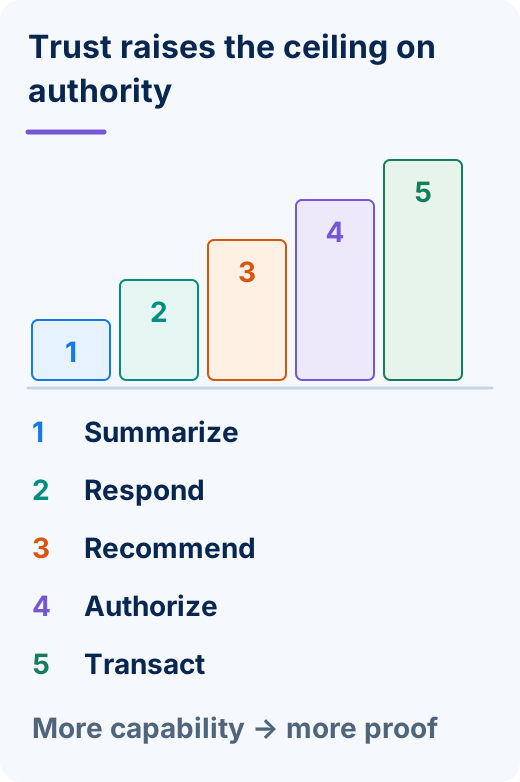
Imagine an AI assistant that can summarize your email.
Useful.
Now allow it to respond to messages.
More useful.
Let it schedule meetings.
Approve purchases.
Access customer records.
Change account information.
Initiate financial transactions.
Communicate with another organization's AI agent.
Every additional capability increases potential value.
It also increases the amount of trust required.
Eventually, the limiting factor may not be what AI can do.
It may be what businesses and customers are willing to allow it to do.
That's a very different problem.
And it suggests something I think we're going to hear much more about:
The economic value of AI will ultimately be constrained by the amount of trust we're willing to place in it.
If that's true, investing in trust isn't slowing AI adoption.
It may be what allows AI adoption to accelerate.
But What Exactly Are We Trusting?
This is where I think the conversation needs to go deeper.
“Trusted AI” can become one of those phrases everyone uses until nobody knows exactly what it means.
We need to be more specific.
Can I trust the model?
Can I trust the data?
Can I trust the answer?
Can I trust that sensitive information won't be exposed?
Can I understand why an important decision was made?
Can I trust that the AI is authorized to perform this action?
All good questions.
But there's another layer that interests me enormously:
Can I trust the identity of everyone participating in the interaction?
Who is the human?
Which AI agent is acting?
Who authorized that agent?
What organization does it represent?
What authority was delegated to it?
Is the destination legitimate?
Is the request itself authentic?
Did the person actually intend to authorize the action?
Trustworthy AI sitting on top of an uncertain identity foundation is still an uncertain transaction.
That is why I continue to believe:
Verifiable Identity is the cornerstone of Digital Trust.
AI Makes Impersonation a Business Problem
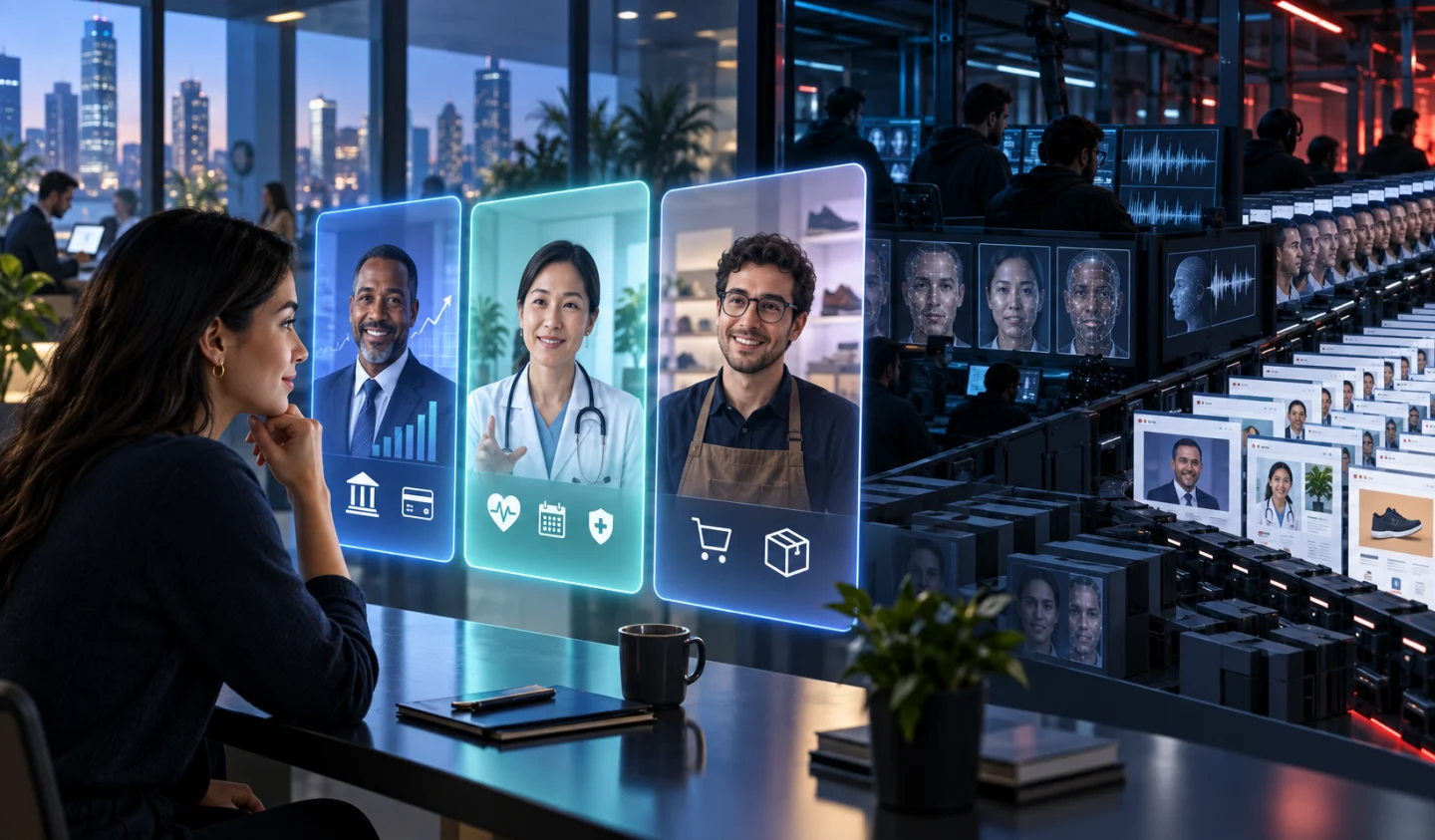
We've already begun seeing what happens when AI lowers the cost of deception.
Voices can be cloned.
Faces can be generated.
Emails can be personalized.
Documents can be fabricated.
Executives can be impersonated.
Customer-service interactions can be spoofed.
And fraudulent digital destinations can become remarkably convincing.
The problem is no longer simply whether something looks legitimate.
Increasingly, we need evidence that it is legitimate.
That changes the role of identity.
Authentication was traditionally about protecting access.
In an AI economy, authentication may increasingly become part of protecting commerce itself.
Because before two parties transact, someone has to establish that the parties are who they claim to be.
We've Been Authenticating Only Half the Relationship
This brings me to a question I've been writing about recently:
Why does authentication traditionally require me to prove who I am without requiring the destination to prove itself to me?
Think about online banking.
The bank asks you to authenticate.
Password.
MFA.
Biometric.
Passkey.
Whatever mechanism it uses.
The bank quite reasonably wants confidence that you are really you.
But you also need confidence that the bank is really the bank.
Historically, we've placed much of that responsibility on the customer.
Check the URL.
Recognize the website.
Don't click the wrong link.
Don't fall for phishing.
That's becoming increasingly difficult as impersonation improves.
And it points toward something I believe will become much more important in the AI economy:
Mutual Trust.
The organization verifies me.
I verify the organization.
And eventually:
The AI agent verifies the system.
The system verifies the agent.
Both verify the authority behind the requested action.
Trust begins to become reciprocal rather than assumed.
This Is Where Full Duplex Authentication Fits Into the Larger Conversation
Years ago, this asymmetry in traditional authentication bothered us enough at Identité® that we approached the problem differently.
It contributed to our patented Full Duplex Authentication® architecture.
The underlying idea is simple:
Trust should work both ways.
The legitimate organization needs confidence in the identity participating in the interaction.
But the person should also have evidence that they are interacting with the legitimate destination and approving the intended request.
User ↔ Legitimate Destination
I mention FDA here not because it solves every problem associated with trustworthy AI. Clearly it doesn't.
Model integrity, data governance, privacy, authorization, explainability and AI safety remain separate and important problems.
The connection is more fundamental.
As digital interactions become increasingly automated, one-way trust becomes harder to justify.
If AI is going to conduct increasingly valuable transactions, we need stronger ways of establishing who and what sits on both sides of those transactions.
Trust Can Reduce Friction Too
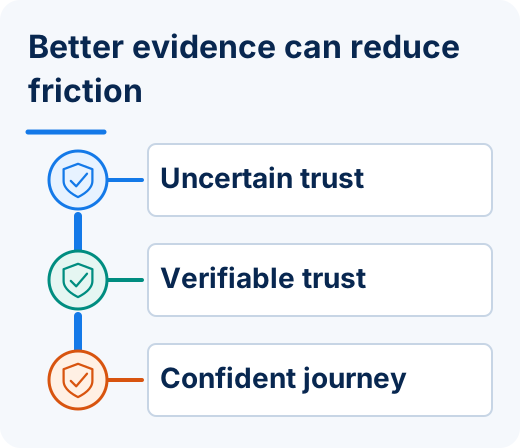
There's another business benefit that doesn't receive enough attention.
Better trust can actually make legitimate transactions easier.
Organizations often introduce friction because they're uncertain.
Another authentication prompt.
Another approval.
Another verification step.
Another fraud review.
Another call to customer service.
Each may be justified.
But every step also creates an opportunity for abandonment.
Customers leave shopping carts.
Employees find workarounds.
Transactions get delayed.
Support costs increase.
Conversion suffers.
What if better evidence allowed us to distinguish legitimate activity from suspicious activity with greater confidence?
Then perhaps we wouldn't need to inconvenience everyone equally.
I've said before:
Friction should follow uncertainty and consequence.
High confidence, routine interaction?
Let it proceed quietly.
Something changes?
Introduce appropriate verification.
That's not simply better security.
It can be a better customer experience.
And better customer experiences have economic value.
Trust Can Become Part of the Product
This is where I think executives should pay particular attention.
Imagine two AI-powered financial platforms offering comparable capabilities.
One essentially tells customers:
Trust us. Our AI is secure.
The other can demonstrate:
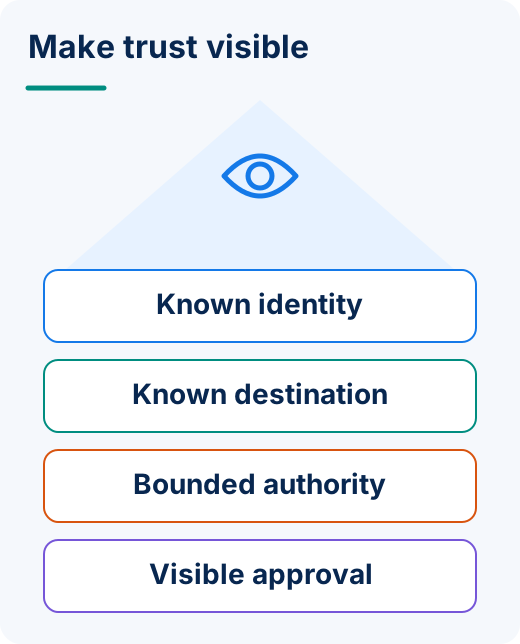
who is participating,
what data is being used,
what authority an agent possesses,
what action is being requested,
whether the destination is legitimate,
and when human approval is required.
Which one would an enterprise customer be more comfortable deploying?
Which one could be given greater authority?
Which one might move through procurement more easily?
Which one might customers use for more consequential transactions?
Suddenly trust isn't sitting beside the product as a compliance feature.
Trust becomes part of the product.
And that changes the revenue conversation.
Trust May Increase the Ceiling on What AI Can Do
This may be the most important economic argument.
Imagine an AI system customers trust enough to answer questions.
That's valuable.
Now imagine they trust it enough to make recommendations.
More valuable.
Now make purchases.
Schedule services.
Move information.
Initiate workflows.
Negotiate with another agent.
Approve routine transactions.
Every step increases potential economic value.
But every step requires more confidence.
So perhaps the relationship looks something like this:
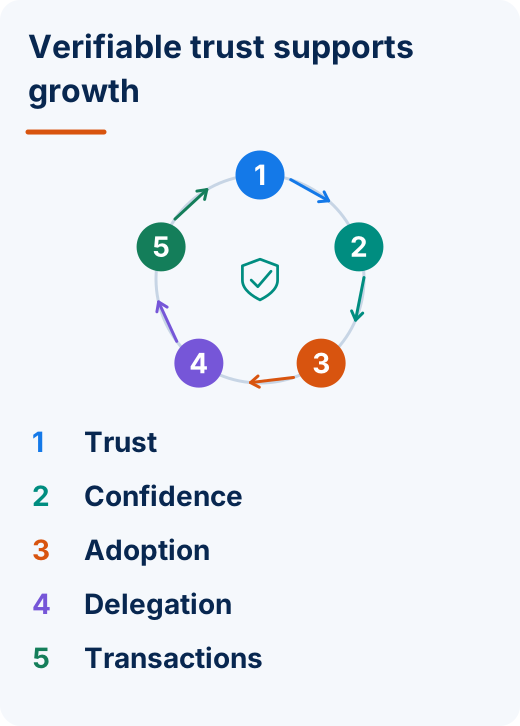
More verifiable trust → greater delegated authority → more valuable AI use cases → greater economic opportunity.
That is why I don't view trust merely as a brake placed on AI to keep it safe.
Properly designed, trust may be the accelerator that allows businesses to use AI for things they would otherwise be unwilling to delegate.
There Is a Revenue Cost to Uncertainty
Businesses usually calculate the cost of fraud.
That's relatively easy.
How much money did we lose?
How much did remediation cost?
What did the breach cost?
But there's another number that's much harder to see:
How much business never happened because someone didn't trust the interaction enough to proceed?
The customer who abandoned registration.
The enterprise that wouldn't allow an AI agent access.
The patient who withheld information.
The buyer who didn't trust the website.
The executive who refused automation because the authorization model wasn't clear.
The transaction stopped for manual review.
The opportunity delayed because security couldn't establish sufficient confidence.
Those don't necessarily appear in the security budget.
They appear as lost economic opportunity.
And that is why trust belongs in conversations with CEOs, CFOs and revenue leaders, not simply CISOs.
Trust Isn't Something You Declare
There's an important warning here.
Companies cannot simply put:
“Trusted AI”
on a website and expect customers to believe it.
Trust is not a marketing adjective.
It has to be earned through evidence.
That's why I increasingly prefer the word verifiable.
Don't tell me to trust the identity.
Let me verify it.
Don't tell me the agent is authorized.
Give me evidence of its authority.
Don't tell me the destination is legitimate.
Establish it.
Don't tell me the transaction is safe.
Show me what I'm approving.
There's an enormous difference between:
“Trust me.”
and:
“Here's why you can.”
The companies that understand that distinction may have an advantage.
The ROI of Trust May Be Bigger Than the Security Budget
So, can investing in AI trust actually drive revenue growth?
I think the answer is yes, but perhaps not in the simplistic sense of spending $1 on trust and immediately generating $3 in sales.
Trust works more fundamentally than that.
It allows customers to adopt.
It allows organizations to automate.
It allows employees to delegate.
It allows machines to act.
It reduces unnecessary friction.
It can improve conversion.
It can reduce fraud.
It can differentiate one provider from another.
And perhaps most importantly, it expands the range of things people are willing to allow technology to do on their behalf.
That last point may become enormously valuable.
Because AI's economic potential isn't determined only by intelligence.
It's determined by permission.
And permission depends on trust.
Trust Starts Before the Transaction
We've spent much of cybersecurity history protecting what happens after someone attempts to enter a system.
The AI economy may require something broader.
Before a meaningful digital transaction takes place, we increasingly need confidence in:
Identity.
Destination.
Authority.
Intent.
Context.
And when appropriate, human approval.
Those aren't obstacles to commerce.
They're what allow higher-value digital commerce to happen safely.
This is why I think our industry's conversation about AI trust needs to change.
Don't ask only:
“How much will trustworthy AI cost us?”
Ask:
“What could we safely allow AI to do if we trusted it more?”
That second question opens a very different discussion.
Because in the next phase of AI, companies may discover that trust isn't simply something security protects.
Trust may be something the business sells.
And the organizations capable of making trust verifiable may ultimately be the ones customers allow to do more.